
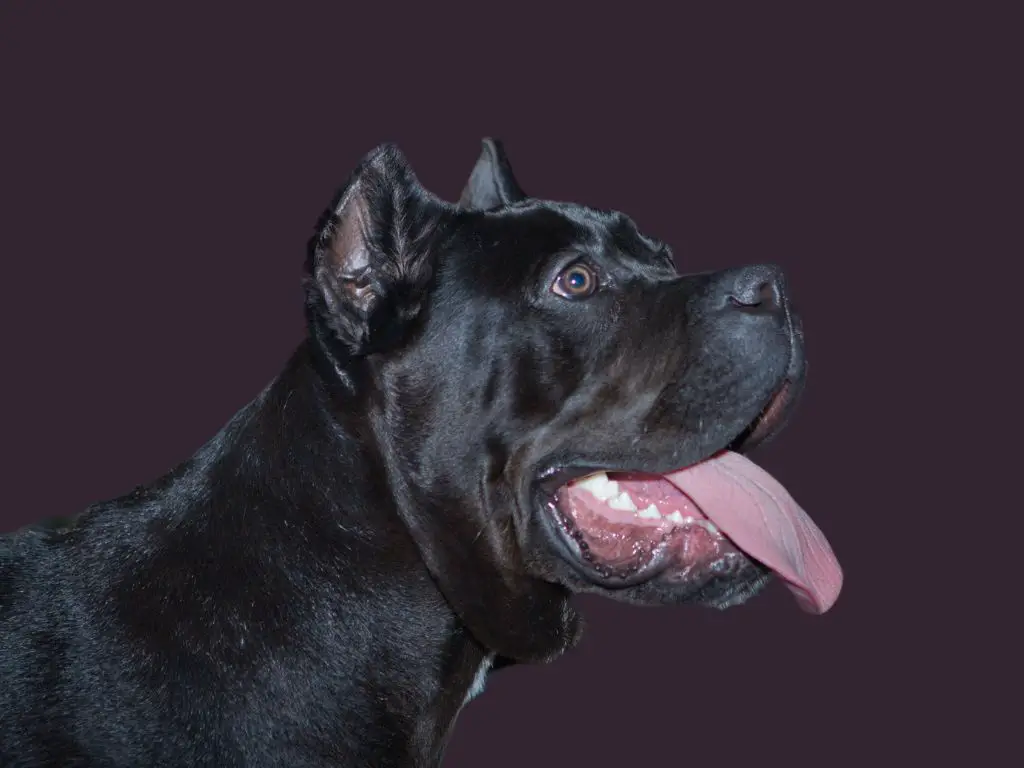
The short answer
No scientist has published a measured bite force for the cane corso. The popular “700 psi” figure has no study behind it. Based on real dog studies, a strong adult cane corso probably bites with about 900–1,400 newtons (roughly 200–315 pounds of force) at its front teeth. That is an estimate, not a measurement.
- Breed
- Cane Corso (Cane Corso Italiano), an Italian mastiff-type guardian
- Height
- 25–27.5 in (males), 23.5–26 in (females)
- Weight
- 45–50 kg / about 99–110 lb (males), 40–45 kg / about 88–99 lb (females)
- Life expectancy
- 9–12 years
- AKC status
- Recognized in 2010 as the 165th breed, Working Group
- Measured bite force
- None published for this breed
- Our estimate
- About 900–1,400 N (200–315 lbf) at the canine teeth, all-out bite

What is the bite force of a cane corso?
The honest answer is that nobody has measured it and published the result. We searched the scientific literature and checked a 2018 veterinary review of dog bite-force research. None of the studies it covers tested a cane corso.
So where does “700 psi” come from? We could not trace it to any study, lab or university. It shows up on breed blogs and “strongest bite” lists, usually with no source at all. Our own older version of this page repeated it, and even gave two different numbers (700 psi and 550 psi) in the same article. We have fixed that.
What we can do is use the real dog studies. They show how hard dogs of different sizes actually bite. Then we can make a careful, clearly labelled estimate for a dog the size of a cane corso.
Cane corso bite force psi: why psi is the wrong unit
Psi means “pounds per square inch.” It is a unit of pressure, which is force spread over an area. Bite meters measure force. Scientists report force in newtons (N), and some people use pounds of force (lbf). One pound of force is about 4.45 newtons.
Pressure depends on how small the contact point is. The same bite pushes much harder per square inch through a sharp fang tip than through a flat back tooth. That means a single “psi” number for a whole dog doesn’t make sense unless you say which tooth and how big the contact area was. Viral lists never say.
In this article, we use newtons, the unit scientists use, with pounds of force alongside.
What real studies measured in dogs
Only a few teams have measured dog bite force. Here is what they found:
- Pet dogs, awake (1995): Researchers used a bite sensor on 22 pet dogs weighing 7–55 kg. Bites ranged from 13 to 1,394 N. The average was 256 N, and 77% of bites were under 400 N. Most dogs don’t bite as hard as they can.
- Dogs under anesthesia (2008): Another team stimulated the jaw muscles of 20 dogs weighing 5–40 kg. This gets a full-strength bite without relying on the dog’s mood. Forces ranged from 147 to 946 N at the canine teeth and 524 to 3,417 N at the back molars. Heavier dogs bit harder.
- Skull study (2009): The same team looked at 127 dog skulls. Predicted bite force rose with body weight and with how wide the skull is across the cheekbones. Broad, short-muzzled heads tended to predict stronger bites in medium and large dogs.
How strong is a cane corso’s bite? Our estimate
Cane corsos weigh about 40–50 kg under the breed standard. That puts them at the heavy end of both study groups. They also have broad mastiff-type heads, which the skull study linked to stronger bites.
Putting that together, here is our estimate for a healthy adult biting as hard as it can:
- Front (canine) teeth: about 900–1,400 N (roughly 200–315 lbf). The low end matches the strongest canine-tooth bites in the anesthesia study. The high end matches the strongest bite recorded in the pet-dog study.
- Back teeth: likely a few thousand newtons. The anesthesia study measured up to 3,417 N at the molars in dogs up to 40 kg.
Treat these as rough estimates. Real dogs vary a lot. Mood, training, how wide the mouth is open, and the tooth used all change the number. If “700 psi” were read as 700 pounds of force, that would be about 3,100 N at the front teeth. That is more than double the strongest bite recorded in that study of awake pet dogs.

Cane corso bite force compared with other breeds and animals
This table marks each figure as measured, estimated or claimed. A “claimed” figure is one we could not find in any published study.
| Animal | Bite force | Type | Source |
|---|---|---|---|
| Cane corso (viral figure) | “700 psi” | Claimed, no study found | Blogs and online lists |
| Cane corso (our estimate) | ~900–1,400 N (200–315 lbf), front teeth | Estimated | Based on Lindner 1995 and Ellis 2008, 2009 |
| Pet dogs, 7–55 kg, awake | 13–1,394 N (average 256 N) | Measured | Lindner et al., 1995 |
| Dogs, 5–40 kg, canine teeth | 147–946 N | Measured (under anesthesia) | Ellis et al., 2008 |
| Dogs, 5–40 kg, back molars | 524–3,417 N | Measured (under anesthesia) | Ellis et al., 2008 |
| Kangal (viral figure) | “743 psi” | Claimed, no study found | Blogs and online lists |
| Spotted hyena | 4,500 N | Measured | Reported in Erickson et al., 2012 |
| Saltwater crocodile | 16,414 N (about 3,690 lbf) | Measured | Erickson et al., 2012 |
What about cane corso vs pit bull, rottweiler, presa canario, boerboel or dogo argentino? We could not find a published bite measurement for any of these breeds. The psi numbers you see for them come from the same kind of unsourced lists. The science does say that bite force rises with body weight and skull width, so larger, broader-headed dogs will usually bite harder than smaller ones. But the gap between two individual dogs can be bigger than the gap between breeds. We also left lions out of the table, because we did not find a direct bite measurement of a live lion to cite.
Look a little closer
If bites really were measured in psi at the tooth tip, “700” would be far too small. When scientists measured crocodiles, they worked out tooth pressures from about 28,000 to 195,000 psi. That happens because a tooth tip touches only a tiny area. So “700 psi” doesn’t work as a force figure or as a pressure figure.
Guess first: in the same dog, which bites harder, the front fangs or the back teeth?
The back teeth, by a wide margin. In the 2008 anesthesia study, dogs bit with 147–946 N at the canines but 524–3,417 N at the second molar. Back teeth sit closer to the jaw hinge, so the jaw muscles get more leverage there, like cracking a nut near the hinge of a nutcracker.
Cane corso jaw strength myths
Myth: cane corsos have “locking jaws”
No dog does. A 2018 veterinary review describes the dog’s jaw joint as moving mainly in a hinge-like up-and-down motion. It is closed by the temporal, masseter and pterygoid muscles. Nothing in that anatomy works like a lock. A dog that keeps hold of something is using muscle and motivation, and it can let go.
Myth: a stronger bite means a more dangerous dog
Bite force tells you what a jaw can do, not what a dog will do. The ASPCA lists heredity, early experience, socialization and training, and sex and reproductive status as factors that affect a dog’s tendency toward aggression.
Breed basics: the Italian guardian
The AKC traces the cane corso back to Roman war dogs, and says the name roughly means “bodyguard dog.” After Rome fell, corsos worked on Italian farms, guarding homes and livestock, hunting wild boar and hauling carts. The breed nearly vanished in the 20th century. In the 1970s, a small group of Italian fans set out to revive it, and Italy’s first breed club formed in 1983. The FCI gave the breed full recognition in 2007, and the AKC followed in 2010.
Why jaw strength matters for owners
A big, strong dog is a big responsibility. The AKC says cane corsos are not inherently aggressive but are naturally protective. It adds that they need early training and socialization and are generally not recommended for first-time owners. Many weigh more than 100 pounds.
- Train early and kindly. The AKC says corsos respond best to affection and rewards.
- Choose safe chews. Cornell’s vet school says most vet dentists use the “thumbnail test”: you should be able to dent a chew with your fingernail. Avoid antlers, hooves and bones, which can break teeth. Pick chews sized for your dog.
- Prevent bites. The AVMA estimates more than 4.5 million people in the US are bitten by dogs each year, and at least half are children. Supervise children around any dog, of any breed.
FAQ
What is the bite force of a cane corso in psi?
There is no measured psi figure for the breed, and psi is the wrong unit for bite force. Our science-based estimate is about 900–1,400 newtons (200–315 pounds of force) at the front teeth.
Is the cane corso bite force really 700 psi?
We found no study that supports it. The number appears on blogs and viral lists without sources.
Does a cane corso have the strongest bite of any dog?
No one knows, because no study has compared large breeds head to head. Big, broad-headed dogs likely bite hardest, but individual dogs vary a lot.
What is the Italian mastiff’s bite force?
“Italian mastiff” is another name people use for the cane corso. (The Neapolitan mastiff is a separate Italian breed.) Neither breed has a published bite measurement.
Can a cane corso lock its jaws?
No. A dog’s jaw is a hinge worked by muscles, with no locking part. Dogs that hold on are choosing to hold on.
Keep exploring
Sources
- Lindner DL et al., “Measurement of Bite Force in Dogs: A Pilot Study,” Journal of Veterinary Dentistry, 1995 — doi.org/10.1177/089875649501200202 — awake pet-dog bite forces (13–1,394 N, average 256 N, 77% under 400 N).
- Ellis JL et al., “Calibration of estimated biting forces in domestic canids: comparison of post-mortem and in vivo measurements,” Journal of Anatomy, 2008 — doi.org/10.1111/j.1469-7580.2008.00911.x — full-strength bite forces under anesthesia (147–946 N canine, 524–3,417 N molar); force rises with body weight.
- Ellis JL et al., “Cranial dimensions and forces of biting in the domestic dog,” Journal of Anatomy, 2009 — doi.org/10.1111/j.1469-7580.2008.01042.x — 127 skulls; bite force scales with body weight, skull width and head shape.
- Kim SE et al., “Bite Forces and Their Measurement in Dogs and Cats,” Frontiers in Veterinary Science, 2018 — doi.org/10.3389/fvets.2018.00076 — review of dog bite-force studies (none on cane corsos); hinge-like jaw motion and jaw-closing muscles.
- Erickson GM et al., “Insights into the Ecology and Evolutionary Success of Crocodilians Revealed through Bite-Force and Tooth-Pressure Experimentation,” PLoS ONE, 2012 — doi.org/10.1371/journal.pone.0031781 — saltwater crocodile 16,414 N; spotted hyena 4,500 N (reported); tooth pressures of about 28,000–195,000 psi.
- American Kennel Club, “Cane Corso” breed page — akc.org/dog-breeds/cane-corso — height, life expectancy, Roman lineage, “bodyguard dog” name.
- American Kennel Club, “AKC Welcomes the Cane Corso, Icelandic Sheepdog and Leonberger,” 2010 — akc.org press release — recognition in 2010 as 165th breed, Working Group.
- American Kennel Club, “Cane Corso History: From Ancient Italy to the Brink of Extinction,” 2024 — akc.org — Roman war-dog ancestry, farm work, 1970s revival, 1983 club.
- American Kennel Club, “Is the Cane Corso the Right Breed for Your Lifestyle?” — akc.org — protective not inherently aggressive, early training and socialization, not for first-time owners, often over 100 lb.
- Fédération Cynologique Internationale, Cane Corso Italiano breed standard No. 343, 2023 — fci.be (PDF) — weight 45–50 kg males, 40–45 kg females; Italian origin. Full recognition date (2007) from the FCI breed page.
- Cornell University College of Veterinary Medicine, “Risks from a fractured tooth” — vet.cornell.edu — thumbnail test; avoid antlers, hooves and bones.
- American Veterinary Medical Association, “Preventing dog bites” — avma.org — more than 4.5 million US dog bites a year, at least half to children.
- ASPCA, “Position Statement on Breed-Specific Legislation” — aspca.org — factors that affect a dog’s tendency toward aggression.
Sources checked: 12 September 2026.


Keep the conversation curious