
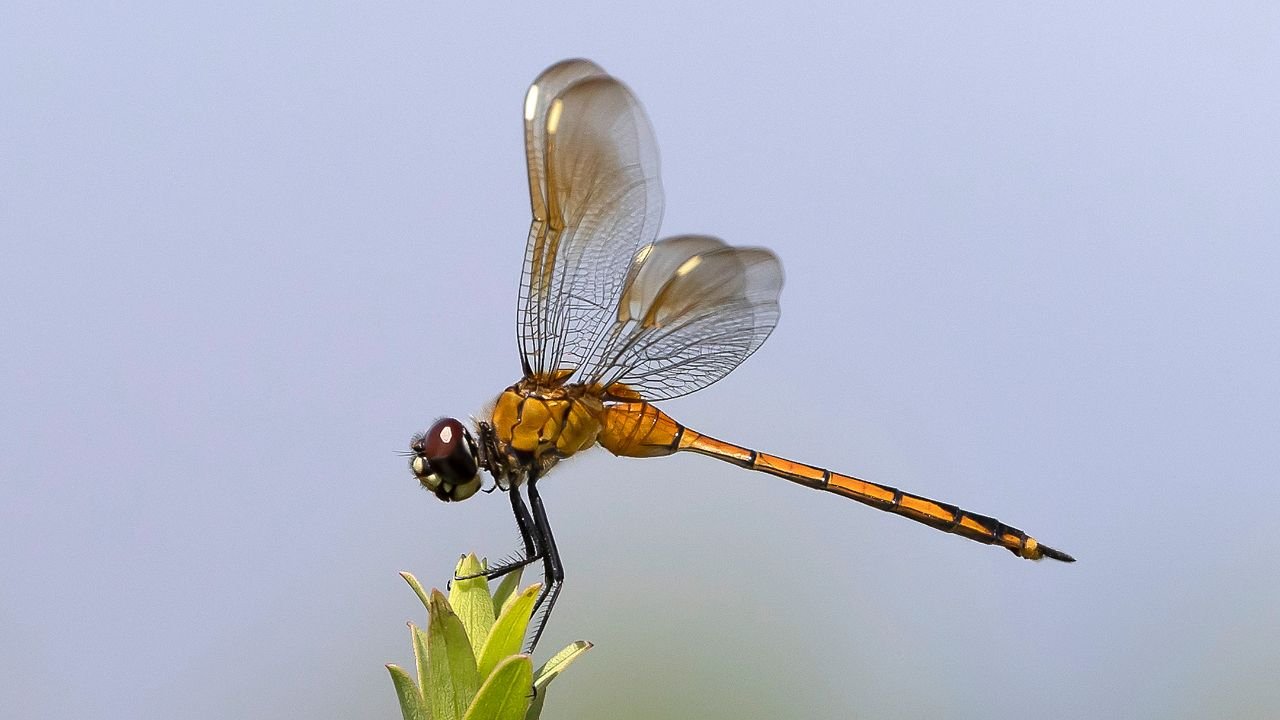
A summer afternoon by a pond. A big green-and-blue dragonfly zips past, stops dead in the air, then lands on your arm. For a second you freeze. Is this thing about to bite, or sting?
Dragonflies can bite, but only if you catch and hold one. Their jaws are made for chewing insects, and a nip rarely breaks human skin. They cannot sting at all, because they have no stinger. The Illinois State Museum’s curator of zoology calls them “completely harmless to man”. Below: why they nip, where the scary myths came from, and how many mosquitoes they really eat.
Key takeaways
- Bite: a dragonfly may pinch if you hold it, but it can’t usually break the skin. Only the biggest species can, says entomologist Richard Jones.
- Sting: never. Dragonflies have no stinger.
- Helpful: adults and their water-living young eat mosquitoes and biting flies, though not as many as the internet claims.
In this article:
- Do dragonflies bite humans?
- Can a dragonfly sting you?
- Why do dragonflies have such strong jaws?
- Are dragonflies dangerous?
- Where do the “devil’s darning needle” myths come from?
- How do dragonflies help people?
- What is the difference between a dragonfly and a damselfly?
- Myths
- Test yourself
- FAQ
- Sources
Do dragonflies bite humans?
Only in self-defence, and only if you hold one. A dragonfly that is caught “might pinch, but it can’t break the skin,” says University of Kentucky entomology specialist Stephanie Bailey. Texas A&M AgriLife Extension agrees that dragonflies “can ‘pinch’ if held firmly on the skin.” A dragonfly will not fly at you to bite you.
The pinch comes from a pair of sharp jaws called mandibles, built for chewing up insects. Writing for BBC Wildlife, entomologist Richard Jones says dragonflies are harmless “unless you force your finger into their mouth”, and that “only the largest dragonflies” can break the skin. Some extension guides go further and say dragonflies cannot bite people at all. They mean the same thing: a free-flying dragonfly never bites anyone.
Can a dragonfly sting you?
No. Dragonflies have no stinger, so they physically cannot sting. “Despite a widespread belief that dragonflies sting, they do not,” writes Dr Everett Cashatt of the Illinois State Museum. In some species, such as the green darner (Anax junius), females have a short egg-laying tube called an ovipositor, which they use to push eggs into the stems of water plants.
That egg-laying tube is used for planting eggs, not for defence. Compare that with a honey bee, whose sting tears away with its venom sac still attached, says Texas A&M AgriLife Extension.
Why do dragonflies have such strong jaws?
Because they are hunters from the day they hatch. An adult dragonfly holds its six legs like a basket to “scoop its prey out of the air,” then eats it in flight, says the Illinois State Museum. Each of its huge eyes has nearly 30,000 tiny units called ommatidia, which it uses to search for small flying insects.
The young, called nymphs or naiads, live underwater for months or even years. They shoot out an extendable mouthpart, grab prey with pincers and pull it back to the mouth, explains the US National Park Service. They eat insects, worms, tadpoles and even small fish, says Iowa State University Extension. See the full menu in what dragonflies eat.
Picture it: how often a dragonfly catches its dinner
In a 2013 study, Stacey Combes and colleagues at Harvard released prey near four kinds of perching dragonflies and counted how many chases ended in a meal. Each bar shows the best and worst result for each kind of prey.
Fruit flies (2–3 mm): 89.5–97.1% caught
Mosquitoes (2.5–7 mm): 66.7–78.7%
Houseflies (6–7 mm): 56.3–66.7%
Deerflies (7–10 mm): 20.0–42.9%
Source: Combes et al. 2013, Integrative and Comparative Biology. The famous “95% success rate” is true for tiny, slow fruit flies. Bigger, faster prey escape far more often.
Guess the number: which dragonfly in the study was the best mosquito catcher, and how often did it succeed? (tap to reveal)
The blue dasher (Pachydiplax longipennis), a medium-sized species, caught 78.7% of the mosquitoes it chased, and 97.1% of fruit flies.
Free to share: credit “Zooologist.com, data from Combes et al. 2013”.
Are dragonflies dangerous?
No. “Dragonflies and damselflies do no harm to people, pets, crops, landscape plants or houses,” says Iowa State University Extension. The Illinois State Museum knows of only one dragonfly that causes any trouble: the bee butcher (Coryphaeschna ingens) of the south-eastern United States, which snatches honeybees near their hives.
So the kindest choice, for you and for the dragonfly, is to watch rather than grab. A dragonfly that lands on you is not attacking you: dragonflies “do not attack humans,” says the University of Kentucky.
Where do the “devil’s darning needle” myths come from?
From old folk names and stories, not from biology. In North America dragonflies have been called “mosquito hawk,” “snake doctor” and “devil’s darning needle,” notes the Illinois State Museum. Another name, “horse stinger,” has no basis, says Iowa State University Extension, because these insects can neither sting nor bite people.
Old folktales claimed that dragonflies sew up people’s ears or lips, notes the University of Kentucky. Dragonflies “do not sew people’s eyes or lips shut at night,” Ohio State University Extension reassures readers. Nobody knows exactly where these stories started.
How do dragonflies help people?
They eat insects that bite us and spread disease. Adult dragonflies help keep down mosquitoes, horseflies, deerflies, black flies and midges, says the Illinois State Museum. Their underwater nymphs eat mosquito larvae. In lab containers, one nymph ate an average of 40 mosquito larvae a day, a 2023 review of 31 studies found.
That review, by Tharaka Priyadarshana and Eleanor Slade, pooled 485 measurements on 47 species of dragonfly and damselfly nymphs. Real ponds are messier than containers, though. As the museum puts it, dragonflies “are not the complete answer” to pest insects, “but they do help reduce the population levels.” A Florida mosquito control district makes the same point: dragonflies are partners, not a replacement for other control.
Dragonflies matter to wildlife too. Swifts, swallows, purple martins, kingbirds and frogs eat the adults, and fish eat the nymphs. Because the larvae feed in water for years, mercury from polluted prey builds up in their bodies, so scientists in the National Park Service’s Dragonfly Mercury Project test larvae from more than 100 national parks to check the health of park waters. For more on how insects shape their surroundings, see animal adaptations explained.
What is the difference between a dragonfly and a damselfly?
Look at the wings when it lands. Dragonflies rest with their wings held out flat, like a plane. Damselflies are smaller and more delicate, and fold their wings together above the body, says Iowa State University Extension. Both belong to the insect order Odonata, and both are harmless: Texas A&M says neither stings, though either may pinch if held firmly.
Both groups grow up the same way. The nymph crawls out of the water, its skin splits down the back, and the winged adult pulls itself out, with no pupa stage in between. That is very different from the four stages of a butterfly, described in the life cycle of a butterfly.
💎 Hidden gems
- A giant ancestor: Meganeura monyi, a dragonfly-like insect from fossil beds about 250 million years old, had wings about 76 cm (2.5 ft) across, says the Illinois State Museum. That is about two and a half 30 cm school rulers end to end. Today’s US dragonflies span 3.2–12.7 cm (1.25–5 in).
- A short adult life: adult dragonflies live only about a month, while the nymph stage lasts months to years, says the National Park Service. Compare that with the mayflies they hunt, in how long mayflies live.
- Small stomachs: about 12 mosquitoes will fill a large dragonfly’s stomach, the National Park Service notes.
Myths about dragonflies
Myth: Dragonflies can sting you.
Fact: They have no stinger. Why people believe it: old names such as “horse stinger” and “devil’s darning needle” made dragonflies sound dangerous. Source: Illinois State Museum; Iowa State University Extension.
Myth: A “devil’s darning needle” will sew your lips or ears shut.
Fact: Dragonflies don’t attack people at all. Why people believe it: it comes from old folktales, says the University of Kentucky. Source: Ohio State University Extension.
Myth: One dragonfly eats hundreds of mosquitoes a day.
Fact: Nobody has measured that in the wild. Online articles claim anything from several dozen to hundreds, but about 12 mosquitoes fill a large dragonfly’s stomach, so the real number is probably at the low end, says the National Park Service. Why people believe it: the figure is repeated from site to site without a study behind it. See more zombie statistics traced to their source.
Myth: Dragonflies catch 95 to 97% of everything they chase.
Fact: That success rate was measured with slow fruit flies. With mosquitoes the four species tested caught 67–79%, and with deerflies as few as 20% (Combes et al. 2013).
Test yourself
1. Can a dragonfly sting?
No. It has no stinger. At most it may pinch if you hold it.
2. How do you tell a damselfly from a dragonfly at rest?
A damselfly folds its wings together above its body. A dragonfly holds them out flat.
3. About how many mosquito larvae did one dragonfly or damselfly nymph eat per day in lab studies?
About 40, on average, in a 2023 review of 31 studies.
Connect the dots
Dragonflies link to many other stories on Zooologist:
Next time a dragonfly lands on your arm, you can stay still and enjoy the view. You are face to face with a hunter whose relatives were already flying 250 million years ago, and which has no interest in biting you.
Where to next?
➡️ Go wider: what praying mantises eat, another insect ambush expert⬆️ Go deeper: what dragonflies eat, from tadpoles to midges🔀 Go sideways: how long mayflies live, and why so many end up as dragonfly food
Frequently asked questions
Does a dragonfly bite hurt?
Usually it feels like a small pinch. Most dragonflies can’t break human skin, though the largest species can, says entomologist Richard Jones in BBC Wildlife. A dragonfly bites only because it has been caught, so the fix is simple: let it go.
Do dragonfly nymphs bite?
Nymphs are fierce hunters underwater, catching insects, tadpoles and small fish with a shoot-out mouthpart. They are not interested in people. If you pick one up in a pond-dipping net, handle it gently in water and put it back where you found it.
Do damselflies bite?
Damselflies are close relatives of dragonflies, in the same insect order, and they have no stinger either. Texas A&M AgriLife Extension says dragonflies and damselflies do not sting but may pinch if held firmly. Like dragonflies, they never bite people unless they are caught.
Are dragonflies harmful to dogs or cats?
No. Iowa State University Extension says dragonflies and damselflies do no harm to people, pets, crops or houses. They have no stinger, and their jaws are sized for gnats and flies.
Sources
- Cashatt, E. D. Illinois State Museum. The dragonfly: friend or foe?
- Bailey, S. University of Kentucky Department of Entomology. Get this bug off of me! Insects and relatives which are not harmful.
- Jackman, J. A. Texas A&M AgriLife Extension. Venomous terrestrial animals of Texas.
- Jones, R. BBC Wildlife (Discover Wildlife). Do dragonflies bite or sting humans and can they be dangerous?
- Iowa State University Extension and Outreach. Dragonflies and damselflies.
- Ohio State University Extension, Butler County (2014). Dragons can fly.
- US National Park Service. Species spotlight: dragonflies.
- Combes, S. A., Salcedo, M. K., Pandit, M. M. and Iwasaki, J. M. (2013). Capture success and efficiency of dragonflies pursuing different types of prey. Integrative and Comparative Biology 53(5): 787-798. doi:10.1093/icb/ict072.
- Priyadarshana, T. S. and Slade, E. M. (2023). A meta-analysis reveals that dragonflies and damselflies can provide effective biological control of mosquitoes. Journal of Animal Ecology 92(8): 1589-1600.
- Lucas, K. J. Collier Mosquito Control District (2025). Partners, not heroes: the real role of dragonflies in mosquito control.
Sources checked 14 October 2026.
Keep the conversation curious