
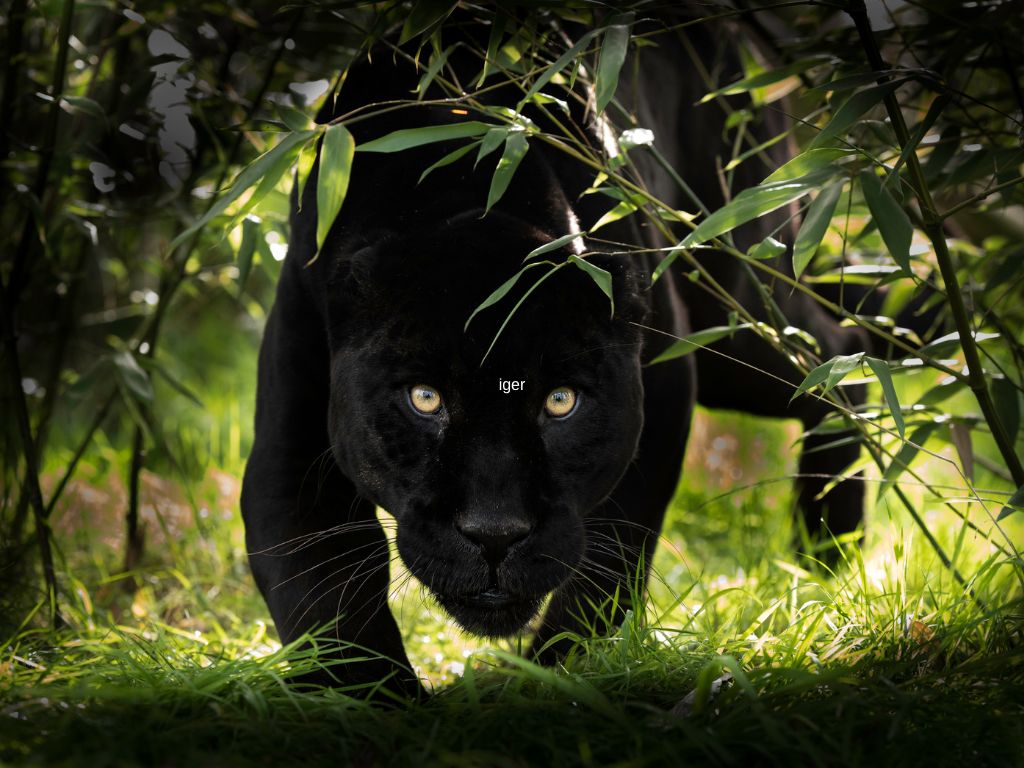
Nobody has timed a wild jaguar at full speed. The figure of 80 km/h (50 mph) that you see online has no published measurement behind it. San Diego Zoo Wildlife Alliance says jaguars can run fairly fast, but that speed is not an important skill for them. Jaguars ambush prey from close range instead of chasing it.
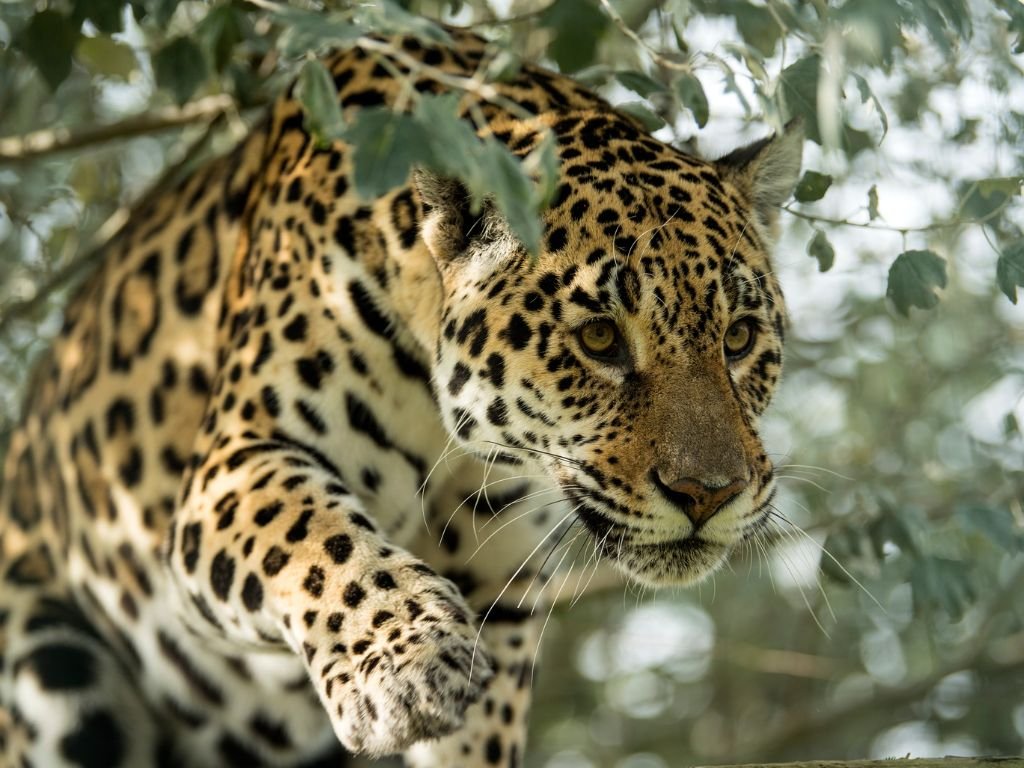
How fast can a jaguar run, really?
The best we can do is compare. Jaguars weigh 31 to 121 kg (70 to 249 lb), says San Diego Zoo. That is between a leopard and a lion. Older records collected by Theodore Garland give about 60 km/h (37 mph) for leopards and 56 to 59 km/h (35 to 37 mph) for tigers and lions, and he warned that some of these are anecdotal (Garland 1983).
So a jaguar’s top speed is probably in the same range as other big cats of its size, roughly 50 to 65 km/h (30 to 40 mph). That is an educated guess, not a measurement. The 80 km/h figure would make the jaguar faster than any big cat except the cheetah, and nothing supports that.
| Cat | Top speed | What kind of figure | Source |
|---|---|---|---|
| Cheetah | 93 km/h (58 mph) | Measured with GPS collars in the wild | Wilson et al. 2013 |
| Leopard | About 60 km/h (37 mph) | Old estimate | Garland 1983 |
| Lion | Up to 53 km/h (33 mph), lioness | Estimate | San Diego Zoo |
| Tiger | About 49–65 km/h (30–40 mph) | Estimate | National Geographic |
| Jaguar | Not measured; probably similar to the leopard and lion | No published measurement | Our estimate from the figures above |
Why has nobody measured it? Most old animal speeds were taken by driving a car beside a running animal and reading the speedometer, Garland explains. That works on open plains. It does not work in a rainforest or a swamp at night, which is exactly where jaguars hunt.

How do jaguars hunt if not by speed?
Jaguars stalk and ambush their prey on the ground, mostly at night, says San Diego Zoo Wildlife Alliance. They wait in cover, creep close, then pounce. There is no long chase at all.
The kill is unusual. Jaguars often kill by biting through the skull with their sharp teeth. Panthera says jaguars use their powerful jaws to pierce the skulls of capybaras, peccaries and even caimans. See how strong a jaguar is for more on that bite.
Jaguars eat more than 85 kinds of prey, including deer, tapirs, capybaras, peccaries and cattle. They have even been seen sitting quietly at the water’s edge, tapping the surface with their tail to attract fish, says San Diego Zoo.
How long can a jaguar run at top speed?
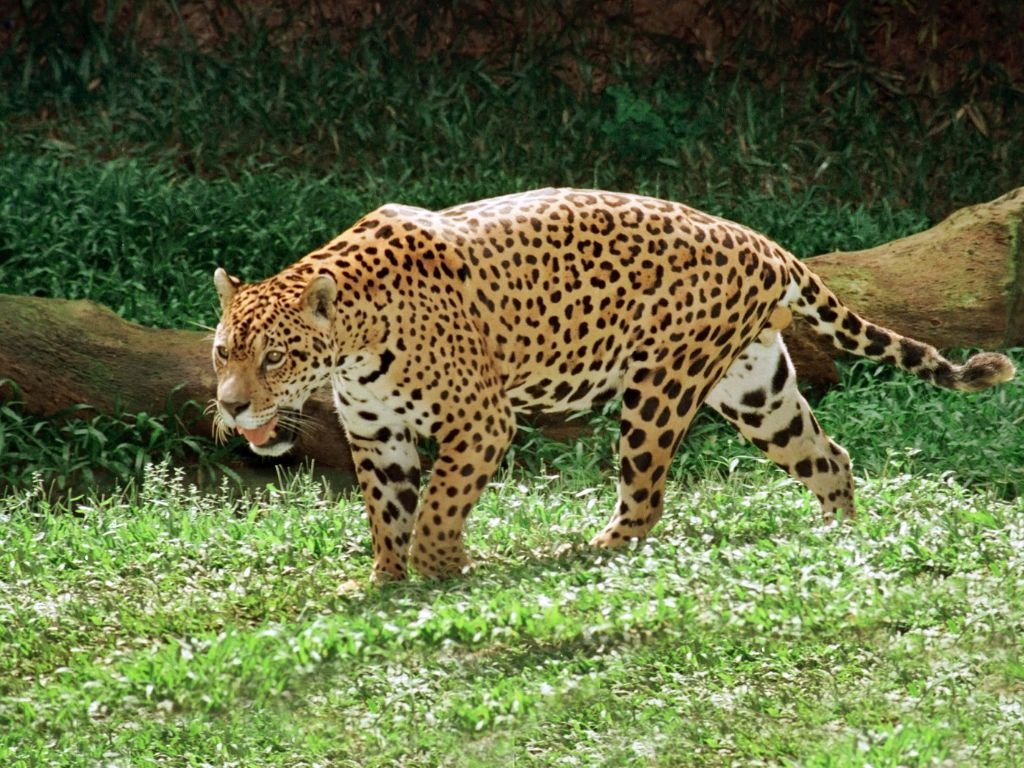
Only a very short way. Like other ambush hunters, a jaguar puts everything into a quick rush of a few bounds. There is no study of how far a jaguar can sprint. For comparison, even the cheetah, the best runner of all cats, chased prey an average of just 173 m (190 yd) per run in Botswana (Wilson and colleagues).
A jaguar that fails in its first rush usually gives up and tries again later. Chasing prey through thick forest would waste energy and make noise that warns every other animal nearby.
Is a jaguar faster than a cheetah?
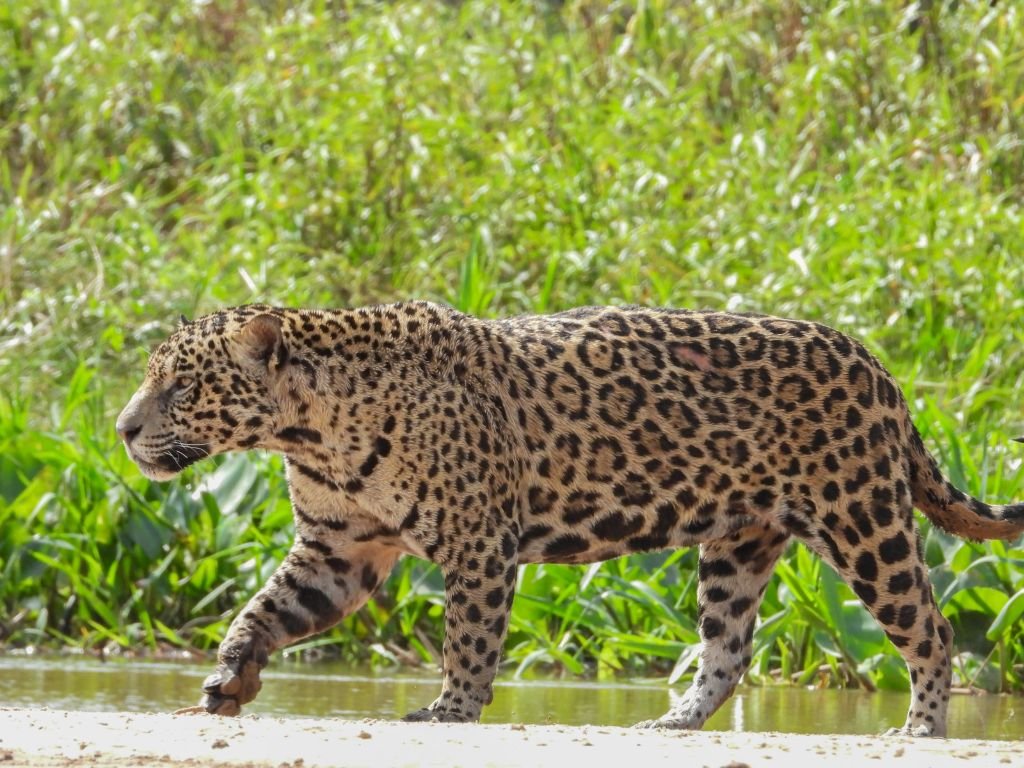
No. The cheetah is the fastest land animal. GPS collars on wild cheetahs recorded 93 km/h (58 mph), found Wilson and colleagues (2013). A jaguar is heavier and more muscular, with a big head and strong jaws, built for power at close range.
The two never meet in the wild. Jaguars live in the Americas, from Mexico to Argentina, while cheetahs live in Africa and Iran. Our pages on cheetah adaptations and the fastest animals in the world show what a real sprinter looks like, and how fast a tiger can run covers another ambush hunter.
Can jaguars swim?
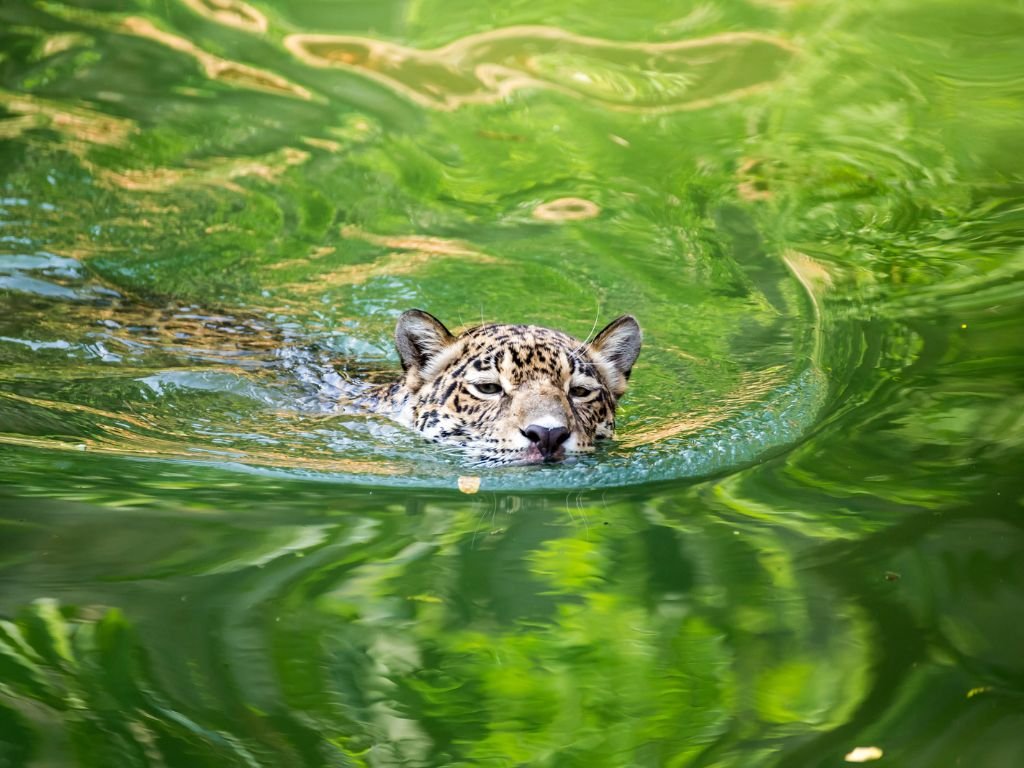
Yes, very well. Jaguars have large, rounded paws that are useful for swimming long distances, says Panthera. They often live near rivers and swamps, such as Brazil’s Pantanal, where Panthera researchers have identified more than 300 jaguars.
Swimming lets jaguars hunt in the water. Caimans, a kind of crocodilian, are on the menu. Muscular limbs and big paws also make jaguars good climbers, says San Diego Zoo. Nobody has measured a jaguar’s swimming speed either.
Are jaguars endangered?
Jaguars are listed as Near Threatened on the IUCN Red List, one step below Vulnerable. They have disappeared from nearly 50% of their historic range, says Panthera, and today live in 18 countries. About 22% of the world’s remaining jaguars live in Colombia.
Speed will not save them. Jaguars need large, connected forests and wetlands with plenty of prey. Where forests are cleared for farms and cattle, jaguars lose both their homes and their food.
Frequently asked questions
What is the fastest cat in the world?
The cheetah. Wild cheetahs fitted with GPS collars in Botswana reached 93 km/h (58 mph), in a study published in Nature in 2013. No other cat comes close. Big cats such as lions, tigers and jaguars are ambush hunters that only sprint for a few seconds.
How long do jaguars live?
Jaguars live 12 to 15 years in the wild and up to 20 years in zoos, says San Diego Zoo Wildlife Alliance. Cubs stay with their mother while they learn to hunt, which takes many months.
How big is a jaguar?
A jaguar is 1.1 to 1.8 m (3.8 to 6 ft) long, not counting the tail, and weighs 31 to 121 kg (70 to 249 lb), says San Diego Zoo. Males are larger than females. It is the largest cat in the Americas and the third largest cat in the world.
Where do jaguars live?
Jaguars live in 18 countries in the Americas, from Mexico to Argentina, says Panthera. They use swamps, tropical forests, scrubland and even deserts, but they do best near water, where prey such as capybaras and caimans is common.
Sources
- San Diego Zoo Wildlife Alliance. Jaguar.
- Panthera. Jaguar.
- Journal of Zoology via University of California, Riverside (1983). The relation between maximal running speed and body mass in terrestrial mammals (Garland, Journal of Zoology 199: 157-170).
- ScienceDaily (Royal Veterinary College news release) (2013). Wild cheetahs accelerate fast and reach speeds of up to 58 miles per hour during a hunt (on Wilson et al., Nature 498: 185-189, doi:10.1038/nature12295).
- San Diego Zoo Wildlife Alliance. Lion.
- National Geographic. A cry for the tiger.
Sources checked 15 September 2026.
Keep the conversation curious