
Nobody knows exactly how long a blue whale’s tongue is, because no scientist has published a reliable measurement. The tongue is soft and baggy, and it turns inside out when the whale feeds, according to a 2011 study of blue whale feeding. The “12 feet” and “18 feet” figures online have no known source. So does the famous 2.7-tonne weight.
That may sound like a letdown, but the real story is stranger than a number. A blue whale’s tongue works more like a stretchy bag than a tongue like yours. To see why, you need to know how the biggest animal ever known eats.
How long is a blue whale’s tongue, and why is it so hard to measure?
Your tongue is a firm muscle with a fixed shape. A blue whale’s tongue is loose and floppy. During feeding it changes shape completely, so it has no single “length” to measure.
Scientists mostly study blue whale tongues from dead whales. By the time a whale is found, its soft tissues have often collapsed or decayed. Whalers cut up thousands of blue whales in the last century, but their records focused on body length and oil, not tongues. That is why no trustworthy tongue length exists.
| Measurement | Figure | How reliable |
|---|---|---|
| Tongue length | No published measurement | Unknown; online figures are guesses |
| Tongue weight | Often quoted as about 2.7 tonnes (6,000 lb) | Widely repeated, but we could not trace it to a study |
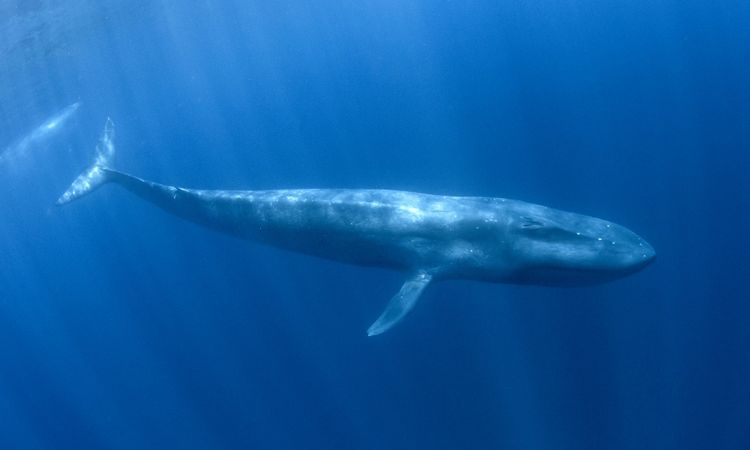
| Body length, Antarctic blue whale | Up to about 33 m (110 ft) | Measured (NOAA Fisheries) |
| Body length, North Atlantic and North Pacific | Up to about 27 m (90 ft) | Measured (NOAA Fisheries) |
| Body length, pygmy blue whale | Up to 24.1 m (79 ft) | Recorded (Australian Government) |
| Krill eaten per day | Up to about 5.4 tonnes (6 tons) | Estimated (NOAA Fisheries) |
| Stretch in mouth and tongue nerves | More than double their resting length | Measured in fin and blue whale tissue (Vogl et al. 2015) |
NOAA gives lengths in feet and daily krill in US tons; the metric figures are conversions. The pygmy blue whale is a smaller subspecies, and the Australian Government records it growing to 24.1 m.
How much does a blue whale’s tongue weigh?
You will often read that a blue whale’s tongue weighs about 2.7 tonnes, as much as an elephant. It is a reasonable guess for the largest animal on Earth. But we could not find a study where a tongue was weighed, so treat it as an estimate, not a record.
What we can say is that the tongue is huge, heavy and mostly soft tissue. It has to be big, because it lines part of the giant pouch the whale fills with water at every gulp.
How does a blue whale use its tongue to eat?
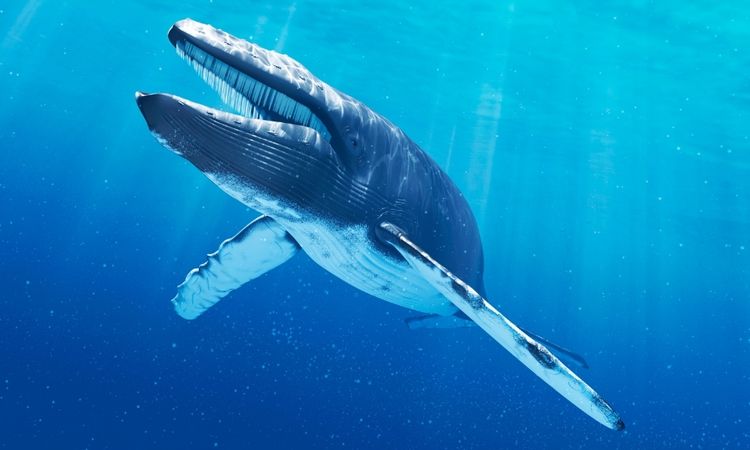
Blue whales eat krill, small shrimp-like animals. The biggest whales eat up to 6 tons of krill a day, says NOAA Fisheries. They catch it with a move called lunge feeding.
- Speed up. The whale swims hard at a thick swarm of krill.
- Open wide. It drops its lower jaw to a very wide angle.
- Balloon out. The pleated skin of its throat stretches like an accordion. The tongue turns inside out to line the pouch that forms.
- Squeeze and filter. The whale closes its mouth and pushes the water out through baleen plates hanging from its upper jaw. The krill stay inside and get swallowed.
The 2011 study by Jeremy Goldbogen and colleagues in the Journal of Experimental Biology describes step three. It says “the tongue inverts and forms a large portion of the capacious sac” that holds the water and krill. In plain words, the tongue flips inside out and becomes part of the bag.
Why don’t blue whale tongue nerves snap?
Stretching a mouth and tongue that much should damage the nerves inside. Most nerves in your body can’t stretch much at all.
In 2015, Wayne Vogl, Robert Shadwick and colleagues at the University of British Columbia solved the puzzle. They studied tissue from fin whales and blue whales from a whaling station in Iceland. The nerves in the tongue and mouth floor can “double in length and then recoil like a bungee cord”, the university’s news release says. The nerve fibres don’t actually stretch. They are folded up and simply unfold when the mouth balloons open.
The study was published in Current Biology. It helps explain how rorquals, the family of whales that lunge feed, can take such enormous gulps without injuring themselves.
Is lunge feeding worth all that effort?
Yes, when there are plenty of krill. Every lunge costs a lot of energy, because the whale has to speed up and then push a huge mass of water. Goldbogen’s team worked out that at high krill densities, a whale gets far more energy back than it spends.
They found that whole feeding dives were about 90 times more efficient than the cost of making them. That was “nearly an order of magnitude higher” than other marine mammals, meaning about ten times better. At low krill densities, though, the payoff drops sharply. Blue whales need dense swarms to make the system work.
Blue whale tongue myths
- Myth: blue whales use their tongues to make their calls. Fact: whales don’t need a tongue to call; their deep sounds are made inside the body without opening the mouth.
- Myth: blue whales swallow schools of big fish. Fact: they feed almost entirely on krill.
- Myth: someone has measured a blue whale tongue in an aquarium. Fact: no blue whale has ever been kept in captivity. They are far too big.
Want the full size story? Read how big a blue whale is. Compare the biggest fish in how big whale sharks are. Or find out what happens when a whale dies, when scientists often get their only close look at whale anatomy.
Frequently asked questions
Does the blue whale have the biggest tongue of any animal?
Almost certainly, by weight. The blue whale is the largest animal known to have lived, and its tongue is very large. But no one has published a measured weight, so the often-quoted 2.7 tonnes is an estimate. No other animal is a serious rival for the title.
Could a blue whale swallow a person?
No. Its mouth is huge, but it is built to filter tiny krill through baleen plates. The throat that food passes down is narrow compared with the whale's size. Blue whales are not dangerous to people, and US rules ask boats to stay at least 100 yards away.
Does a blue whale have teeth?
No. Blue whales are baleen whales. Instead of teeth, they have rows of baleen plates hanging from the upper jaw. Baleen is made of keratin, the same material as your fingernails. It works like a sieve, letting water out while trapping krill inside.
How big is a blue whale's mouth?
Big enough to take in a mass of water and krill that weighs tonnes in one lunge. The lower jaw opens to a very wide angle, and the pleated throat balloons outward. Exact mouth size varies with the whale's length, which is up to about 33 m (110 ft).
Sources
- NOAA Fisheries. Blue whale (Balaenoptera musculus) species profile.
- The Company of Biologists (2011). Mechanics, hydrodynamics and energetics of blue whale lunge feeding: efficiency dependence on krill density (Goldbogen, Calambokidis, Oleson, Potvin, Pyenson, Schorr & Shadwick), Journal of Experimental Biology 214(1): 131–146.
- University of British Columbia news release via Phys.org (2015). Gigantic whales have stretchy 'bungee cord' nerves (on Vogl et al., 'Stretchy nerves are an essential component of the extreme feeding mechanism of rorqual whales', Current Biology).
- Australian Government Department of Climate Change, Energy, the Environment and Water. Balaenoptera musculus: Blue Whale, Species Profile and Threats Database.
Sources checked 15 September 2026.
Keep the conversation curious