
A shelled reptile plods across a dusty path. One person calls it a turtle. Another says no, it’s a tortoise. Here is the twist: they can both be right.
Turtle vs tortoise comes down to one idea: a tortoise is a turtle that lives on land. Tortoises have high, domed shells and thick, elephant-like legs with no webbing, and most eat plants. Other turtles usually live in or near water and have flatter shells with webbed feet or flippers. So every tortoise is a turtle, but most turtles are not tortoises. Below you’ll find a side-by-side ID table, a 3-second test, and the tricky cases that fool almost everyone.
Key takeaways
- All tortoises are turtles. Tortoises are one family (Testudinidae) inside the turtle order, which has 357 living species.
- Shell and feet give it away: a domed shell and stumpy, unwebbed feet mean tortoise; a flatter shell with webbed feet or flippers means a water turtle.
- Most tortoises swim badly. Never put one in a pond. Some giant tortoises can float, though, and one drifted about 740 km across the sea.
- Tortoises hold the age record: Jonathan, a giant tortoise thought to have hatched around 1832, is the oldest turtle of any kind on record.
The 3-second ID
Domed shell + thick, unwebbed “elephant” feet + on dry land = tortoise.
Flatter shell + webbed feet or flippers + in or near water = a water turtle.
One catch: some land turtles, such as box turtles, are not tortoises. More on that below.
In this article
- What is the difference between a turtle and a tortoise?
- Is a tortoise a turtle?
- How can you tell a turtle from a tortoise by its shell and feet?
- Can tortoises swim?
- What do turtles and tortoises eat?
- Which lives longer, a turtle or a tortoise?
- What is a terrapin?
- Why do turtles and tortoises matter to their ecosystems?
- Myths about turtles and tortoises
- Test yourself
- Frequently asked questions
What is the difference between a turtle and a tortoise?
A tortoise is a land-living turtle from the family Testudinidae. It has a domed shell, thick elephant-like back legs and short feet with no webbing, and it eats mostly plants. Most other turtles spend much of their lives in water and have flatter shells, webbed feet or flippers, and a much wider range of diets.
| Feature | Water turtles (sea and freshwater) | Tortoises |
|---|---|---|
| Group | Many families in the turtle order, Testudines | One family, Testudinidae, about 40–50 species |
| Where it lives | Oceans, rivers, ponds, marshes; some in salty-fresh (brackish) water | Only on land, from deserts to rainforests |
| Shell | Flatter and more streamlined for swimming | High and domed |
| Legs and feet | Webbed feet with claws (freshwater) or paddle-like flippers (sea turtles) | Thick, elephant-like back legs; short feet with no webbing |
| Swimming | Strong swimmers; leatherbacks dive to about 1,200 m (4,000 ft) | Most swim poorly; some giant tortoises can float |
| Diet | Varies: jellyfish (leatherback), seagrass and algae (adult green turtle), clams and snails (diamondback terrapin) | Mostly plants: grasses, flowers, succulents and fruit; a few also eat carrion |
| Lifespan examples | Green turtle: estimated 70+ years; leatherback: estimated 50+ years | Record holder about 194 years old in 2026 (Jonathan) |
| Examples | Leatherback, green turtle, diamondback terrapin, red-eared slider | Galápagos, Aldabra, gopher and sulcata tortoises |
Sources: Animal Diversity Web (tortoise family); NOAA Fisheries (leatherback and green turtle); Chesapeake Bay Program (terrapin); Guinness World Records. The table is our own summary of those sources.
Teachers and writers: you are welcome to reuse this table.
Please credit it like this: “Turtle vs tortoise ID table: Zooologist.com (zooologist.com), sources checked 14 October 2026.” and link back to this page. You can copy the table as it is or add your own photos alongside it.
Is a tortoise a turtle?
Yes. Scientists use “turtle” for every member of the order Testudines, the reptiles with a bony shell. The Turtle Taxonomy Working Group’s 2021 checklist counts 357 living species. Tortoises are one family inside that group, the land turtles, so a tortoise is always a turtle, the way a lion is always a cat.
Tortoises are only a slice of the turtle world, which you can explore from our animal index. Animal Diversity Web puts the tortoise family at about 40–50 species, “depending on the source.” That works out to roughly one turtle species in every eight (our own calculation: 45 ÷ 357 ≈ 0.13).
Everyday words muddy things. In the UK, “turtle” is usually kept for animals that live in the sea, says Bristol Aquarium, while in the US “turtle” covers sea turtles and pond turtles alike. Neither usage is wrong. They are just different habits of speech.
Is a box turtle a tortoise?
No, and it is the best trick question in this topic. The eastern box turtle is “a medium-sized terrestrial turtle” that lives on land and can shut itself inside its hinged shell, says the Virginia Department of Wildlife Resources. But it belongs to Emydidae, the pond turtle family, not to the tortoise family. Living on land does not make a turtle a tortoise. Family does.
How can you tell a turtle from a tortoise by its shell and feet?
Check the shell first, then the feet. Tortoise shells are high and domed, while water turtles have flatter, streamlined shells that slip through water. Tortoises walk on thick, elephant-like back legs with short, unwebbed feet. Freshwater turtles have webbed feet with claws, and sea turtles have flippers instead of feet.
The domed carapace (the top half of the shell) and “thick, elephantine rear legs, short, web-less feet” are the tortoise family’s land adaptations, says Animal Diversity Web. These are structural adaptations, body parts shaped by where an animal lives (see structural, behavioural and physiological adaptations explained). Flatter turtle shells “help them swim more efficiently,” according to the Nashville Zoo, as quoted by the Forest Preserve District of Will County.
Picture it: three shell shapes, side by side
Simplified side views, not drawn to scale. Notice how the shell gets flatter as the animal spends more time in water.
Tortoise
High dome, pillar-like legs
Pond turtle
Lower shell, webbed feet
Sea turtle
Flat, streamlined shell, flippers
Our own illustration, based on the descriptions from Animal Diversity Web, the Nashville Zoo and NOAA Fisheries.
Spot the difference. Tap each clue to check your eye.
Clue 1: The shell is tall and rounded, like an upturned bowl.
Tortoise. A tortoise has no need for a streamlined shell, because it lives on land. Its domed carapace is one of the tortoise family’s land features, says Animal Diversity Web.
Clue 2: The toes are joined by skin, and there are long claws.
Freshwater turtle. Webbed feet push against water like paddles. The diamondback terrapin, for example, has “webbed feet with strong claws,” says the Chesapeake Bay Program.
Clue 3: It has flippers and can’t pull its head into its shell.
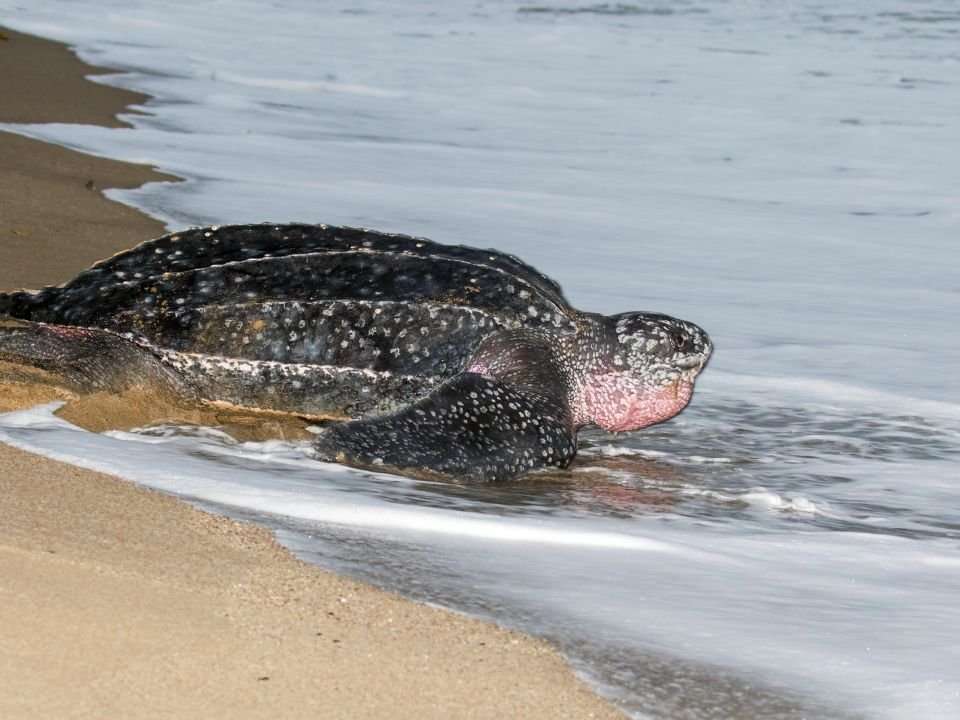
Sea turtle. Unlike other turtles, sea turtles cannot pull their heads, flippers or tails into their shells, says a Florida Sea Grant lesson published by NOAA.
Clue 4: It lives on dry land, but its shell has a hinge and closes tight like a box.
Box turtle, a land turtle that is not a tortoise. It belongs to the pond turtle family.
Can tortoises swim?
Most tortoises are poor swimmers, and some cannot swim at all. University of Florida experts warn: “Never, ever put a tortoise in the water,” because gopher tortoises are land turtles that can’t swim. Their heavy, domed shells and unwebbed feet are built for walking and digging, not paddling.
That warning comes from the UF/IFAS Extension, and it is the single most useful fact for anyone who finds a tortoise or keeps one, including big pet species like the African sulcata (see how big sulcata tortoises get). A garden pond can drown one.
Some giant tortoises are an amazing exception, but they float rather than swim well. In December 2004, an Aldabra giant tortoise walked out of the sea at Kimbiji in Tanzania, covered in goose barnacles and starving, reported Gerlach, Muir and Richmond in the Journal of Natural History. The researchers concluded it had probably drifted from Aldabra atoll, 740 km away. They called it the first direct evidence of a tortoise surviving a sea crossing.
The barnacles were about 6–7 weeks old. If that matches the trip, the tortoise drifted roughly 15–18 km a day (our calculation: 740 km ÷ 42–49 days). That is about what a person covers in three or four hours of easy walking at 5 km/h, every single day, without food, for weeks.
What do turtles and tortoises eat?
Tortoises are mainly plant-eaters, munching grasses, sedges, flowers, succulents and fruit, though a few also eat carrion. Water turtles eat a far wider menu. Leatherbacks live on jellyfish, adult green turtles graze algae and seagrass, and diamondback terrapins crunch clams, snails and mussels.
The tortoise menu comes from Animal Diversity Web. Galápagos tortoises have a favourite: prickly pear cactus, says San Diego Zoo Wildlife Alliance. They bite with the bony edges of their jaws instead of teeth.
In the sea, the leatherback is built for soft, open-ocean prey “such as jellyfish and salps,” says NOAA Fisheries, while an adult green turtle’s diet “mainly consists of algae and seagrasses” (NOAA). Read more in what sea turtles eat and which animals turtles hunt. Some land turtles are omnivores too: the eastern box turtle eats fruit, mushrooms and slugs.
Which lives longer, a turtle or a tortoise?
Tortoises hold the record. Jonathan, a Seychelles giant tortoise on the island of St Helena, is believed to have hatched around 1832, making him about 194 in 2026, says Guinness World Records. Sea turtles also live long lives, but their lifespans are poorly known: NOAA estimates 70+ years for green turtles.
Jonathan’s age is an estimate. He was described as “fully mature,” so at least 50, when he arrived on St Helena in 1882, says Guinness World Records, which calls him the oldest chelonian (turtle of any kind) ever. The previous holder, Tu’i Malila, a radiated tortoise given to the Tongan royal family by Captain Cook, lived to at least 188.
Picture it: how long shelled reptiles live
Years, drawn to scale. Paler bars are estimates with big uncertainty.
Jonathan, Seychelles giant tortoise (record, still alive): about 194
Tu’i Malila, radiated tortoise (previous record): at least 188
Eastern box turtle in captivity (typical average 25–35): more than 100
Green sea turtle (NOAA estimate): 70 or more
Leatherback sea turtle (NOAA estimate): 50 or more
Sources: Guinness World Records; Virginia DWR; NOAA Fisheries. Full bar = 200 years.
Why do they last so long? A 2022 study in Science by Rita da Silva and colleagues looked at 52 turtle, terrapin and tortoise species in zoos. About 75% showed slow or negligible ageing, and about 80% aged more slowly than modern humans, according to the study’s news release. These were captive animals, so wild turtles may age differently. The same release says protective adaptations “like bony shells” and a slow pace of life help explain such slow ageing.
What is a terrapin?
A terrapin is a turtle, not a tortoise. In North America the name belongs to the diamondback terrapin, which lives in brackish water, the salty-fresh mix of marshes and estuaries. The word comes from an Algonquin word for edible turtles that live in brackish water, says the Chesapeake Bay Program.
The Chesapeake Bay Program adds that it is “believed to be the only turtle in the world that lives exclusively in brackish water.” It grows to about 23 cm (9 in) long and has webbed feet. In Britain, the word is used more loosely: Bristol Aquarium describes terrapins as amphibious, spending time both in water and on land. It also notes that thousands of unwanted pet sliders were released into the wild in the UK after outgrowing their tanks, causing “huge problems for native wildlife.” Never release a pet turtle; contact a reptile rescue instead.
Why do turtles and tortoises matter to their ecosystems?
Both play roles other animals rely on. Gopher tortoises are keystone species: their burrows shelter more than 350 other species, so losing the tortoise means losing those shelters. In the sea, adult green turtles graze seagrass and algae, and leatherbacks hunt jellyfish and salps, linking them to two very different food webs.
Tortoises: a gopher tortoise digs tunnels that average 4.6 m (15 ft) long, and “other animals depend on their burrows for survival,” says the UF/IFAS Extension. Burrowing owls and the endangered eastern indigo snake are among the burrow users. Take the tortoise away and those animals lose their shelter. On the Galápagos, tortoises eat prickly pear cactus and grasses, and some finches pick ticks off their skin and shells, says the Galápagos Conservancy.
Water turtles: leatherbacks hunt jellyfish and salps in the open ocean, and adult green turtles graze seagrass and algae (NOAA). See how the green sea turtle lives and why the leatherback is endangered.
Many are in trouble. Of the 357 turtle species, 183 (51.3%) are threatened, according to the 2021 Turtles of the World checklist. You can help by never buying wild-caught turtles, leaving wild tortoises where you find them, and never releasing pets.
Hidden gems
- The shell is made of bone you can’t take off. A turtle’s shell is “a modified ribcage and part of the vertebral column,” says Animal Diversity Web.
- It started with ribs. Eunotosaurus, a reptile from about 260 million years ago with broad, T-shaped ribs, is thought to be an early relative on the road to the turtle shell (Lyson et al., 2013).
- A tortoise that crossed an ocean: the Kimbiji tortoise arrived in Tanzania weighing just 25 kg. About a year and a half later it weighed 42.5 kg.
- Turtles barely age: in zoos, about three in four turtle species showed slow or negligible ageing (da Silva et al., 2022).
Myths about turtles and tortoises
Myth: A turtle can crawl out of its shell.
Fact: The shell is built from the turtle’s own ribs and part of its backbone, so it cannot come off. Why people believe it: cartoons show turtles stepping out of their shells like a coat. Source: Animal Diversity Web.
Myth: You can tell a turtle’s age by counting the rings on its shell.
Fact: A review of 145 studies found only four case studies with enough data to show that a steady number of rings was added each year, and concluded there is “no justification” for using rings to age many species. Why people believe it: it works for tree rings, so it sounds right. Source: Wilson, Tracy & Tracy, 2003, Herpetologica.
Myth: Tortoises can swim like turtles, so a pond is fine.
Fact: Most tortoises are land turtles that swim poorly, and the UF/IFAS Extension warns never to put a gopher tortoise in water. Why people believe it: “tortoise” and “turtle” are used as if they were the same animal. Source: UF/IFAS Extension.
Test yourself
1. True or false: every tortoise is a turtle.
True. Tortoises are the land-living family (Testudinidae) inside the turtle order.
2. A land-living reptile has a hinged shell it can close completely. Is it a tortoise?
No. That describes a box turtle, which belongs to the pond turtle family.
3. Why should you never put a tortoise in a pond?
Most tortoises swim poorly and can drown. Their domed shells and unwebbed feet are built for land.
Where to next?
➡️ Go wider: what sea turtles eat, from jellyfish to seagrass⬆️ Go deeper: how big a sulcata tortoise gets🔀 Go sideways: another reptile mix-up, crocodiles vs alligators
Frequently asked questions
Can a turtle live without its shell?
No. A turtle’s shell is not a house it carries around. It is part of the skeleton, formed from a modified ribcage and part of the backbone, says Animal Diversity Web. Because the shell is part of its body, a turtle can never leave it or swap it for a new one.
Is a sea turtle a tortoise?
No. Sea turtles are ocean-living turtles, and tortoises are a separate land-living family. Sea turtles have flippers instead of feet, flatter shells, and cannot pull their heads into their shells. The biggest, the leatherback, weighs about 340–450 kg (750–1,000 lb), as much as four to six average American adults (compare more animals in animal sizes vs a human).
Are turtles and tortoises reptiles or amphibians?
Both are reptiles. Turtles and tortoises belong to the order Testudines in the class Reptilia, alongside snakes and lizards, says Animal Diversity Web.
Do turtles and tortoises have teeth?
No. Living turtles bite with hard jaw edges instead. Even very early fossil turtles had already lost the teeth along their jaws and probably had a keratin beak, says Animal Diversity Web. Galápagos tortoises use the bony edges of their jaws instead of teeth to eat cactus and grass, says San Diego Zoo Wildlife Alliance.
Sources
- Animal Diversity Web, University of Michigan. Testudinidae (tortoises).
- Animal Diversity Web, University of Michigan. Testudines (turtles).
- Turtle Taxonomy Working Group (2021). Turtles of the World: Annotated Checklist and Atlas (9th ed.). Chelonian Research Monographs 8: 1–472.
- Guinness World Records. Oldest turtle/chelonian.
- da Silva, R. et al. (2022). Slow and negligible senescence among testudines challenges evolutionary theories of senescence. Science, doi:10.1126/science.abm0151. Via EurekAlert news release.
- Gerlach, J., Muir, C. and Richmond, M. D. (2006). The first substantiated case of trans-oceanic tortoise dispersal. Journal of Natural History 40: 2403–2408.
- UF/IFAS Extension Lake County (2021). Gopher tortoises: a keystone species and important native neighbor.
- NOAA Fisheries. Leatherback turtle.
- NOAA Fisheries. Green turtle.
- McGuire, M. et al. (2016). One in a thousand: those amazing sea turtles (5th grade curriculum). Florida Sea Grant, NOAA Institutional Repository.
- Forest Preserve District of Will County (2020). What’s the difference: turtle vs. tortoise (quoting the Nashville Zoo).
- Chesapeake Bay Program. Diamondback terrapin.
- Bristol Aquarium. Red-eared slider.
- Virginia Department of Wildlife Resources. Eastern box turtle.
- Wilson, D. S., Tracy, C. R. and Tracy, C. R. (2003). Estimating age of turtles from growth rings: a critical evaluation of the technique. Herpetologica 59: 178–194.
- Lyson, T. R. et al. (2013). Evolutionary origin of the turtle shell. Current Biology 23: 1113–1119.
- San Diego Zoo Wildlife Alliance. Galápagos tortoise.
- Galápagos Conservancy. Galápagos tortoises.
- Centers for Disease Control and Prevention, NCHS. Body measurements (2021–2023 data).
Sources checked 14 October 2026.

Keep the conversation curious