

A grey mountain bird called a Clark’s nutcracker flies over a mountain slope in autumn, pushing pine seeds into the soil one hiding place after another. Months later, under snow, it comes back and digs many of them up again.
There is no “dumbest animal”. Scientists who study animal minds do not rank species on one scale from smart to stupid. Each animal’s brain is shaped for the problems its own life throws at it. A bird that cannot solve a puzzle box may remember thousands of hiding places, and an animal that seems slow may be very good at something we never thought to test.
Key takeaways
- No valid ranking: there is no agreed test that puts all animals on a single intelligence scale, so “dumbest animal” lists are opinion, not science.
- Intelligence is specialised: a 2020 review found that chimpanzees, dogs and New Caledonian crows each excel in some kinds of thinking and do poorly in others.
- Many “dumb animal” stories are myths: ostriches do not bury their heads in the sand, and goldfish remember things for months, not seconds.

Which animal is the dumbest?
No animal can fairly be called the dumbest. Intelligence is not one thing that animals have more or less of. It is a set of skills, such as memory, learning, problem-solving and communication, and each species has the mix that suits its way of life. Lists that crown one “dumbest” animal usually judge it by human standards or repeat myths.
That is the conclusion of a 2020 review in the Journal of Intelligence by Juliane Bräuer and colleagues. They looked at chimpanzees, domestic dogs and New Caledonian crows and found each was highly skilled in one area of thinking yet performed poorly in others that people assume go together, according to the Max Planck Institute. Bräuer warned that judging animals by human abilities gives only a narrow, human-centred picture.
What do scientists mean by animal intelligence?
Scientists usually talk about cognition: how an animal takes in information, learns, remembers and makes decisions. Instead of asking “how smart is it?”, they ask “what problems does this animal need to solve, and how well does it solve them?” The Bräuer team called this a biocentric approach, judging each species on its own terms.
This changes which tests make sense. A test built around hands, eyes and human-style puzzles may suit a chimpanzee and be unfair to a dog, which relies more on smell and on reading people. A poor score can say more about the test than about the animal.
Can you measure an animal’s IQ?
Not in any way that lets you compare species. IQ tests were designed for people, using language and puzzles that make no sense to a horse or a bee. Figures you may see online giving sheep or horses an “IQ” of 0.8 or 0.9 are not IQ scores at all, and we could not trace them to a published study, so we have removed them from this page.
Brain size is not a simple answer either. Small animals can do remarkable things with small brains. Honeybees are a good example.
What can “unexpected” animals do?
Plenty. Honeybees use a “waggle dance” that tells hive-mates both the direction and the distance of a food source. For food closer than about 50 m, they use a simpler round dance instead, explains NC State Extension. Karl von Frisch’s work decoding the dance earned him the Nobel Prize in Physiology or Medicine in 1973.
Memory is another skill where small brains shine. A single Clark’s nutcracker can collect as many as 33,000 pine seeds and bury them in more than 2,500 separate caches, reports the National Wildlife Federation. Researchers such as Alan Kamil found the birds find them again using landmarks, and they may still be eating stored seeds a year later.
Picture it: could you remember 2,500 hiding places?
Imagine hiding 2,500 sweets around your town, one or a few at a time, with no map or notes. Then imagine finding most of them again months later, after snow has covered the ground. That is roughly the memory job a Clark’s nutcracker does every winter.
Pine seeds one nutcracker may collect: up to 33,000
Separate caches it may make: more than 2,500
Source: National Wildlife Federation. Bars drawn to scale.
Why is every animal “smart” for its own life?
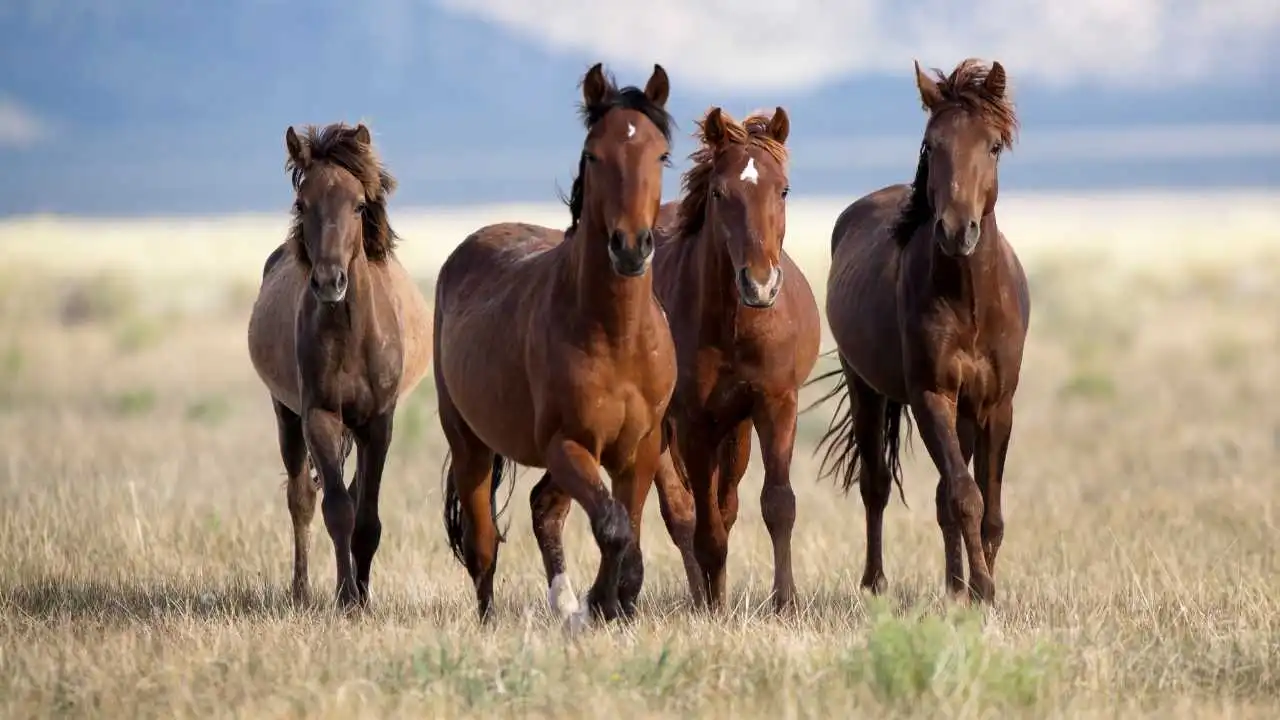
Because evolution shapes minds the same way it shapes bodies. An animal only needs the thinking skills that help it find food, avoid danger and raise young where it lives. A nutcracker needs a huge memory for hiding places. A bee needs to share directions. A grazing animal needs to notice danger and stay with its group.
Those skills matter well beyond the animal itself. Whitebark pine seedlings sprout almost entirely from seeds that Clark’s nutcrackers bury and never come back for, says the US National Park Service. One bird’s memory, and its forgetting, helps plant a whole mountain forest.

Myths about “dumb” animals

Myth: Ostriches bury their heads in the sand when scared.
Fact: They don’t. An ostrich usually escapes by running, at bursts of up to 70 km/h (43 mph). If it can’t flee, it drops to the ground and lays its head and neck flat, says San Diego Zoo Wildlife Alliance. Why people believe it: from far away, a lying ostrich’s pale head blends into the soil, so it looks buried. See how big an ostrich is.
Myth: Goldfish have a three-second memory.
Fact: Goldfish can keep memories for at least three months and can be trained, reports BBC Wildlife (Discover Wildlife). In one study at Plymouth, goldfish learned to press a lever for food at the right time of day.
Myth: Scientists have a ranked list of the dumbest animals.
Fact: No such scientific list exists. Researchers argue that species should be judged on their own terms, not on a single human-style scale (Bräuer et al. 2020).
Test yourself
1. Do scientists rank animals from smartest to dumbest?
No. They study what each species can do and how its thinking fits its way of life.
2. What two things does a honeybee’s waggle dance tell other bees?
The direction and the distance of a food source.
3. What does a scared ostrich really do if it can’t run away?
It lies flat with its head and neck on the ground.
Where to next?
➡️ Go wider: explore our animal guides⬆️ Go deeper: how dolphins hunt, breathe and sleep🔀 Go sideways: how strong is a chimpanzee?
Frequently asked questions
What is the least intelligent animal?
Science has no answer, because there is no single measure of intelligence that works across all animals. Each species has thinking skills that fit its needs. Animals that do badly on one test often do very well on another, as a 2020 review of chimpanzees, dogs and crows found.
Is the ostrich the dumbest animal?
No. The ostrich’s reputation comes from the myth that it buries its head in the sand. In fact it runs from danger at up to 70 km/h (43 mph), or lies flat to hide, says San Diego Zoo Wildlife Alliance. Both are sensible ways to stay alive on open plains.
Do animals have IQ scores?
No. IQ tests were made for humans and rely on language and human-style puzzles. Numbers online that give animals an “IQ” are not real IQ scores and usually have no clear source. Scientists instead test particular skills, such as memory or problem-solving, one species at a time.
Do bigger brains mean smarter animals?
Not simply. Honeybees, with tiny brains, share the direction and distance of food through a dance, and a Clark’s nutcracker can remember thousands of seed caches. What matters is how the brain fits the animal’s way of life, not raw size alone.
Sources
- Max Planck Institute for the Science of Human History (2020). More than one cognition: a call for change in the field of comparative psychology (on Bräuer, J. et al., Journal of Intelligence 8(3): 28, doi:10.3390/jintelligence8030028).
- NC State Extension. Honey bee dance language.
- National Wildlife Federation (2000). The bird that never forgets. National Wildlife magazine.
- US National Park Service. Conserving whitebark pine and Clark’s nutcrackers.
- San Diego Zoo Wildlife Alliance. Ostrich.
- BBC Wildlife (Discover Wildlife). Do goldfish really only have a 3 second memory?
Sources checked 12 October 2026.

Keep the conversation curious