
Just after dusk, something trots across the end of a suburban street and slips into the trees. It was dog-shaped, with a bushy tail. Was it a coyote or a fox? Most people only get two or three seconds to decide, and the tail tip is usually the best clue.
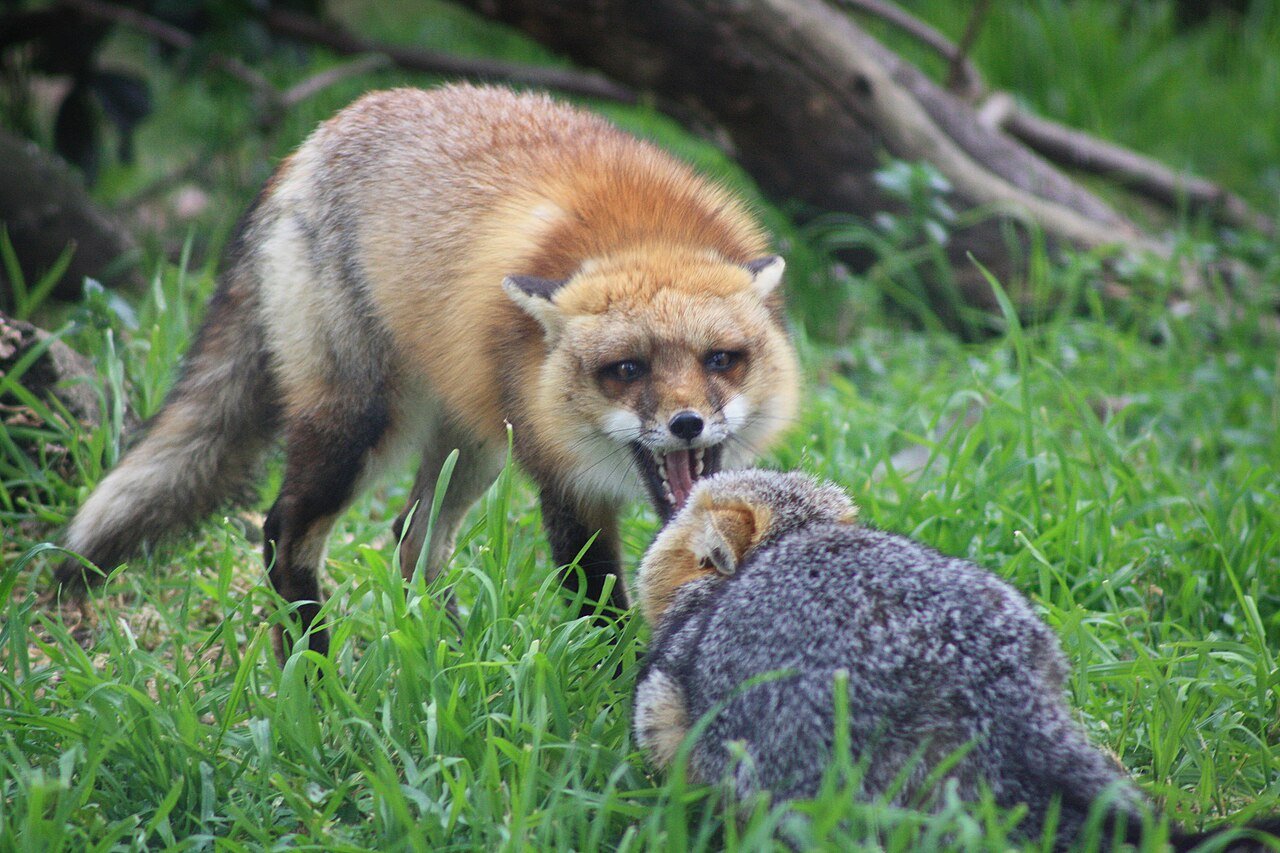
A coyote (Canis latrans) is much bigger than a fox: a typical Yellowstone coyote weighs 11 to 16 kg (25 to 35 lb), about two to three times as much as a red fox. Red foxes have black “stockings” on their legs and a white tail tip. Gray foxes are grizzled gray with a black-tipped tail and can climb trees. Coyotes kill foxes, but the two cannot interbreed. Here is how to tell all three apart.
Key takeaways
- Size: coyotes weigh about 7–21 kg (15–46 lb); red foxes 3–14 kg (7–31 lb); gray foxes usually 3–5 kg (7–11 lb).
- Tail tip: white on a red fox; black on a gray fox and usually black on a coyote.
- Legs: red foxes have black legs and feet; a coyote’s front legs are whitish.
- Rivals, not relatives: coyotes kill foxes, and they belong to a different genus, so they cannot breed together.
- Status: all three are listed as Least Concern on the IUCN Red List.
The 3-second ID
1. Check the tail tip. White? Red fox. Black? Gray fox or coyote.
2. Check the legs. Black “stockings” below a rusty-red body? Red fox. Pale front legs on a long-legged, gray-tan animal the size of a medium dog? Coyote.
3. Check where it went. Up a tree? Gray fox. It is the canid that readily climbs.
What is the difference between a coyote and a fox?
A coyote is a medium-sized wild dog in the same genus as wolves and domestic dogs, Canis. “Fox” covers several smaller canids in other genera; in North America the two you are most likely to see are the red fox (Vulpes vulpes) and the gray fox (Urocyon cinereoargenteus). Coyotes are bigger and longer-legged, and they howl; foxes are smaller, and they bark and scream.
| Feature | Coyote | Red fox | Gray fox |
|---|---|---|---|
| Scientific name | Canis latrans | Vulpes vulpes | Urocyon cinereoargenteus |
| Weight | 7–21 kg (15–46 lb) [1]; 11–16 kg (25–35 lb) in Yellowstone [4] | 3–14 kg (7–31 lb) [2]; males 5–5.4 kg (11–12 lb) in Yellowstone [5] | 2–9 kg (4–20 lb), usually 3–5 kg (7–11 lb) [3] |
| Shoulder height | 41–51 cm (16–20 in) [4] | Smaller; no reliable range found | Smaller; no reliable range found |
| Coat | Light gray or dull yellow, hairs tipped with black [6] | Reddish yellow above, whitish cheeks, throat and belly [7] | Grizzled gray, coarser fur [8] |
| Tail tip | Usually black [6] | White, in every color phase [7] | Black, with a black stripe along the top [3][8] |
| Legs | Front legs whitish [6] | Legs and feet black [7] | No black stockings |
| Backs of ears | Reddish [6] | Blackish [7] | Not used for ID here |
| Climbs trees? | No | No | Yes, readily [8] |
| Main calls | Barks, yips and howls, often in choruses [6] | Barks; females give a shrill scream-like call [7] | Barks [8] |
| Top speed | About 65 km/h (40 mph) [1]; up to 72 km/h (45 mph) according to the National Park Service [9] | About 48 km/h (30 mph) [2] | Not measured |
| Estimated canine bite force | 275 N [10] | 164 N [10] | 114 N [10] |
| Range | Panama to Alaska and most of Canada [1] | Widest distribution of any canid [2] | Southern Canada to Venezuela and Colombia [3] |
| IUCN status | Least Concern (2018 assessment) [11] | Least Concern (2016 assessment, amended 2021) [11] | Least Concern (2016 assessment) [11] |
Numbers in brackets match the numbered sources at the end of this page. “No” for tree climbing reflects the sources’ description of the gray fox as the climber of the group. The table is our own compilation; teachers and writers are welcome to reuse it with the credit “Source: Zooologist.com, coyote vs fox ID table” and a link to this page.
Which is bigger, a coyote or a fox?
The coyote, by a lot. In Yellowstone, coyotes weigh 11 to 16 kg (25 to 35 lb) and stand 41 to 51 cm (16 to 20 in) at the shoulder, while adult male red foxes there weigh only about 5 to 5.4 kg (11 to 12 lb). So one coyote weighs as much as two or three red foxes [4][5].
Picture it: weight on the scales
Coyote (Yellowstone): 11–16 kg
Red fox (Yellowstone male): about 5–5.4 kg
Gray fox (typical): 3–5 kg
Bars are drawn to scale against 16 kg; the paler end of each bar shows the range. Working: 11 ÷ 5.4 ≈ 2.0 and 16 ÷ 5 ≈ 3.2, so a coyote weighs about two to three red foxes. Sources: NPS Yellowstone [4][5]; Animal Diversity Web [3].
Size varies a lot from place to place. Missouri’s coyotes seldom exceed 14 kg (30 lb) [6], while Animal Diversity Web gives a range of 7 to 21 kg (15 to 46 lb) across the species [1]. Foxes vary too, but even a big red fox rarely overlaps with a typical coyote. Size also buys speed: see how fast a coyote can run.
How do you tell a red fox, a gray fox and a coyote apart?
Use the tail tip and the legs first. A red fox has a white-tipped tail and black legs and feet. A gray fox is grizzled gray with a black-tipped tail that has a black stripe along the top. A coyote is bigger and grayish-tan, with whitish front legs and usually a black tail tip [3][6][7].
Color alone can fool you. Red foxes come in other color phases, such as the “cross fox” with a dark band across the shoulders, but every phase keeps the white tail tip, says the Missouri Department of Conservation [7]. Animal Diversity Web estimates about a quarter of red foxes are cross foxes and about a tenth are silver [2]. Those big ears, the bushy tail and the famous mousing pounce are explained in red fox adaptations.
Spot the difference: test your eye
A dark, almost black fox crosses a field. Its tail has a white tip. Which fox?
A red fox in a dark color phase. All red fox color phases keep the white tail tip [7].
A small gray canid is sitting on a tree branch 3 m off the ground. What is it?
A gray fox. Gray foxes readily climb trees, gripping the trunk with their front feet and pushing with their back feet [8]. Their dens have been found up to 10 m above the ground [3].
A long-legged animal the size of a medium dog, gray-tan, with a black tail tip, is trotting in a straight line across a meadow. Fox or coyote?
A coyote. It is far bigger than either fox, and coyotes tend to travel in straight lines rather than meandering like many dogs [6].
The fox’s tail looks triangular when you see it end-on, not round. Red or gray?
Gray. A gray fox’s tail is triangular in cross section; a red fox’s is round [7][8].
How do coyote and fox tracks compare?
Coyote tracks are bigger. National Park Service measurements give coyote front tracks of about 5.4–7.9 cm (2⅛–3⅛ in) long, while Cascade red fox front tracks measure about 4.7–6.2 cm (1⅞–2½ in) [13]. Missouri’s guides give about 6.4 cm (2½ in) for a coyote front track, 5.1–5.7 cm (2–2¼ in) for a red fox and about 5.1 cm (2 in) for a gray fox [6][7][8].
Coyote front track: 5.4–7.9 cm
Red fox front track: 4.7–6.2 cm
Gray fox front track: about 5.1 cm
Scale: 0 to 7.9 cm. The ranges overlap, so size alone is not proof. Sources: NPS [13]; Missouri Department of Conservation [8].
Because the ranges overlap, look at other clues too. Red foxes have fur-lined feet that can blur their prints, especially in winter [13]. A gray fox’s prints show claw marks, unlike a cat’s [8]. A walking coyote often places its hind feet in its front prints, leaving a neat line with prints about 46–56 cm (18–22 in) apart [6].
Do coyotes kill foxes?
Yes. Coyotes kill foxes, and scientists call this intraguild predation: one predator killing another that competes with it for food. Yellowstone National Park lists coyotes among the killers of red foxes [5], and Animal Diversity Web lists coyotes among gray fox predators, noting that in the southern US gray fox numbers depend heavily on coyote numbers [3].
Foxes cope by keeping out of the way. In Yellowstone, red foxes prefer forest while coyotes use sagebrush and open meadows, and in winter the two species are most active at opposite times of day [5]. A 30-year study in Minnesota found the effect at landscape scale: where wolves held coyote numbers down, foxes became more common [14].
Can coyotes and foxes interbreed?
No. Coyotes belong to the genus Canis, while red foxes belong to Vulpes and gray foxes to Urocyon. A genus is a group of closely related species, and these lines are far apart. Their chromosomes are very different too: dogs and gray wolves have 78, red foxes just 34 plus a few small extra ones [15], and gray foxes more than 64 [16].
Coyotes can, however, breed with their close relatives. They hybridize with domestic dogs and occasionally with gray wolves [1], and hybridization with wolves and dogs has been documented in the eastern part of their range [12]. That is where the idea of “coydogs” and “coywolves” comes from. A “coyfox” is not supported by any evidence we found.
What sounds do coyotes and foxes make?
Coyotes are the singers. They bark, yip, growl and whimper, and their calls often rise into a long, flat howl. Groups howl together in choruses that can carry 3 to 5 km (2 to 3 miles), mostly between sunset and sunrise [6]. Yellowstone calls them “song dogs” [4].
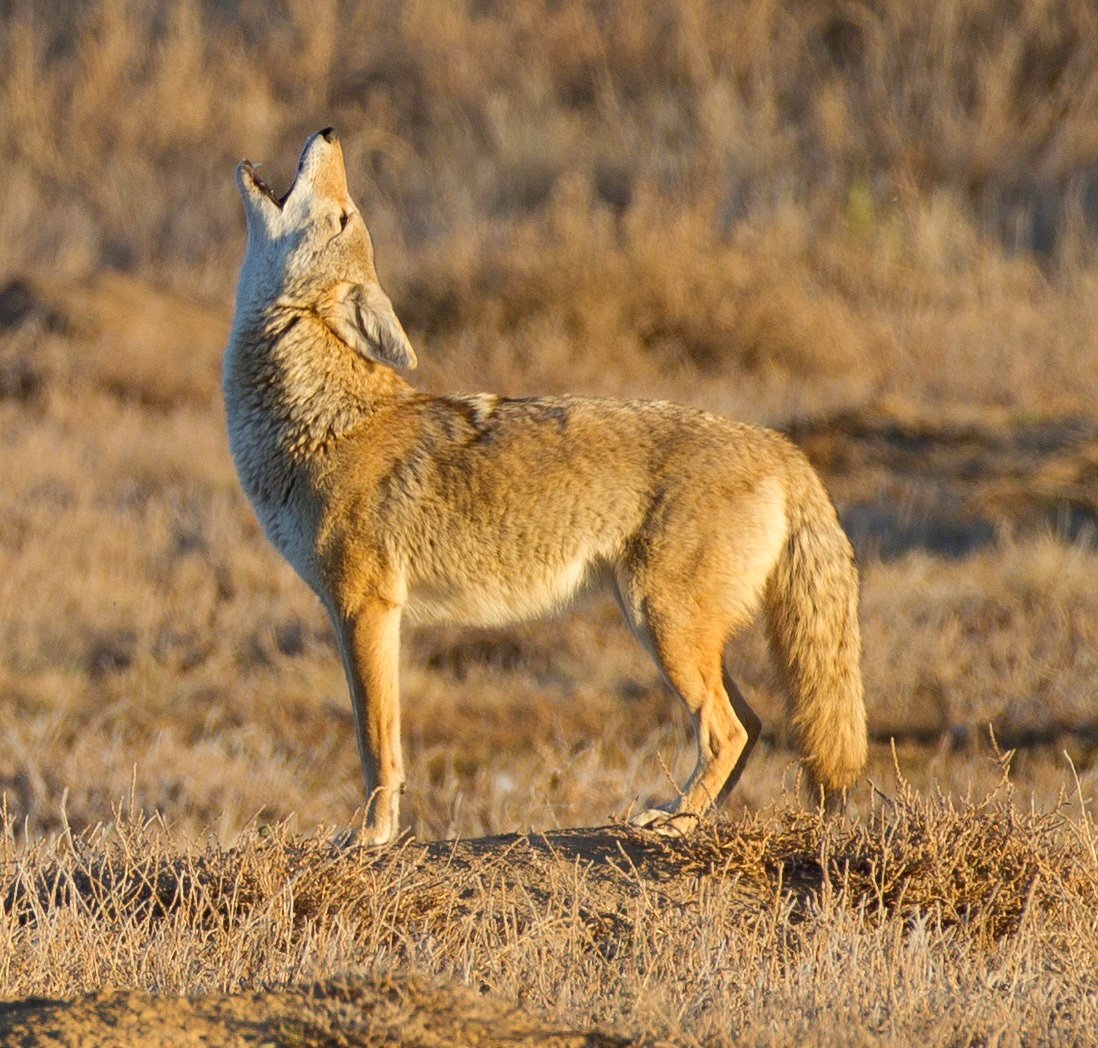
Foxes bark and scream rather than howl. Red foxes “bark; rarely howl or sing”, says Yellowstone [5]. In the breeding season, female red foxes give a shrill squall and males answer with two or three short barks [7]. Researchers have described 28 different kinds of red fox call [2]. If you hear what sounds like a person screaming in the woods on a winter night, it may well be a fox.
Which is more dangerous to pets and people, a coyote or a fox?
The coyote, though attacks on people are rare. Only two fatal coyote attacks on people have been recorded in North America: a 3-year-old girl in Glendale, California, in 1981, and a 19-year-old hiker in Cape Breton, Nova Scotia, in 2009 [17][18]. Most problems start when coyotes lose their fear of people, often because they are fed [4][19].
Pets are at greater risk. In one Californian case study, a resident had lost a small dog to a coyote and three or four neighborhood cats had been taken [19]. Foxes are much smaller and pose less danger to people, but along with bats, skunks and raccoons they are among the animals most often found with rabies in the US, says the CDC [20]. Red foxes also take poultry where they can [7].
To stay safe: never feed coyotes or foxes, keep a close eye on cats and small dogs where coyotes live, give chickens an enclosed run, and make sure pets are vaccinated against rabies [4][6][7][20]. Coyotes that stay wary of people cause fewer problems, which is why Yellowstone staff scare bold coyotes away with noise-making shells and other deterrents [4].
Do coyotes and foxes live in cities?
Yes, both do. Coyotes have spread across much of North America since about 1900, moving into forests, farmland and cities, helped by forest fragmentation and the loss of larger predators such as wolves [12]. Red foxes live in towns too [21], and they can become used to people, usually because someone feeds them [5].
In the city, they share space by splitting it up. A study that radio-collared 11 coyotes and 12 red foxes in Madison, Wisconsin, found that coyotes chose home ranges with lots of natural areas, while red foxes chose open spaces and moderately built-up areas. Both were active at similar times of day, but their habitat split may help them live side by side [21].
Hidden gems
- The tree-climbing dog. Gray fox dens have been found 10 m (33 ft) up in trees [3].
- Fruit lovers. In spring, fruit can make up 70% of a gray fox’s diet [3].
- Bite for size. In a skull-based study, the red fox’s bite force for its size was slightly higher than the coyote’s, with bite force quotients of 92 and 88 [10].
- Wolves help foxes. By keeping coyotes in check, returning wolves can indirectly help foxes [14].
What roles do coyotes and foxes play in their ecosystems?
Both are mid-sized predators and scavengers that keep small mammals in check. Rabbits and mice make up most of a coyote’s diet in Missouri, along with fruit such as persimmons and carrion [6]. Red foxes eat mostly rabbits, mice and rats, plus birds, insects and some fruit [7], and gray foxes eat a lot of fruit: up to 70% of their diet in spring [3].
They are linked in a chain. Gray wolves kill coyotes: after wolves returned to Yellowstone, coyote numbers fell by as much as 50% [4]. Coyotes in turn kill foxes [5], and golden eagles, great horned owls and bobcats also prey on gray foxes [3]. Learn more in what eats a coyote and wolf adaptations.
What happens when one link changes? The Minnesota study shows the ripple. Where wolves are present, they suppress coyotes, which releases foxes from coyote control. Where wolves are gone, coyotes become the top predator and suppress small carnivores such as foxes and house cats, which in turn has been shown to increase songbird and rodent numbers [14].
Myths about coyotes and foxes
Myth: Coyotes and foxes can breed and make “coyfoxes”.
Fact: They belong to different genera with very different chromosome sets, and no such hybrid has been documented [1][15][16]. Why people believe it: coyotes really do hybridize with dogs and wolves, so “coydog” and “coywolf” are real ideas that get stretched to foxes [12].
Myth: A fox or coyote seen in daylight must be sick or rabid.
Fact: Red foxes are mainly nocturnal but may come out during the day, especially at dawn and dusk [7]. Watch for strange behavior instead, and keep your distance from any wild animal [20]. Why people believe it: foxes are among the animals most often found with rabies [20], so any daytime sighting can seem alarming.
Myth: Coyotes only howl at night, at the moon.
Fact: Most howling happens between sunset and sunrise, but coyotes also howl in the daytime, for example in answer to a siren or a whistle [6]. Why people believe it: night choruses are the ones people notice, and the “howling at the moon” image is a cartoon favorite.
Test yourself
1. A fox has a white tip on its tail. Which fox is it?
A red fox. Gray foxes have black tail tips.
2. Which North American canid readily climbs trees?
The gray fox.
3. Why can’t a coyote and a red fox have pups together?
They are in different genera, Canis and Vulpes, with very different chromosome numbers.
The next time a bushy-tailed shape crosses your path at dusk, look for the tail tip before it vanishes. Whatever you saw, you shared your street with a wild predator that has learned to live alongside people, and that works best for both sides when we keep them wild. Explore more mammals in our animal guides.
Where to next?
➡️ Go wider: how fast a coyote can run⬆️ Go deeper: how a red fox’s ears, tail and pounce work🔀 Go sideways: the Arctic fox, built for the far north
Frequently asked questions
Is a coyote a fox?
No. A coyote is a wild dog in the genus Canis, the same genus as wolves and domestic dogs. Foxes belong to other genera, such as Vulpes for the red fox and Urocyon for the gray fox. Coyotes are bigger, howl in groups and are close enough to dogs and wolves to hybridize with them.
What is the easiest way to tell a coyote from a fox?
Size and the tail tip. A coyote is about the size of a medium dog, two to three times heavier than a red fox. A red fox has a white tail tip and black legs. A gray fox has a black tail tip and a grizzled gray coat, and it can climb trees.
Are foxes afraid of coyotes?
They have good reason to be. Coyotes kill foxes, and in Yellowstone red foxes use forests while coyotes use open meadows, with the two species active at opposite times of day in winter. In a Minnesota study, fox numbers rose where wolves kept coyotes down.
How fast can a fox run compared with a coyote?
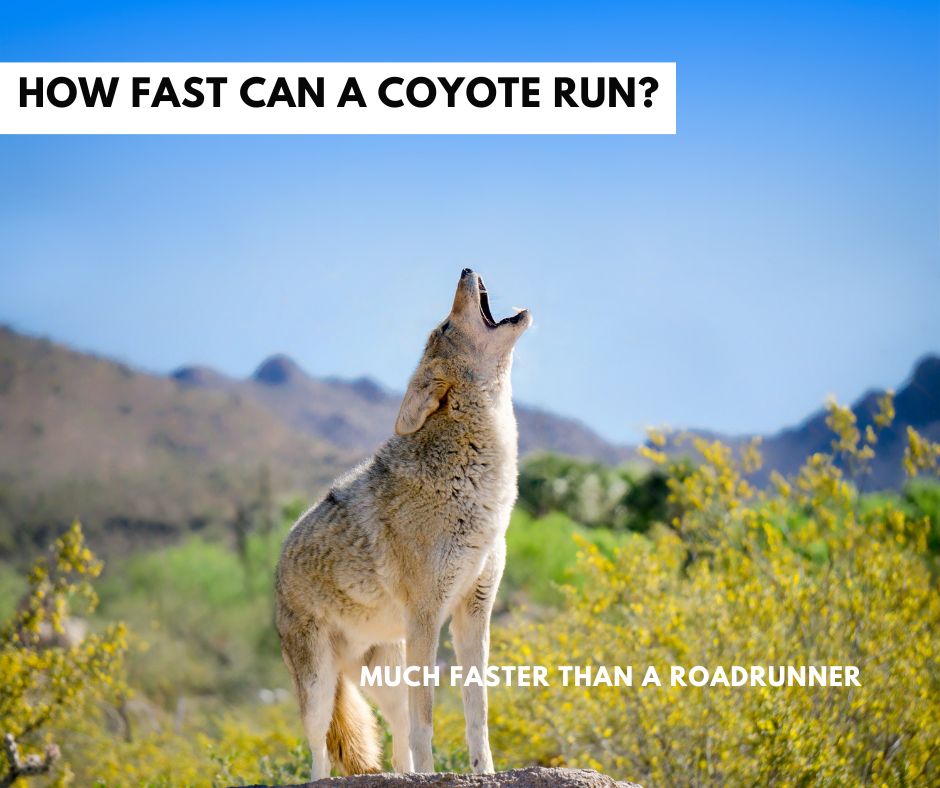
A red fox can run at about 48 km/h (30 mph), according to Animal Diversity Web. Coyotes are faster, at about 65 km/h (40 mph), with some National Park Service estimates up to 72 km/h (45 mph). These are estimates rather than careful measurements.
Do arctic and fennec foxes look like coyotes?
Not really. Both are small Vulpes foxes adapted to extreme places: the Arctic fox to the cold, the fennec fox to the desert, with its huge ears. Read about fennec fox adaptations and Arctic fox adaptations.
Sources
- Animal Diversity Web, University of Michigan. Canis latrans (coyote).
- Animal Diversity Web, University of Michigan. Vulpes vulpes (red fox).
- Animal Diversity Web, University of Michigan. Urocyon cinereoargenteus (gray fox).
- National Park Service, Yellowstone. Coyote.
- National Park Service, Yellowstone. Red fox.
- Missouri Department of Conservation. Coyote field guide.
- Missouri Department of Conservation. Red fox field guide.
- Missouri Department of Conservation. Gray fox field guide.
- National Park Service. Coyotes.
- Wroe, S., McHenry, C. and Thomason, J. (2005). Bite club: comparative bite force in big biting mammals and the prediction of predatory behaviour in fossil taxa. Proceedings of the Royal Society B 272: 619–625.
- IUCN Red List of Threatened Species: Canis latrans (Kays, R., 2018 assessment, errata 2020); Vulpes vulpes (Hoffmann, M. & Sillero-Zubiri, C., 2021, amended version of 2016 assessment); Urocyon cinereoargenteus (Roemer, G., Cypher, B. & List, R., 2016 assessment).
- Hody, J.W. and Kays, R. (2018). Mapping the expansion of coyotes (Canis latrans) across North and Central America. ZooKeys 759: 81–97.
- National Park Service, Mount Rainier National Park. Carnivore tracking in Washington’s national parks (PDF).
- Levi, T. and Wilmers, C.C. (2012). Wolves–coyotes–foxes: a cascade among carnivores. Ecology 93: 921–929.
- Vozdova, M. et al. (2019). Comparative study of the bush dog (Speothos venaticus) karyotype and analysis of satellite DNA sequences and their chromosome distribution in six species of Canidae. Cytogenetic and Genome Research 159: 88–96.
- Wayne, R.K., Nash, W.G. and O’Brien, S.J. (1987). Chromosomal evolution of the Canidae. I. Species with high diploid numbers. Cytogenetics and Cell Genetics 44: 123–133.
- Wood, M.J., Peckmann, T.R. and Pringle, A.M. (2012). Patterns of injury in fatal coyote attack: a case study from Nova Scotia, Canada. Proceedings of the American Academy of Forensic Sciences.
- Urban Coyote Research Project. Coyotes around the continent: Cape Breton.
- Baker, R.O. and Timm, R.M. (1998). Management of conflicts between urban coyotes and humans in southern California. Proceedings of the Vertebrate Pest Conference 18.
- Centers for Disease Control and Prevention. About rabies.
- Mueller, M.A., Drake, D. and Allen, M.L. (2018). Coexistence of coyotes (Canis latrans) and red foxes (Vulpes vulpes) in an urban landscape. PLoS ONE 13: e0190971.
Sources checked 14 October 2026.
Keep the conversation curious