
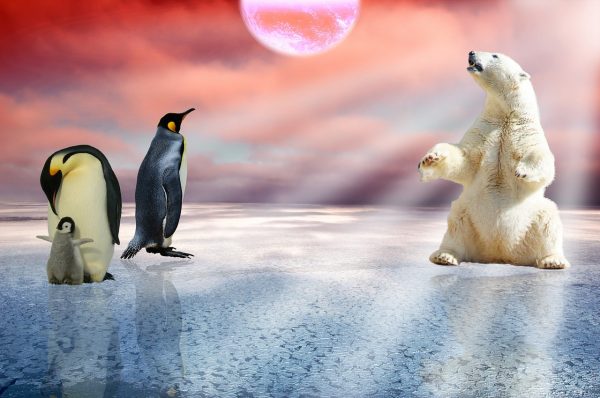
On a Christmas card, a polar bear and a penguin share an ice floe under the northern lights. It is a lovely picture. It is also impossible: in the wild, these two animals live at opposite ends of the Earth.
No, polar bears do not eat penguins. Polar bears live only in the Arctic, around the North Pole, while wild penguins live in the Southern Hemisphere, mostly around Antarctica. The two are separated by roughly 20,000 km (12,400 miles) of land, warm ocean and tropics, so they never meet in the wild. A polar bear’s real prey is seals.
Key takeaways
- Opposite poles: polar bears live in the Arctic (Canada, Greenland, Norway, Russia and the US); penguins live south of the equator.
- Seal hunters: polar bears prey mainly on ringed seals, with bearded seals as a lesser prey (US Fish and Wildlife Service).
- The closest call: the Galápagos penguin is the most northerly penguin, but it lives on the equator, still thousands of kilometres from any polar bear.

Why don’t polar bears eat penguins?
Because they never meet. Polar bears live in Arctic and sub-Arctic seas of Canada, Greenland, Norway, Russia and the United States, says the US Fish and Wildlife Service. Penguins live in the Southern Hemisphere. No wild penguin lives anywhere near the Arctic, so no polar bear has ever had the chance to hunt one in the wild.
As glaciologist Bethan Davies puts it on AntarcticGlaciers.org, polar bears live in the Northern Hemisphere and penguins in the Southern Hemisphere. That is the whole answer in one sentence. The more interesting question is why each animal stays on its own side of the planet.
How far apart do polar bears and penguins live?
About as far apart as two animals can be on Earth. The North Pole and the South Pole are roughly 20,000 km (12,400 miles) apart, measured along the surface. Polar bears live in the far north and most penguins in the far south, so the gap between them is most of that distance, with the warm tropics in between.
Picture it: from pole to pole
Walk from the North Pole to the South Pole at a steady 5 km/h for 8 hours a day, and you would need about 500 days, nearly a year and a half. (Working: half of Earth’s pole-to-pole circumference is about 20,000 km; 20,000 ÷ 40 km a day = 500 days.)
The closest the two groups come is at the equator. The Galápagos penguin is the most northerly penguin species in the world, says the Galapagos Conservation Trust. It lives on islands such as Isabela, which sits astride the equator at the end of the cold, food-rich Humboldt Current. Even so, the nearest polar bears are thousands of kilometres farther north.
What do polar bears eat instead?
Seals, mostly. Polar bears prey heavily on ringed seals, with bearded seals as a lesser prey, and occasionally take walruses and belugas, says the US Fish and Wildlife Service. One ringed seal can give a polar bear about 11 days’ worth of energy, according to San Diego Zoo Wildlife Alliance.

Polar bears also eat whale carcasses, caribou, grass and seaweed, but San Diego Zoo Wildlife Alliance says these foods don’t give them enough reliable nutrition. Fatty seals are what keep them going. See what polar bears eat for the full menu.
As top predators of the Arctic marine ecosystem, polar bears help keep seal numbers in check, and Arctic foxes follow polar bears across the sea ice to scavenge the leftovers of their kills, says SeaWorld. Read more on whether polar bears eat Arctic foxes.
What eats penguins, if not polar bears?
In the Southern Hemisphere, penguins have their own hunters. At sea, leopard seals, fur seals, sea lions, sharks and killer whales catch them, while in Antarctic and subantarctic colonies skuas, sheathbills and giant petrels take eggs and chicks, says SeaWorld. Our page on what eats penguins covers each one.
Would a polar bear eat a penguin if it could?
Probably, yes, though it has never happened in the wild. Polar bears are hungry, opportunistic hunters that will try many foods when seals are scarce, so a penguin on the ice would very likely be seen as a meal. But this is a guess about an imaginary meeting, not something anyone has observed.
Putting the two together to find out would be cruel and pointless. Zoos keep them in separate habitats, and that is how it should stay.

Myth vs fact
Myth: Polar bears and penguins live together at the North Pole.
Fact: Polar bears live only in the Arctic and wild penguins only south of (or right on) the equator. Why people believe it: cartoons, adverts and holiday cards often put “cold animals” together in one snowy scene.
Myth: There are penguins in the Arctic.
Fact: There are none. The Arctic did once have a flightless black-and-white seabird, the great auk (Pinguinus impennis), but it was related to puffins, not penguins, and was hunted to extinction by the mid-1800s, says the Biodiversity Heritage Library. Why people believe it: the great auk looked like a penguin, and its scientific name even sounds like one.
Myth: Polar bears live in Antarctica.
Fact: No bears of any kind live in Antarctica. Polar bears are found in five Arctic countries: Canada, Greenland (Denmark), Norway, Russia and the United States. Why people believe it: both poles are icy, so people assume they share the same animals.
Test yourself
1. Which seal do polar bears hunt most?
The ringed seal.
2. Which is the most northerly penguin in the world?
The Galápagos penguin, which lives on the equator.
3. The great auk looked like a penguin. Which living bird was it actually related to?
The puffin.
Where to next?
➡️ Go wider: where polar bears live, country by country⬆️ Go deeper: how penguins are built for cold seas🔀 Go sideways: does anything eat polar bears?
Frequently asked questions
Have polar bears and penguins ever met?
Not in the wild. Polar bears live only in the Arctic, and wild penguins live in the Southern Hemisphere or on the equator. There is no natural place where their ranges overlap, so a wild polar bear has never had the chance to meet, chase or eat a penguin.
Do polar bears live in Antarctica?
No. Polar bears live only in the Arctic and sub-Arctic, in Canada, Greenland, Norway, Russia and the United States, says the US Fish and Wildlife Service. Antarctica has no bears at all. There, penguins are hunted at sea by leopard seals and killer whales instead.
Are polar bears endangered?
Polar bears are listed as Vulnerable on the IUCN Red List, a status confirmed in the 2015 assessment, says the IUCN Polar Bear Specialist Group. About 26,000 live in 19 subpopulations, according to the US Fish and Wildlife Service. Loss of sea ice is the main threat.
Are there any penguins in the Northern Hemisphere?
Only at the very edge. Isabela Island in the Galápagos sits astride the equator, and the Galápagos penguin, the most northerly penguin species, lives there. All other wild penguins live in the Southern Hemisphere.
Sources
- US Fish and Wildlife Service. Polar bear (Ursus maritimus).
- San Diego Zoo Wildlife Alliance. Polar bear.
- Davies, B. (2013). Do polar bears eat penguins? AntarcticGlaciers.org.
- Galapagos Conservation Trust. Isabela.
- Biodiversity Heritage Library / Smithsonian Libraries (2014). Once there were billions: the great auk.
- IUCN SSC Polar Bear Specialist Group. IUCN Red List (on Wiig et al. 2015, doi:10.2305/IUCN.UK.2015-4.RLTS.T22823A14871490.en).
- SeaWorld Parks. All about penguins: longevity and causes of death.
- SeaWorld Parks. Arctic fox facts.
Sources checked 12 October 2026.

Keep the conversation curious