
Almost nothing eats adult polar bears. Polar Bears International says their only predators are humans and, on rare occasions, other polar bears. Cubs face more danger: adult males sometimes kill them, and wolves have been recorded taking one. Killer whales, walruses and Greenland sharks are often named online, but none of them regularly hunts polar bears.
Do polar bears have any natural predators?
Not really. Adult males normally weigh 350 to more than 600 kg (775 to more than 1,300 lb), says the Polar Bears International FAQ. Very few animals could take on something that big. You can see all the numbers on our page about how big a polar bear is.
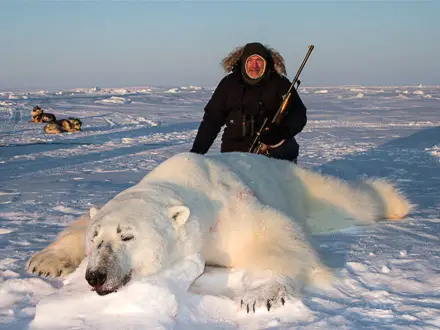
The Alaska Department of Fish and Game lists just two predators of polar bears: male polar bears and Alaska Native hunters. So the honest answer to “what eats polar bears?” is a short list. It is people, plus other polar bears.
That does not mean polar bears live without danger. Cubs are small and easy to catch. Adults can be hurt by the big animals they try to hunt. The table sorts the animals people ask about by how much danger each one really poses.
| Animal | Kills adult bears? | Kills cubs? | What the evidence says |
|---|---|---|---|
| Humans | Yes | Yes | Hunting is legal but managed in most places (ADFG, IUCN PBSG) |
| Other polar bears | Sometimes | Yes | Adult males sometimes kill and eat cubs (Polar Bears International) |
| Wolves | No known case | Very rarely | A 2004 cub kill was only the second case ever documented (Arctic journal, 2006) |
| Walrus | Can hurt a bear that attacks it | No | Tusks and thick skulls make walruses risky prey (Polar Bears International) |
| Killer whale (orca) | No documented case | No documented case | Orcas are spending longer in the Arctic, but no bear kills are recorded |
| Greenland shark | Unknown | Unknown | Polar bear remains found in a few shark stomachs; hunted or scavenged is unknown |
Other polar bears: the main natural threat
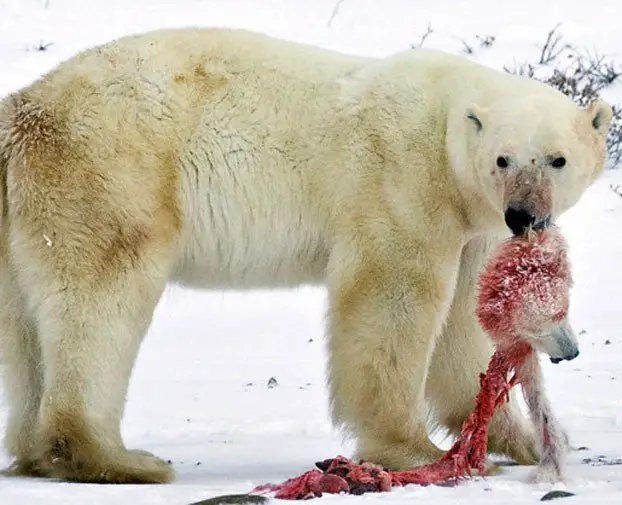
The animal most likely to kill a polar bear is another polar bear. Adult males sometimes kill cubs, and they sometimes eat them, though not always. Biologist Andrew Derocher explains this in a 2025 article for Polar Bears International. Mothers with cubs usually stay well away from adult males for exactly this reason.
Why do males do it? Nobody is completely sure. Derocher lists three ideas: the male gets a meal, he removes cubs that would compete with his own young, or the mother becomes ready to mate again sooner.
Bears eating other bears has always been a rare, natural event. Some scientists think it may be getting more common because bears now go hungry for longer, according to the Polar Bears International FAQ. When the sea ice melts, bears lose the platform they use to hunt seals. Our guide to what polar bears eat explains why seals matter so much.
What eats polar bear cubs?
Cubs are the easy targets. They stay with their mother for about two and a half years, says the Alaska Department of Fish and Game. For that whole time she is their only protection. Their main dangers are these:
- Adult male polar bears. This is the best-known natural threat, as described above.
- Wolves. On 20 April 2004, scientists in a helicopter followed the tracks of a mother bear and two cubs on the sea ice off Banks Island, Canada. Wolf tracks joined them. The team landed and found the remains of a cub that the wolves had split from its mother and killed. It was only the second documented case of wolves killing a polar bear (Richardson and Andriashek, 2006).
- Long swims and hunger. A US Geological Survey study tracked mother bears from 2004 to 2009. Five of the 11 mothers that set off on long swims with cubs lost their young, reports National Geographic.
Arctic foxes are much too small to threaten a cub that is guarded by its mother. For the other side of that story, read do polar bears eat Arctic foxes. Once a cub grows up, its list of enemies shrinks to people and other bears.
Do killer whales eat polar bears?
There is no scientific record of it. We could not find a single documented case of a killer whale (orca) killing or eating a polar bear in the studies and wildlife agency pages we checked. You will find stories and “who would win” videos online, but not proof.
Part of the reason is simple geography. Polar bears live on the sea ice. Killer whales need open water, because they must come up to breathe. For a long time, thick ice kept orcas out of much of the polar bear’s range.
That is changing. Four underwater microphones in the Bering, Chukchi and Beaufort seas picked up killer whales spending longer in the Arctic between 2012 and 2019, reports the University of Washington. The change followed the loss of sea ice. In Canada, government scientist Steve Ferguson told Yale Environment 360 that orcas have become a top predator there, alongside the polar bear.
So could an orca catch a polar bear? In theory, yes, if the bear were swimming far from the ice. Polar bears are slow swimmers next to a whale; see how fast a polar bear can swim. But being able to catch something is not the same as hunting it. So far, Arctic orcas have been linked to attacks on whales and seals, not bears.
Would a polar bear beat a killer whale?
In the water, almost certainly not. The killer whale is the largest member of the dolphin family, and a big one is many times heavier than any bear. A polar bear’s best defence is to stay on the ice, where an orca cannot follow. On land and ice the bear is king. In deep water, the whale is.
Can a walrus kill a polar bear?
A walrus is dangerous prey rather than a predator. Polar bears do hunt walruses, but a walrus fights back. It has thick skin, a heavy skull and long tusks. Even a young walrus can take an adult male bear hours to kill, says Polar Bears International.
A 2021 study by Ian Stirling, Kristin Laidre and Erik Born looked at reports of bears hitting walruses on the head with rocks or blocks of ice. It happens rarely, but it shows how hard a walrus is to kill (PBI). A bear that is struck by a tusk can be badly hurt. Walruses never eat bears, though. They feed on the seafloor; see what walruses eat.
Do Greenland sharks eat polar bears?
Sometimes they eat polar bear, but nobody knows if they kill it. Greenland sharks are large sharks that live in cold Arctic water. In a 2019 study of Greenland shark stomachs, polar bear remains turned up in 1.3% of stomachs from sharks longer than 2 m (6.6 ft). The study was led by Julius Nielsen and published in Frontiers in Marine Science.
A shark could have found a bear that had already died and eaten the body. Until someone sees a shark attack a living bear, it is fairer to call the Greenland shark a possible scavenger of polar bears, not a predator.
Why are humans the biggest threat to polar bears?
People are the only animal that regularly kills adult polar bears. Today most hunting is managed. In Alaska, trophy hunting ended after the Marine Mammal Protection Act of 1972. Only Alaska Native people may now hunt polar bears, for food and clothing, says the Alaska Department of Fish and Game.
Other countries set their own rules. The IUCN Polar Bear Specialist Group tracks all 20 polar bear subpopulations. Its table notes that hunting has been banned in Russia since 1957. In Baffin Bay, shared by Canada and Greenland, there is a yearly quota; about 144 bears a year were taken on average over five years.
Some bears are also killed when they come too close to people and camps. If you ever visit polar bear country, follow official advice such as Parks Canada’s polar bear safety guide. Plan ahead, stay calm, back away quietly if the bear has not seen you, and carry a deterrent such as bear spray.
The bigger danger: melting sea ice
The largest threat is not a hunter at all. The IUCN lists the polar bear as Vulnerable, in an assessment from 2015. It names the loss of sea ice as the most serious threat across the bear’s whole range. The assessment found about a 71% chance that the world population would fall by more than 30% over three generations (IUCN Polar Bear Specialist Group).
Less ice means fewer seals caught, thinner bears and fewer cubs that survive. That is why hunger, not a hungry predator, is the real enemy. Read more in are polar bears endangered and where polar bears live.
Frequently asked questions
What is a polar bear's biggest enemy?
People, and in the long run, melting sea ice. Adult bears have almost no natural predators, and hunting is managed in most places. But the loss of sea ice cuts bears off from the seals they eat. That is the main reason the IUCN listed the polar bear as Vulnerable in its 2015 assessment.
Is the polar bear an apex predator?
Yes. Adult polar bears sit at the top of the Arctic food chain on the sea ice and land, and they eat mostly seals. At sea, killer whales share the top spot. The two rarely meet, because polar bears stay on or near the ice and orcas need open water.
Do polar bear mothers eat their own cubs?
This is often claimed online, but we could not find a well-documented case in the sources we checked. What is well recorded is that adult males sometimes kill cubs and sometimes eat them. Mothers usually keep away from adult males to protect their young, according to Polar Bears International.
Can a polar bear kill a killer whale?
Not realistically. A killer whale is the largest member of the dolphin family and is many times heavier than a polar bear. It also moves far faster in water. A bear's safest place is the sea ice, where an orca cannot reach it.
What should you do if you see a polar bear?
Stay calm and keep your group together. If the bear has not noticed you, back away quietly and do not run. Parks Canada advises carrying a deterrent such as bear spray and practising with it first. If a bear stalks or charges, stand your ground, make noise and be ready to fight back.
Sources
- Polar Bears International. Frequently asked questions.
- Polar Bears International (2025). Do polar bear fathers interact with their cubs? (Andrew Derocher).
- Alaska Department of Fish and Game. Polar bear species profile.
- Arctic (Arctic Institute of North America) (2006). Wolf (Canis lupus) predation of a polar bear (Ursus maritimus) cub on the sea ice off northwestern Banks Island (Richardson & Andriashek, Arctic 59(3), doi:10.14430/arctic318).
- Polar Bears International. Do polar bears invent tools? (on Stirling, Laidre & Born 2021, Arctic).
- University of Washington (2021). Killer whales spending more time in the Arctic as sea ice declines.
- Yale Environment 360. In Canada's High Arctic, killer whales are the new top predator.
- Frontiers in Marine Science (2019). Greenland shark (Somniosus microcephalus) stomach contents and stable isotope values reveal an ontogenetic dietary shift (Nielsen et al., doi:10.3389/fmars.2019.00125).
- IUCN SSC Polar Bear Specialist Group (2024). Population status and harvest table.
- IUCN SSC Polar Bear Specialist Group (2015). IUCN Red List: polar bear (Vulnerable).
- Parks Canada (Wapusk National Park). Polar bear safety: handling an encounter.
- National Geographic (2011). Longest polar bear swim recorded: 426 miles straight (on Durner et al. 2011).
Sources checked 15 September 2026.

Keep the conversation curious