
A tiger is strong enough to kill and drag prey five times its own weight, says National Geographic. Its canine bite is modelled at about 1,525 newtons, roughly 155 kg (343 lb) of force, in a 2005 skull study. Nobody has measured a live tiger’s bite.

How strong is a tiger’s bite?
Scientists estimate bite force from skulls. In the 2005 study, Wroe and colleagues measured dry skulls, worked out how big the jaw muscles were, and treated the jaw like a lever. Their tiger skull came from a cat of about 187 kg (412 lb). It gave a canine bite of 1,525 newtons. About 10 newtons equals the push of 1 kg.
| Animal | Bite force | About equal to | Bite force quotient | Method |
|---|---|---|---|---|
| Tiger | 1,525 N | 155 kg (343 lb) | 127 | Skull model (Wroe 2005) |
| Lion | 1,768 N | 180 kg (397 lb) | 112 | Skull model (Wroe 2005) |
| Jaguar | 1,014 N | 103 kg (228 lb) | 137 | Skull model (Wroe 2005) |
| Leopard | 467 N | 48 kg (105 lb) | 94 | Skull model (Wroe 2005) |
| Brown bear | 751 N | 77 kg (169 lb) | 78 | Skull model (Wroe 2005) |
| Lioness (front teeth) | 1,594 N | 163 kg (358 lb) | Not given | Measured (van der Meijden 2023) |
The bite force quotient, or BFQ, compares a bite with what you’d expect for the animal’s weight. An average score is 100. The tiger scores 127, so it bites harder than most mammals its size. The lion skull in the study bit harder overall, but it came from a much heavier lion.
Models can miss the real number. When scientists measured live bears in a 2023 study, spectacled bears bit far harder than models had predicted. So treat the tiger’s 1,525 newtons as a careful estimate. The real bite of a big male may be higher.

How much can a tiger drag or carry?
National Geographic says a tiger can kill and drag prey five times its weight. San Diego Zoo Wildlife Alliance says a tiger can carry something twice its own weight 3 m (10 ft) up a tree. These are expert descriptions, not lab tests. We found no study that put a tiger on a force meter.
The prey list shows the power. Tigers hunt deer and wild pigs, and sometimes gaur, a wild cattle that can weigh up to 1,500 kg (3,300 lb), says Panthera. A tiger usually kills large prey with a bite to the throat or neck, then pulls it into cover to eat. It may eat up to 34 kg (75 lb) in a night, says the Smithsonian.
How strong is a tiger swipe?
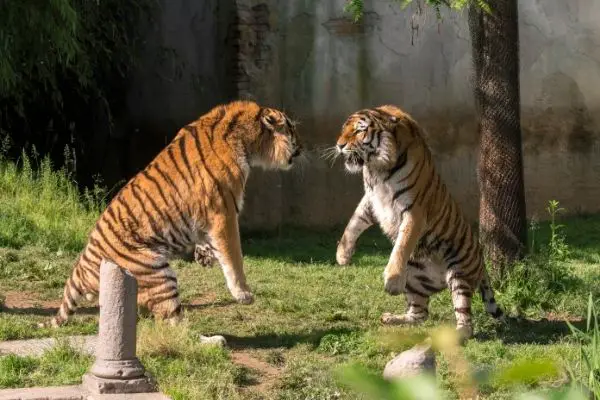
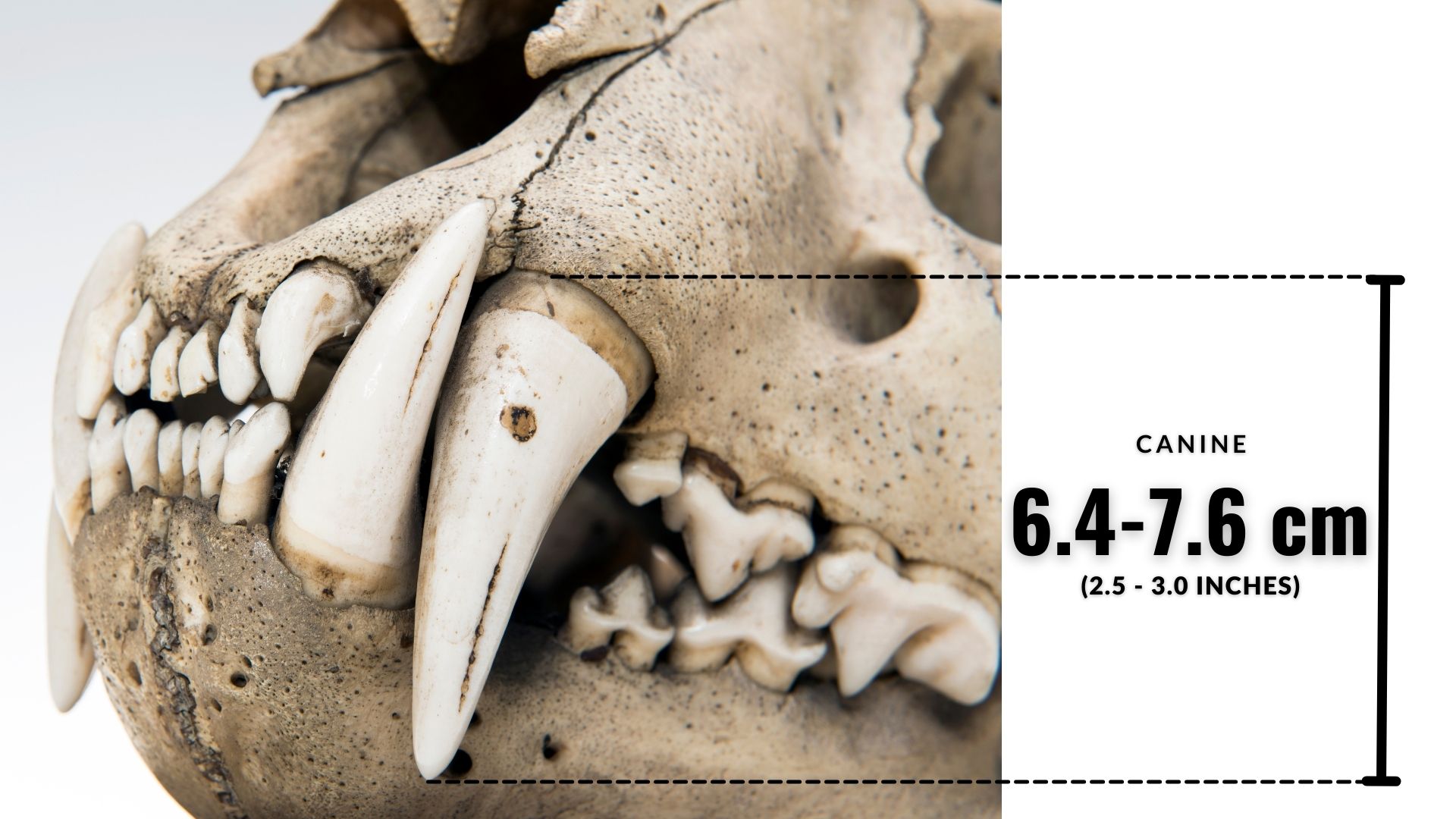
Nobody has measured it. You may read that a tiger swipe hits with 10,000 lb of force, or can break a bear’s skull. We found no study behind those claims. What we can measure is the tiger’s gear: claws up to 10 cm (4 in) long and canine teeth 6.4 to 7.6 cm (2.5 to 3 in) long, according to SeaWorld.
Tigers use their front legs to grab and pull prey off balance, not to punch it. The claws pull back into sheaths when not in use, so they stay sharp. A tiger’s forearms are thick and muscular, which is what you need to hold a struggling deer.

How fast and high can a tiger jump?
Tigers are built for power, not long runs. They can burst above 56 km/h (35 mph), says National Geographic. One tiger was filmed jumping about 4 m (13 ft) straight up from flat ground at a ranger riding an elephant. SeaWorld says tigers can leap up to 10 m (32.5 ft) forward.
Those powerful back legs are part of the tiger’s strength. They launch the ambush that ends most hunts. Our page on how fast a tiger is goes into speed in more detail.

Tigers are also strong swimmers. Panthera calls them powerful swimmers, and they often cool off in rivers and lakes. Few other big cats like water as much.
Are tigers the strongest big cats?
Tigers are the heaviest big cats on average. San Diego Zoo gives adult tigers 75 to 325 kg (165 to 716 lb), while male lions weigh 150 to 260 kg (330 to 570 lb). Weight is the best clue we have to overall strength, since bigger muscles pull harder.
But strength has more than one meaning. For its size, the jaguar has the strongest bite of the big cats. See how strong a jaguar is, how strong a lion is, and the head-to-head page on tiger vs lion.
How strong is a tiger compared to a human?
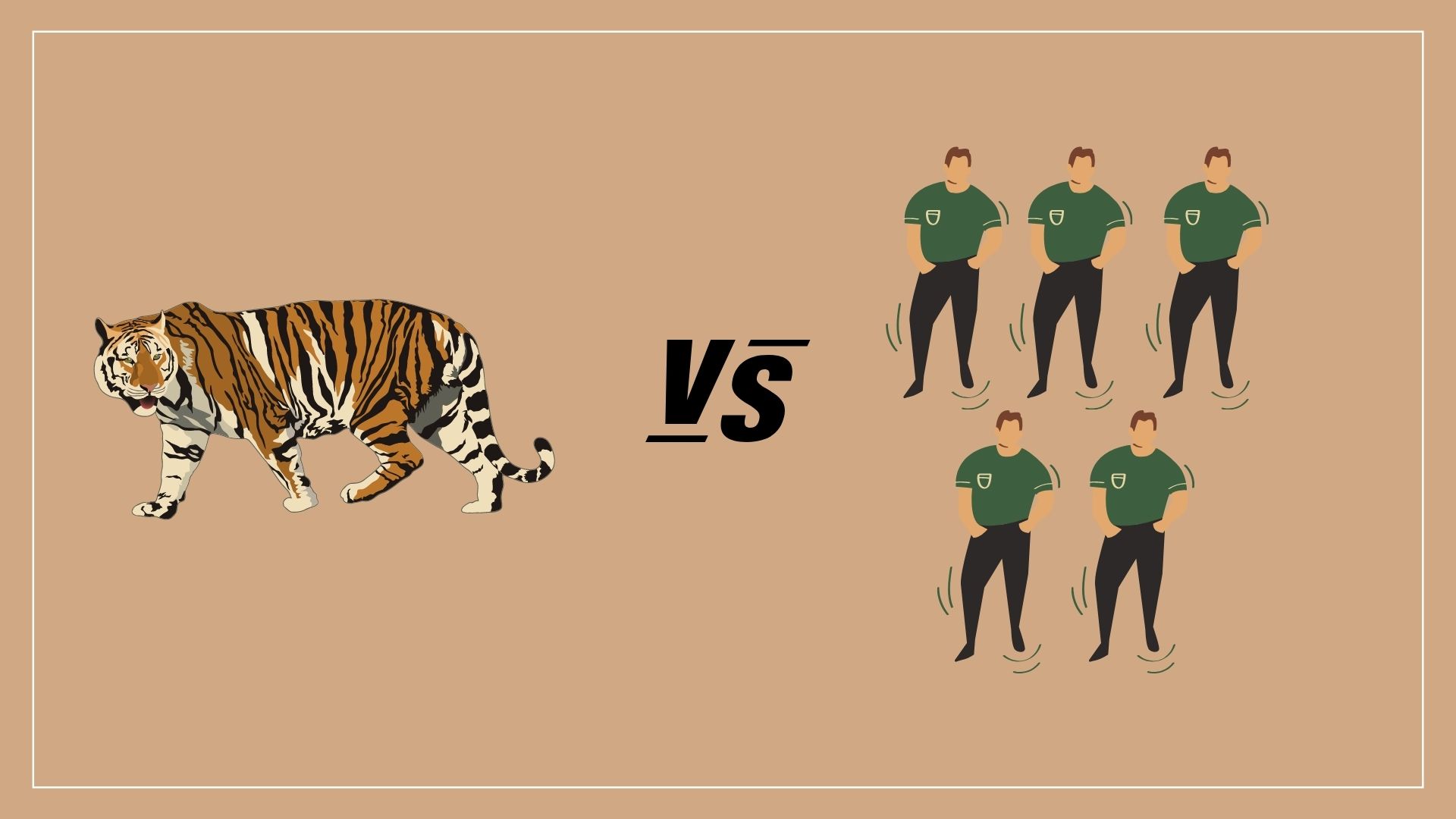
There is no fair test, so ignore claims like “a tiger is ten times stronger than a person”. What we can compare is size. A male Bengal tiger weighs about 220 kg (480 lb), SeaWorld says, which is about three adult men. It has 10 cm claws and 7 cm fangs. No person could win a fight with a tiger.
That is why tigers are dangerous in the places they live. People in tiger areas are advised to stay in groups and follow local forest rules. Tigers are listed as Endangered, with about 4,500 left in the wild, according to Panthera. The Smithsonian gives a slightly lower 3,900.

What makes a tiger so strong?
Three things. First, size: tigers are the heaviest cats. Second, build: short, thick front legs and big shoulders for grabbing prey. Third, the skull: a short, wide face gives the jaw muscles good leverage, which is why the tiger’s BFQ is high. Read more in adaptations of a tiger.
Quick facts: tiger strength
- Modelled canine bite: about 1,525 N, or 155 kg (343 lb) of force.
- Drags prey up to about five times its own weight.
- Claws up to 10 cm (4 in); canines 6.4 to 7.6 cm (2.5 to 3 in).
- Filmed jumping about 4 m (13 ft) high.
- Paw swipe strength: never measured.
Frequently asked questions
Can a tiger kill a bear?
Yes, sometimes. In Russia's Far East, Amur tigers share forests with brown bears and Asiatic black bears, and tigers are reported to kill bears there, mostly young ones. Adult bears can also fight back hard. See our tiger vs grizzly bear page for what is known.
How strong are a tiger's teeth?
A tiger's canine teeth are 6.4 to 7.6 cm (2.5 to 3 in) long, according to SeaWorld. They are the longest teeth of any living cat. The tiger's back teeth, called carnassials, work like scissors to slice meat and can crack bone, says National Geographic.
Can a tiger kill a gaur?
Yes. Tigers sometimes kill gaur, a wild cattle that can weigh up to 1,500 kg (3,300 lb), says Panthera. A tiger will usually pick a young, old or weak gaur. A healthy adult bull is risky prey, because it is several times heavier than the tiger.
Is a tiger stronger than a gorilla?
A tiger is much heavier than a gorilla and has long claws and fangs, so it would be far more dangerous in a fight. But gorillas and tigers don't live in the same places, and no one has compared their strength directly. Any claim with a number is guesswork.
Sources
- National Geographic. Tigers: can they survive?.
- Proceedings of the Royal Society B (author copy hosted by the University of Tennessee) (2005). Bite club: comparative bite force in big biting mammals and the prediction of predatory behaviour in fossil taxa (Wroe, McHenry & Thomason, doi:10.1098/rspb.2004.2986).
- Journal of Experimental Biology (2023). Measurement of voluntary bite forces in large carnivores using a semi-automated reward-driven system (van der Meijden et al., doi:10.1242/jeb.245255).
- San Diego Zoo Wildlife Alliance. Tiger.
- SeaWorld Parks and Entertainment. Tiger: physical characteristics.
- Panthera. Tiger.
- Smithsonian's National Zoo and Conservation Biology Institute. Tiger.
Sources checked 15 September 2026.

Does the tiger have stronger paw swipes than lions??