
On a wooden pier, a heap of brown bodies barks, shoves and flops over one another. Out on the rocks, a spotted animal lies still, then wriggles into the sea like a giant caterpillar. Both get called “seals.” Only one of them is.
Seal vs sea lion is easy once you know where to look. Sea lions have small ear flaps, long front flippers, and can turn their back flippers forward to walk on all fours. Seals have only ear holes, short front flippers, and shuffle along on their bellies. Sea lions bark loudly; seals are mostly quiet. Below are a side-by-side ID table, a 3-second test, and where the walrus fits.
Key takeaways
- Ears: sea lions have small outer ear flaps (“eared seals”); true seals have ear holes with no flaps.
- On land: sea lions walk on four flippers; seals move on their bellies like caterpillars.
- In water: sea lions row with their long front flippers; seals push with their back flippers, moving them back and forth.
- Three families: true seals (19 living species), eared seals, meaning sea lions and fur seals (15), and the walrus (1).
- Related to dogs? Distantly. They share a branch of the carnivore tree with dogs and bears, but their closest relatives are probably bears or the weasel family.
The 3-second ID
Little ear flaps + walks on all fours + loud bark = sea lion.
No ear flaps, just holes + wriggles on its belly + quiet = seal.
Giant tusks and whiskers? That’s a walrus, in a family of its own.
In this article
- What is the difference between a seal and a sea lion?
- Are sea lions seals?
- How can you tell a seal from a sea lion?
- How do seals and sea lions swim?
- Do seals bark like sea lions?
- Which is bigger, a seal or a sea lion?
- Where do seals and sea lions live?
- Where does the walrus fit?
- Are seals and sea lions related to dogs?
- Why do seals and sea lions matter in their ecosystems?
- Myths about seals and sea lions
- Test yourself
- Frequently asked questions
What is the difference between a seal and a sea lion?
Sea lions are “eared seals” with visible ear flaps, long front flippers and back flippers they can rotate under the body to walk. True seals have ear holes but no flaps, short front flippers, and move on land by wriggling on their bellies. Sea lions are usually bigger, noisier and more social, though a few seals, such as elephant seals, are giants.
| Feature | True seal (Phocidae) | Sea lion (Otariidae) | Walrus (Odobenidae) |
|---|---|---|---|
| Ears | Ear holes, no outer flap | Small outer ear flaps | No outer ear flaps |
| Front flippers | Small, with a claw on each toe | Large and long | Short |
| Moving on land | Wriggles on its belly | Turns back flippers forward and walks | Turns back flippers under the body and walks on all fours |
| Swimming power | Back flippers, moved back and forth | Front flippers, paddled | Back flippers |
| Sound | Mostly quiet: soft grunts, growls, hisses | Loud, dog-like barks | Not compared in our sources |
| Social life | Many less social, especially at sea | Gather in big groups (“herds” or “rafts”) | Not compared in our sources |
| Living species | 19 | 15 (6 sea lions + 9 fur seals) | 1 |
| Examples | Harbor seal, ringed seal, elephant seals | California sea lion, Steller sea lion, northern fur seal | Walrus |
Sources: NOAA Fisheries; Society for Marine Mammalogy species list (April 2026); SeaWorld; Animal Diversity Web. The table is our own summary.
Teachers and writers: you are welcome to reuse this table.
Please credit it like this: “Seal vs sea lion ID table: Zooologist.com (zooologist.com), sources checked 14 October 2026.” and link back to this page. You can copy the table as it is or add your own photos alongside it.
Are sea lions seals?
Sort of. Sea lions are “eared seals,” and true seals are “earless seals.” Both belong to the pinnipeds, the flipper-footed marine mammals, along with the walrus. Scientists split the pinnipeds into three families: true seals (Phocidae), eared seals (Otariidae, the sea lions and fur seals) and walruses (Odobenidae).
NOAA Fisheries describes these as the three major types of pinniped. The Society for Marine Mammalogy’s species list, updated in April 2026, counts 37 pinniped species, 2 of them extinct. That leaves 19 living true seals, 15 living eared seals and 1 walrus. So true seals make up just over half of all living pinnipeds (our calculation: 19 ÷ 35 ≈ 54%). You can browse more marine mammals from our animal index.
One surprise: fur seals are not true seals. Despite the name, the northern fur seal and its relatives are eared seals in the sea lion family, with ear flaps and walking flippers. According to NOAA, a northern fur seal can outrun a human on slippery rocks.
How can you tell a seal from a sea lion?
Look at the ears, then watch it move. Sea lions have small outer ear flaps; seals have only ear holes. On land, a sea lion rotates its back flippers under its body and walks, while a seal can’t, so it moves on its belly in a caterpillar-like motion. Sea lions also have much longer front flippers.
Seals “have ear holes but lack an external ear flap,” while sea lions have external ear flaps, “giving them the nickname ‘eared seals,'” says NOAA Fisheries. Seals have small front flippers “with a claw on each small toe,” and sea lions have “large, elongated front flippers.”
Picture it: how each one stands on land
Simplified side views, not to scale.
Sea lion
Head up, ear flap, standing on long front flippers, back flippers turned forward
True seal
Lying on its belly, ear hole only, tiny front flippers, back flippers trailing
Our own illustration, based on NOAA Fisheries’ descriptions.
Spot the difference. Tap each clue to check your answer.
Clue 1: It props itself upright on its front flippers and climbs a rock.
Sea lion (or fur seal). Eared seals can rotate their back flippers under the body and walk.
Clue 2: It has a smooth head with just a tiny hole where the ear should be.
True seal. Seals have ear holes but no outer ear flap.
Clue 3: A crowd of them on a dock is barking non-stop.
Sea lions. They are noisy and gather in big groups. Seals are usually much quieter.
Clue 4: It has no ear flaps, but it walks on all four flippers, and has huge tusks.
Walrus. It mixes seal and sea lion features and has a family of its own.
How do seals and sea lions swim?
They use opposite ends of the body. Sea lions “propel themselves by paddling their front flippers,” pulling through the water with those long, wing-like limbs. Seals swim by moving their rear flippers back and forth. Walruses also power themselves mainly with their hind flippers, like seals.
The swimming styles come from NOAA Fisheries, and the walrus detail from Animal Diversity Web, which says it “uses its hind flippers as a motor.” The flipper shapes are structural adaptations for each style; see walrus adaptations for how tusks, whiskers and blubber fit the same body plan.
Do seals bark like sea lions?
No. Barking is a sea lion trait. NOAA says sea lions “can be noisy and are easily recognizable by their loud and distinct ‘bark,'” while seals are quiet and, when they call, use “soft grunts, growls, or hisses.” Male California sea lions bark like dogs to communicate with other males and with females.
That last detail comes from NOAA’s California sea lion page. Seal pups can be loud, though: NOAA says grey seal pups can sound like crying human babies, which helps their mothers find them on crowded beaches.
Which is bigger, a seal or a sea lion?
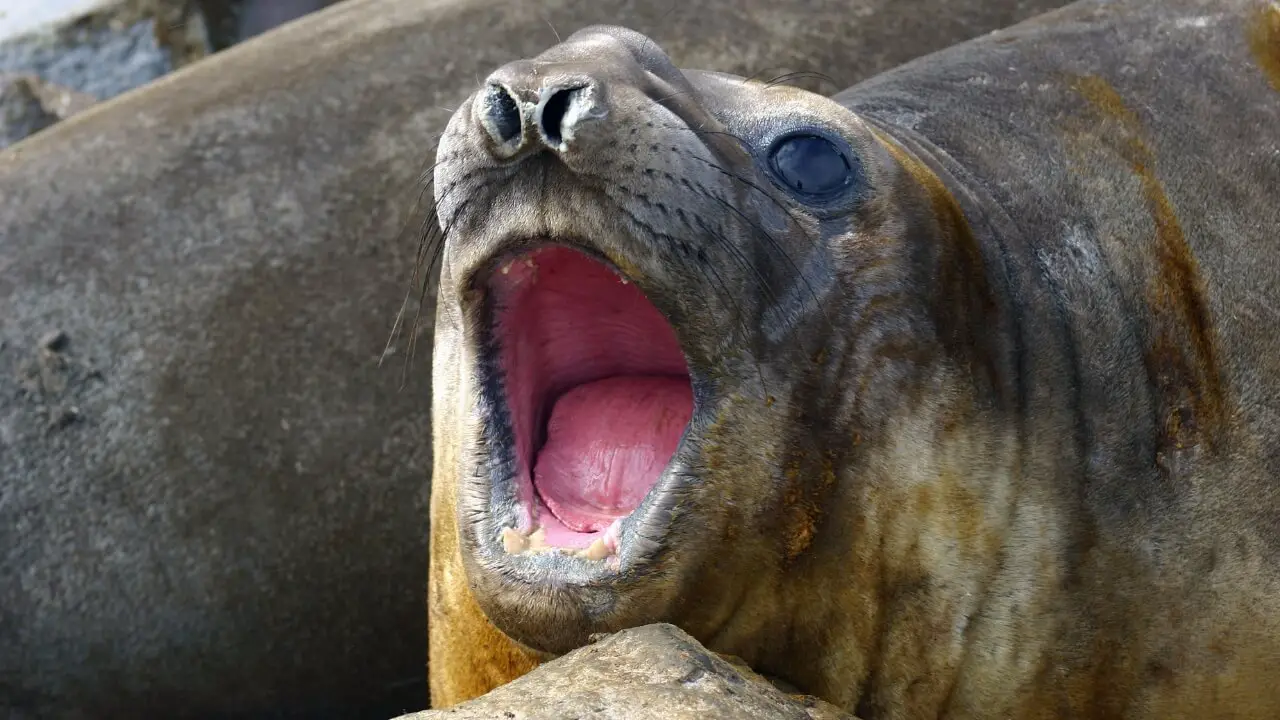
Usually the sea lion. A male California sea lion weighs about 318 kg (700 lb), more than twice a big harbor seal at up to 129 kg (285 lb). But the biggest pinniped of all is a seal: a male northern elephant seal can weigh nearly 2,000 kg (4,400 lb), as much as about 22 average American men.
Figures are from NOAA Fisheries. The Steller sea lion, “the largest member of the family Otariidae,” reaches up to 1,134 kg (2,500 lb) in males (NOAA). Females of every species here are much smaller: female California sea lions weigh about 109 kg (240 lb), and female northern elephant seals up to 590 kg (1,300 lb).
Picture it: pinniped weights side by side
Heaviest typical adult males, in kg, drawn to scale.
Ringed seal (smallest Arctic seal): 50–68
Harbor seal: 82–129
California sea lion (male): about 318
Steller sea lion (male): up to 1,134
Walrus (male): 1,200–1,500
Northern elephant seal (male): nearly 2,000
Average American man, for scale: about 90
Brown = true seals, grey = sea lions, green = walrus. Sources: NOAA Fisheries; Animal Diversity Web (walrus); CDC (human, 199 lb, 2021–2023). Our conversions from pounds.
For the walrus in detail, see how big a walrus is, and for more giants next to a person, animal sizes compared with a human.
Where do seals and sea lions live?
Both live along coasts and in the open sea, but in different places. California sea lions range from south-east Alaska to central Mexico. Harbor seals live along much of the US coast, from Alaska and the West Coast to New England. Ringed seals are the commonest Arctic seal, northern elephant seals roam the North Pacific, and Hawaiian monk seals live only in the Pacific Islands.
Those ranges come from NOAA’s species pages for the California sea lion, harbor seal, ringed seal and northern elephant seal, and NOAA’s seal secrets feature. Polar seas hold many true seals; meet their neighbours in animals that live in the Arctic.
Is it a seal or a sea lion at the zoo or on the pier?
Use the walk test. If the animal props itself up on its front flippers, climbs and barks, it is a sea lion. The famous barking crowd at PIER 39 in San Francisco is California sea lions, “a popular sea lion hangout,” says The Marine Mammal Center. Some aquariums, such as the Aquarium of the Pacific, keep harbor seals and California sea lions together, which is a great chance to compare them side by side.
Where does the walrus fit?
The walrus is a pinniped in a family of its own, Odobenidae, with just one species. It is a mix of both: like a true seal, it has no outer ear flaps and swims mainly with its back flippers. Like a sea lion, it can turn its back flippers under its body and walk on all fours.
SeaWorld says “walruses lack external ear flaps” and can walk by “rotating their hind flippers under their pelvic girdle” (SeaWorld). Males can weigh 1,200–1,500 kg, says Animal Diversity Web. Walruses feed on the seafloor; find out what walruses eat.
Are seals and sea lions related to dogs?
Only distantly. Seals, sea lions and walruses belong to the Caniformia, the “dog-like” branch of the carnivores, which also includes dogs, bears, weasels, skunks and raccoons. But they did not come from dogs. Studies suggest the pinnipeds’ closest living relatives are either the bears or the weasel family.
The US National Library of Medicine’s MeSH classification defines Caniformia as a “suborder of dog-like carnivores which include dogs, coyotes, skunks, mustelids, walruses, seals, bears, and procyonids” (MeSH). Within that branch, morphological and molecular studies “suggest a sister relationship with ursoids (for example bears) or musteloids,” wrote Natalia Rybczynski and colleagues in Nature in 2009. Their fossil, Puijila darwini, from an early Miocene lake bed in Nunavut, Canada, had a long tail, land-mammal legs and probably webbed feet. It was a semi-aquatic carnivore that suggests pinnipeds passed through a freshwater stage on their way to the sea. So a sea lion’s dog-like face and bark don’t make it a close cousin of dogs.
Why do seals and sea lions matter in their ecosystems?
Seals and sea lions are mid-to-top predators that link fish and squid to the biggest hunters in the sea. They eat fish, squid and crustaceans, and they are eaten by killer whales, sharks and, in the Arctic, polar bears. When their numbers crash, the effects can ripple all the way to kelp forests.
Sea lions: California sea lions eat squid, anchovies, mackerel, rockfish and sardines (NOAA). Steller sea lions eat more than a hundred kinds of fish plus squid and octopus, and their main predators are “killer whales, sharks, and humans” (NOAA). Read about one of those predators in how big a great white shark is.
Seals: harbor seals eat mainly fish, shellfish and crustaceans (NOAA), and northern elephant seals dive 300–760 m (1,000–2,500 ft) for squid and fish; see what elephant seals eat. In the Arctic, polar bears hunt ringed seals, “their primary prey,” says NOAA. Read what polar bears eat and see the whole system in the Arctic food web.
The ripple effect: with seals and sea lions “in short supply in the North Pacific,” killer whales in western Alaska appear to have switched to eating sea otters, a team led by James Estes reported in Science in 1998. With fewer otters, sea urchins boomed and kelp densities fell by a factor of 12, according to the University of California, Santa Cruz. The researchers linked the seal and sea lion decline to fewer fish offshore, “possibly due to overfishing,” though the exact causes are still debated.
There is good news too. Northern elephant seals were once thought extinct after 1800s hunting, with only a few hundred surviving in Mexico, and have since recovered (NOAA). The endangered Hawaiian monk seal has grown about 2% a year since 2013. You can help by keeping at least 50 yards (46 m) from seals and sea lions, keeping dogs leashed on seal beaches, and picking up fishing line and plastic.
Hidden gems
- Seals “see” with whiskers. Scientists think seals can use their whiskers to detect vibrations from swimming prey, and blind seals can still hunt, says NOAA.
- Seals don’t eat on land. They fast for long periods, living off their blubber, while on shore (NOAA).
- A seal pup’s birth weight varies hugely: about 11 kg (24 lb) for a harbor seal, but 34 kg (75 lb) for a northern elephant seal.
- A fossil with feet, not flippers: Puijila darwini, an early relative of the pinnipeds from Canada’s Arctic, had legs and probably webbed feet instead of flippers (Rybczynski et al., 2009).
Myths about seals and sea lions
Myth: Seals have no ears.
Fact: Seals do have ears; they just lack the outer ear flap. You can see a small ear hole on each side of the head. Why people believe it: the flap is the part we notice on sea lions. Source: NOAA Fisheries.
Myth: Fur seals are a kind of true seal.
Fact: Fur seals are eared seals, in the same family as sea lions (Otariidae), and can walk on all four flippers. Why people believe it: the name. Source: Society for Marine Mammalogy; NOAA.
Myth: A seal pup alone on the beach has been abandoned and needs rescuing.
Fact: Mother seals often leave pups on the beach for up to 24 hours while they feed. If people crowd the pup, the mother may not come back. Stay at least 50 yards (46 m) away and call a stranding network if you are worried. Why people believe it: a lone pup looks helpless. Source: NOAA Fisheries.
Test yourself
1. Which has visible ear flaps, a seal or a sea lion?
A sea lion. That is why sea lions are called “eared seals.”
2. Which one swims mainly by moving its back flippers?
A true seal. Sea lions paddle with their front flippers.
3. Is the biggest pinniped a seal, a sea lion or a walrus?
A seal. Male northern elephant seals can weigh nearly 2,000 kg (4,400 lb).
Where to next?
➡️ Go wider: the Arctic food web, from plankton to polar bears⬆️ Go deeper: how a walrus survives the icy seafloor🔀 Go sideways: what, if anything, eats a polar bear
Frequently asked questions
Is a walrus a seal or a sea lion?
Neither. The walrus is a pinniped in its own family, Odobenidae, with just one living species. It shares traits with both: no ear flaps and hind-flipper swimming like a true seal, but it can walk on all four flippers like a sea lion. Its tusks and thick whiskers make it easy to spot.
Are sea lions dangerous?
They are wild animals and should be watched from a distance. NOAA advises staying at least 50 yards (46 m), about half a football field, from seals and sea lions on land or in water, for their safety and yours. Never feed, touch or chase them, and keep dogs on a lead near haul-out sites.
What is a group of sea lions called?
Sea lions commonly gather in large groups called “herds” or “rafts,” says NOAA Fisheries. Seals tend to be less social, especially in the water, though seals do gather on land to nurse their pups, says NOAA.
Do seals drink seawater?
Not on purpose. Seals get most of the water they need from their food, says NOAA, and a seal or sea lion that drinks too much seawater can become seriously sick.
Sources
- NOAA Fisheries (2024, updated 2026). Is it a seal or a sea lion?
- NOAA Fisheries (2021). 14 seal secrets.
- NOAA Fisheries. Marine life viewing guidelines: guidelines and distances.
- NOAA Fisheries. Species pages: California sea lion; Steller sea lion; harbor seal; northern elephant seal; ringed seal.
- Society for Marine Mammalogy, Committee on Taxonomy (2026). List of marine mammal species and subspecies (April 2026 version).
- SeaWorld Parks. Walrus fact sheet.
- Animal Diversity Web, University of Michigan. Odobenus rosmarus (walrus).
- US National Library of Medicine. MeSH: Caniformia.
- Rybczynski, N., Dawson, M. R. and Tedford, R. H. (2009). A semi-aquatic Arctic mammalian carnivore from the Miocene epoch and origin of Pinnipedia. Nature 458: 1021–1024.
- Estes, J. A. et al. (1998). Killer whale predation on sea otters linking oceanic and nearshore ecosystems. Science 282: 473–476. Summary: University of California, Santa Cruz news release via ScienceDaily.
- The Marine Mammal Center. California sea lion.
- Aquarium of the Pacific. Seals and sea lions habitat.
- Centers for Disease Control and Prevention, NCHS. Body measurements (2021–2023 data).
Sources checked 14 October 2026.
Keep the conversation curious