
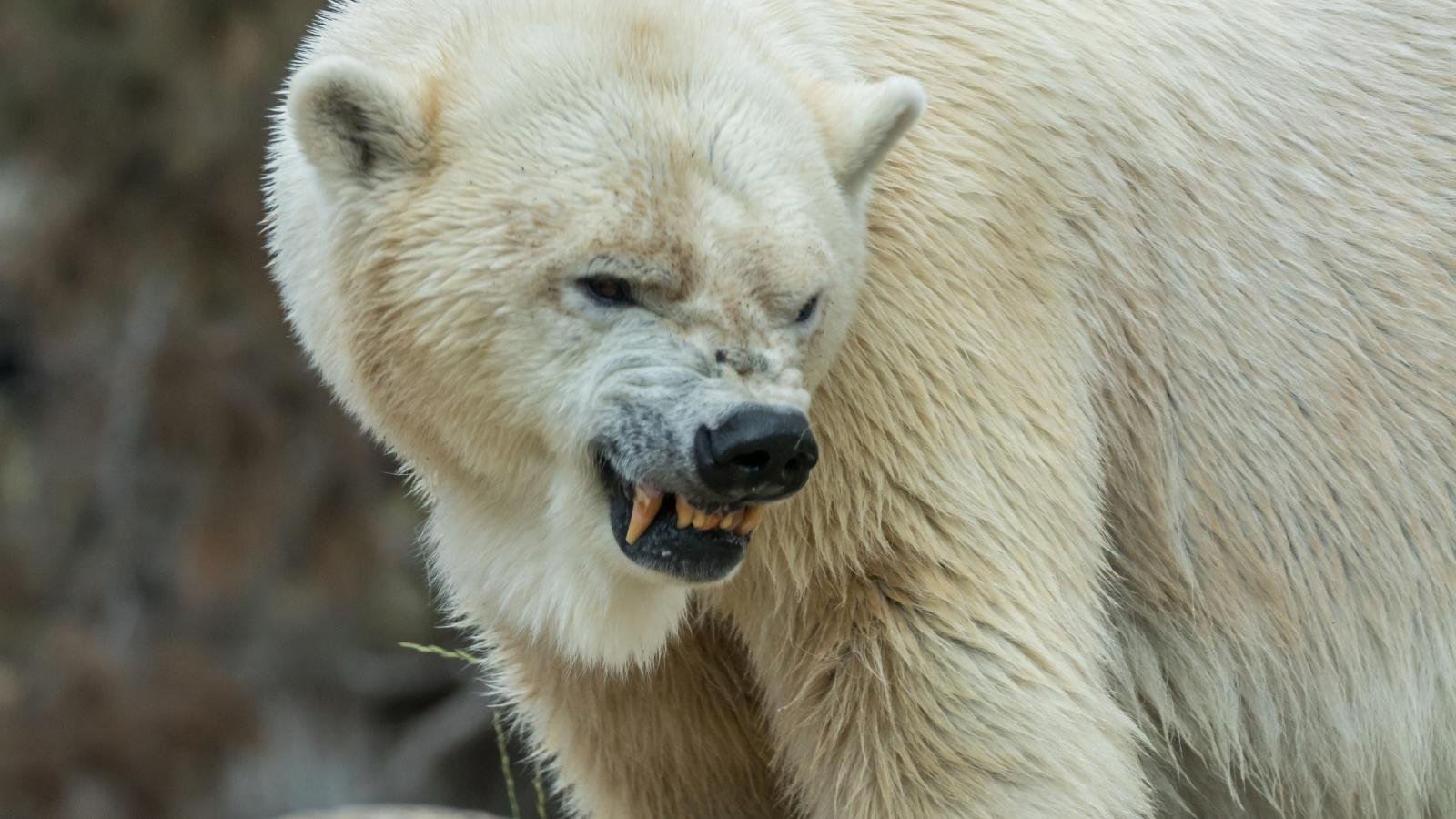
Polar bears have black skin. Their fur only looks white: each hair is clear, with no colour of its own, and scatters light, says Polar Bears International. You can see the black skin on a bear’s nose, lips and foot pads. Cubs are born with pink skin that turns black at 3–4 months old.
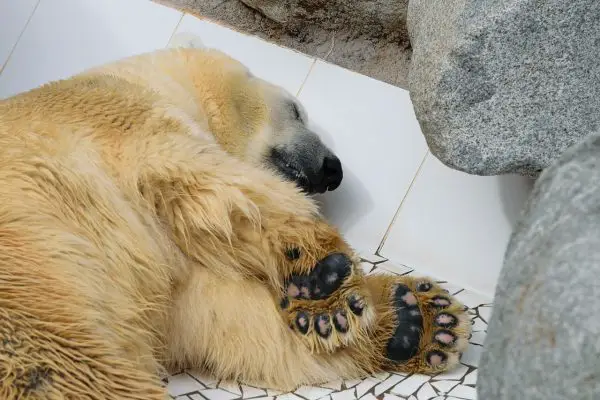
So a polar bear is really a black animal in a see-through coat. Here is why the skin is dark, why the fur still looks white, and why some bears turn yellow or even green.
| Body part | Colour | Source |
|---|---|---|
| Skin (adult) | Black | Polar Bears International; Hinterland Who’s Who |
| Skin (newborn cub) | Pink, turning black at 3–4 months | Polar Bears International |
| Nose, lips and foot pads | Black: the places where you can see the skin | Polar Bears International |
| Tongue | Pink at birth; in adults, anything from pink to mottled blue-black to black | Polar Bears International |
| Each hair | Clear, with no pigment | Polar Bears International |
| Whole coat | Looks white or yellowish | Alaska Department of Fish and Game |
| Claws | Brownish | Hinterland Who’s Who |
Why do polar bears have black skin?
Scientists are not completely sure, but there are two leading ideas. Polar Bears International staff scientist Thea Bechshoft explains both in a 2021 article, Why do polar bears have black skin?
- Heat. Dark colours absorb heat better than light ones. Black skin may soak up a little warmth from the sun.
- Sun protection. Dark skin likely protects the bear from harmful ultraviolet (UV) light. Arctic summers bring 24-hour daylight, and snow and ice bounce sunlight back up at the bear.
Both ideas may be true at once. Hinterland Who’s Who describes the polar bear as having see-through hair and black skin to absorb and keep body heat. What black skin does not do is heat the bear by itself. As you will see below, the fur and fat do most of that work.
What colour is a polar bear cub’s skin?
Pink. A newborn cub has pink skin showing through a short, white fuzz, and even its nose and foot pads are pink. At 3–4 months old, around the time the family leaves the snow den, the pink skin turns black, says Polar Bears International.
The tongue changes too. Cubs are born with pink tongues that become blotched with black after a few months. Adult tongues vary a lot: some stay mostly pink, some are so blotchy they look blue, and some are almost all black. For more on how cubs grow, see the polar bear life cycle.
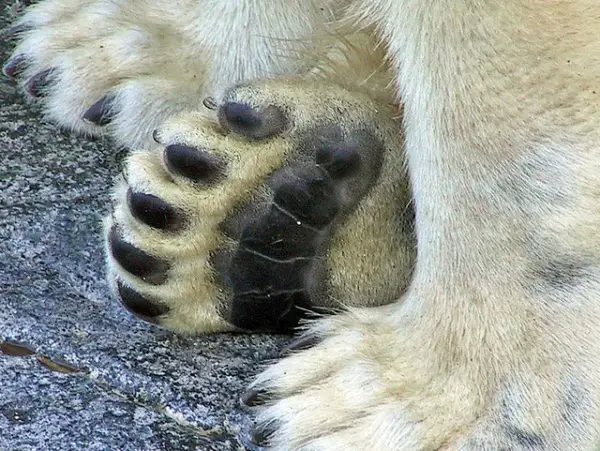
If the skin is black, why does a polar bear look white?
Because of how the hairs handle light. A polar bear has two layers of fur: a dense underfur and longer guard hairs on top. Each guard hair is pigment-free and transparent, with a hollow core, says Polar Bears International. The hair and its core scatter visible light in every direction.
When all the colours of sunlight bounce back to your eye mixed together, you see white. Snow works the same way. A single ice crystal is clear, but a pile of them looks white because each crystal scatters the light. A polar bear’s coat is like a pile of clear straws.
The white look is useful. WWF says the thick white coat and fat layer give insulation and camouflage (WWF-UK). On snow and ice, a pale bear is harder for a seal to spot. Our guide to what polar bears eat explains how bears hunt seals from the ice.
Is polar bear fur hollow?
The outer guard hairs are. San Diego Zoo Wildlife Alliance describes them as clear, hollow tubes filled with air. The air helps with insulation, like the air trapped inside a puffy winter jacket.
Myth: polar bear hairs carry sunlight to the skin
You may read that polar bear hairs work like fibre-optic cables, piping sunlight down to the black skin to warm it. This idea spread in the 1970s. It is wrong.
In 1998, physicist Daniel Koon measured how much light actually travels down a single polar bear hair. Less than 0.001% of red light made it along a typical hair about an inch long. For violet light, it was less than a trillionth. That is reported by Ned Rozell of the University of Alaska Fairbanks Geophysical Institute. Almost no light reaches the skin that way.
So how do polar bears stay warm?
Mainly with fur and fat. The two layers of fur prevent almost all heat loss, says Polar Bears International. Under the skin is a layer of blubber 5 to 10 cm (2 to 4 in) thick, according to San Diego Zoo Wildlife Alliance.
This works so well that polar bears can overheat quickly when they run (PBI). That is one reason they usually walk slowly. Read more in how fast a polar bear can run and in polar bear adaptations.
Why do polar bears sometimes look yellow, grey or green?
Because clear hair shows whatever light and dirt it meets. The Alaska Department of Fish and Game describes the coat as white or yellowish. Many adult bears look cream or yellow, especially before they moult. Clear fur also picks up the colour of the light around it, so a bear can look grey on a cloudy day and orange at sunset.
Zoo bears can turn green. At San Diego Zoo, algae from the pool grows inside the hollow guard hairs in summer, says San Diego Zoo Wildlife Alliance. The bears stay healthy, and the green goes when they moult. For about two weeks in March to April, the zoo’s bears shine a brilliant white. Zoo bears can also take on the colour of whatever they roll in.
Do polar bears have black skin everywhere?
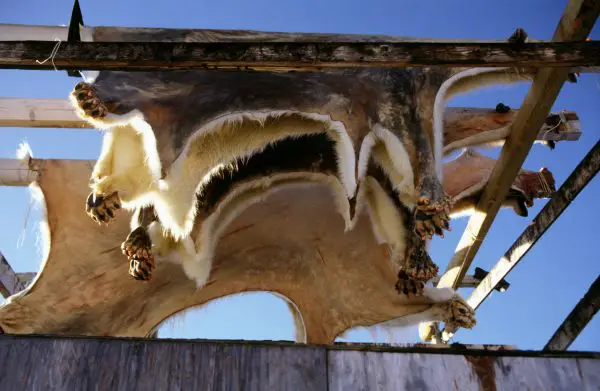
Yes, the skin is dark all over, but you rarely see it. Fur covers almost the whole body, even most of the soles of the feet, says the Alaska Department of Fish and Game. Only the nose, lips and foot pads are easy to spot. A bear that is wet, or one that has lost patches of fur, can show more of its dark skin.
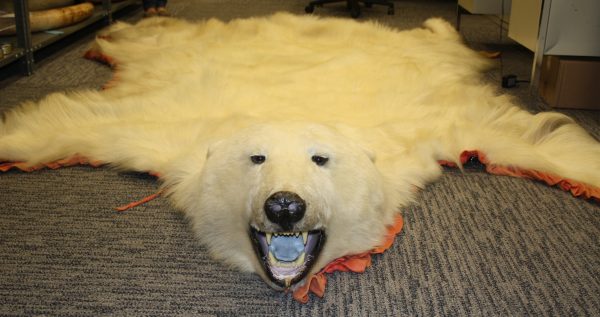
Polar bear hides are still traded from legal, managed hunts. For how hunting fits with conservation today, see are polar bears endangered.
Frequently asked questions
What colour is polar bear fur really?
Clear. Each hair has no pigment and is transparent, with a hollow core, according to Polar Bears International. The coat looks white because the hairs scatter all the colours of light back at your eye, the same way a pile of clear ice crystals looks like white snow.
Do polar bears have pink skin?
Only as newborn cubs. Cubs are born with pink skin, pink noses and pink foot pads under short white fuzz. At 3–4 months old, around the time they leave the den, the skin turns black, says Polar Bears International. Adult polar bears have black skin all over.
What colour is a polar bear's tongue?
It varies. Cubs are born with pink tongues that become blotched with black after a few months. In adults, some tongues stay mostly pink, some are so blotchy they look blue, and some are nearly all black, according to Polar Bears International.
Why is a polar bear's nose black?
The nose is one of the few places where the bear's black skin is not covered by fur. The lips and foot pads show it too. The dark skin likely helps absorb warmth and protects against strong ultraviolet light reflected off snow and ice.
Sources
- Polar Bears International (2021). Why do polar bears have black skin? (Thea Bechshoft).
- Polar Bears International. Adaptations and characteristics.
- Hinterland Who's Who (Canadian Wildlife Federation / Environment and Climate Change Canada). Polar bear.
- San Diego Zoo Wildlife Alliance. Polar bear.
- University of Alaska Fairbanks Geophysical Institute (1998). Debunking the myth of polar bear hair (Ned Rozell, on Koon 1998).
- San Diego Zoo Wildlife Alliance (2015). Punk rock polar bears?.
- Alaska Department of Fish and Game. Polar bear species profile.
- WWF-UK. Polar bears.
Sources checked 15 September 2026.

I hope I never become jaded to the atrocities and the wrath that humans have plagued Mother Earth, including all of the impressive amazing animals she’s provided us. We should be in awe and cherish that gift.
No one will read this and no one cares. No one even knows that polar bear are black. I’ve known since 4th grade & im 53 now. I rest my case !!!