
Off the coast of what is now California, about 3.6 million years ago, a large, serrated tooth drifts down onto the sandy seabed. It belongs to the biggest predatory shark that ever lived. Within a geological moment, no new teeth like it will fall anywhere on Earth.
Megalodon (Otodus megalodon) went extinct about 3.6 million years ago, near the start of the late Pliocene. So why did megalodon go extinct? There was no single killer. Scientists think a cooling ocean, fewer of the whales it fed on, competition from the newly evolved great white shark and its own hungry, warm-bodied lifestyle combined to finish it. And no, megalodon is not still alive. Below you’ll find the evidence for each idea, how big megalodon really was, and where the “it’s still out there” myth came from.
Key takeaways
- When: about 3.6 million years ago, according to a 2019 study that rechecked every young fossil record. The older figure of 2.6 million years is now out of date.
- Why: probably several pressures at once: cooling seas and shrinking coastal habitat, changes in its whale prey, competition with great white sharks, and the high energy cost of a warm body.
- How big: estimates range from about 15 m to a possible 24 m (49 to 80 ft), because no complete skeleton has ever been found.
- Still alive? No. No megalodon tooth younger than about 3.6 million years has ever been found, and the 2013 TV “documentary” that claimed otherwise used actors and faked footage.
When did megalodon go extinct?
Megalodon went extinct about 3.6 million years ago, at the boundary between the early and late Pliocene. That date comes from a 2019 study in PeerJ by Robert Boessenecker and colleagues, who found that every younger-looking megalodon tooth in western North America had been washed out of older rock or had an unreliable origin.
Many websites still say 2.6 million years. That number comes from a 2014 study by Catalina Pimiento and Christopher Clements, which was the first to estimate the date with a statistical model. Boessenecker’s team re-checked the same kind of data, threw out doubtful records, and re-ran the model. They got a median date of 3.51 million years, close to the youngest reliable fossils at about 3.6 million years. They also noted that megalodon might have vanished from different oceans at slightly different times. London’s Natural History Museum now gives 3.6 million years too.
How long did megalodon live, compared with great whites and humans?
Megalodon teeth turn up in marine rocks from about 20 million to 3.6 million years old, says the Natural History Museum. That gives the species a run of roughly 16 million years. The modern great white appeared only about 6 to 5 million years ago, and our own species about 300,000 years ago.
Timeline: who shared the sea with megalodon?
Millions of years ago, from 20 on the left to today on the right. Each bar is drawn to scale.
Megalodon: about 20 to 3.6 million years ago
Great white shark: about 6–5 million years ago to today
Humans (Homo sapiens): about 300,000 years ago to today
20 million years ago10Today
The arithmetic: 20 − 3.6 = about 16.4 million years for megalodon. Great whites and megalodon overlapped for about 5 − 3.6 = 1.4 million years (up to 2.4 million if great whites appeared 6 million years ago). The last megalodon died about 3.6 − 0.3 = 3.3 million years before the first Homo sapiens. Megalodon’s 16.4 million years is about 16.4 ÷ 0.3 ≈ 55 times as long as our species has existed so far.
Sources: Natural History Museum; Boessenecker et al. 2019 (great white origin, citing Ehret and colleagues); Smithsonian Human Origins. The pale part of the great white bar shows the uncertainty in when it appeared. The dinosaurs are not on this chart: they died out 66 million years ago, about 46 million years before the first megalodon teeth.
Why did megalodon go extinct?
Nobody has found one smoking gun. The leading explanations are a cooling ocean that shrank warm coastal habitat, changes in the whales megalodon ate, competition with the great white shark, and the high fuel cost of its warm body. Most researchers now think several of these worked together, and they still argue about which mattered most.
1. A cooling ocean and shrinking coastal seas
The end of the Pliocene was a time of big swings in climate and sea level. A 2017 study in Nature Ecology & Evolution found that 36% of large marine animal genera of that time (sharks, whales, seabirds and turtles) did not survive into the next epoch. The authors suggest that the sudden loss of shallow, productive coastal habitat was a key driver, and that warm-bodied animals with high energy needs were hit hardest.
Coastal seas mattered to megalodon. In Panama, scientists found a 10-million-year-old site full of small megalodon teeth from sharks about 2 to 10.5 m long, which they interpreted as a nursery area: a shallow, food-rich place where young sharks grew up.
There is a catch, though. A 2016 study of megalodon’s worldwide range found no direct link between global temperature and where megalodon lived. And a 2025 study estimated that newborn megalodon were already 3.6 to 3.9 m long, which made the authors doubt that pups needed nurseries at all. So cooling probably set the stage rather than acting alone.
2. Changes in its whale prey
Megalodon fed largely on marine mammals. The same 2016 range study found that megalodon’s decline came first as a drop in numbers in the late Miocene, then as a shrinking range in the Pliocene. That collapse lined up mainly with a fall in the diversity of filter-feeding (baleen) whales and the arrival of new competitors.
Boessenecker’s team adds that whale diversity peaked in the middle Miocene and then fell, while the remaining baleen whales got bigger. In their view, declining numbers of small baleen whales may have helped push megalodon out. The very large filter feeders we know today, such as the blue whale, only became giants later, in the Plio-Pleistocene, according to a 2017 study by Graham Slater and colleagues.
3. Competition with the great white shark
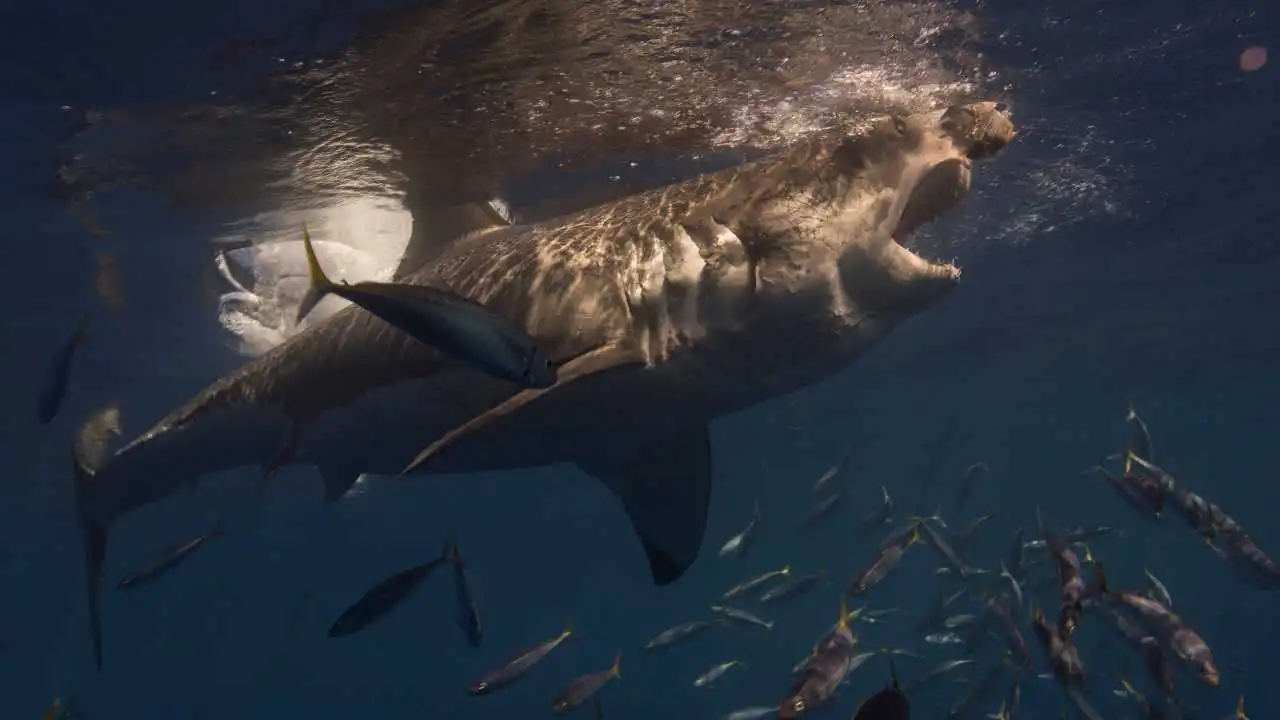
The great white evolved its modern, coarsely serrated teeth about 6 to 5 million years ago, and appeared around the world in the early Pliocene, just as megalodon disappeared. Boessenecker’s team points out that adult great whites were about the same size as young megalodon, so the two would likely have hunted the same prey.
Chemistry backs this up. Zinc in tooth enamel changes with an animal’s position in the food chain. A 2022 zinc isotope study led by Jeremy McCormack found that early Pliocene great whites and megalodon living in the same waters fed at a similar average level of the food chain, “a finding that may hold clues to the extinction” of megalodon, in the authors’ words. A separate 2022 nitrogen isotope study led by Emma Kast found that megalodon fed at a higher level of the food chain than any other marine animal known, living or extinct. In other words, it sat even higher than today’s top ocean hunters.
The 2025 study by Kenshu Shimada and 28 co-authors went further. It concluded that the great white’s rise was “at least partly responsible” for megalodon’s end, through competition for food. The authors call all of their findings working hypotheses, so treat this as the best current guess rather than settled fact.
4. A warm body with a huge appetite
Megalodon was not cold-blooded like most fish. By measuring rare isotopes in fossil teeth, a 2023 study in PNAS led by Michael Griffiths found that megalodon’s body was about 7 °C (13 °F) warmer than the water around it, and warmer even than the great whites and mako sharks living alongside it. The authors suggest that the high metabolic cost of a big, warm body may have made megalodon more vulnerable to extinction than other sharks that survived the Pliocene. A warm body is a powerful engine, but it needs a lot of fuel.
| Explanation | Evidence for | Caveat | Key studies |
|---|---|---|---|
| Cooling ocean, lost coastal habitat | Pliocene marine megafauna extinction; warm-bodied animals hit hardest | No direct link found between global temperature and megalodon’s range | Pimiento et al. 2017; Pimiento et al. 2016 |
| Changing whale prey | Range collapse matched a fall in baleen whale diversity | Hard to measure prey numbers from fossils | Pimiento et al. 2016; Boessenecker et al. 2019 |
| Competition with great whites | Similar food-chain level in the early Pliocene; timing matches | Isotopes show overlap, not a direct contest | McCormack et al. 2022; Shimada et al. 2025 |
| Warm body, high energy needs | Body about 7 °C warmer than the sea | Shows vulnerability, not a cause on its own | Griffiths et al. 2023 |
How big was megalodon, really?
Probably at least 15 m (49 ft) long, and possibly much more. Because a shark skeleton is made of cartilage that rarely fossilises, every size estimate is worked out from teeth or vertebrae compared with living sharks. Older tooth-based studies put the largest at about 15 to 20 m (49 to 66 ft). A 2025 study suggested about 24.3 m (80 ft) as a possible maximum.
Here is how scientists get those numbers, and why they keep changing:
- From teeth: researchers measure a tooth and scale up using the great white, whose tooth sizes and body lengths are known. A 2015 study of 544 teeth by Pimiento and Meghan Balk estimated lengths from 2.2 to 17.9 m, with an average of about 10 m (33 ft).
- From vertebrae: a partial backbone in Brussels, Belgium, measures 11.1 m (36 ft) on its own. In 1996 the same fossil had been estimated at only 9.2 m long for the whole shark, using great white proportions. That mismatch made researchers question whether the great white is a good model at all (Sternes et al. 2024).
- The slender-body revision: Sternes and colleagues argued in 2024 that megalodon was more slender than a great white. In 2025, Shimada and colleagues added a head and tail in typical shark proportions to the Belgian backbone and got about 16.4 m (54 ft). Scaling up to a giant 23 cm (9 in) vertebra from Denmark gave about 24.3 m, with a possible weight of around 94 tonnes. The authors stress these figures are hypothetical.
Tracing a viral number: the old version of this page said megalodon was “over 58.7 feet long”. That figure is 17.9 m converted to feet (17.9 × 3.28 = 58.7). It is the single largest estimate in Pimiento and Balk’s 544-tooth dataset, not a typical size. The average was about 10 m.
Bite force is an estimate too. A 2008 computer model of shark jaws suggested megalodon could bite with roughly 108,000–182,000 N, reported as about 10.8 to 18.2 tonnes of force (Discover, on Wroe et al. 2008). That makes it the strongest estimated bite of any animal, but nobody has measured it. See which animal has the strongest bite force for how it compares with measured bites. The “40,000 psi” sometimes quoted online is most likely the top figure in pounds of force (182,000 N ÷ 4.448 ≈ 40,900 lbf) relabelled as pressure.
Picture it: megalodon next to a school bus
Lengths in metres, drawn to scale against the longest blue whale ever reliably measured. US national school bus specifications allow buses up to 45 ft (13.7 m) long.
Newborn megalodon (2025 estimate): 3.6–3.9 m
Large great white shark: about 6 m
Average megalodon from 544 teeth: about 10 m
Longest school bus allowed (US): 13.7 m
Largest tooth-based megalodon: 17.9 m
Possible maximum megalodon (2025, hypothetical): about 24.3 m
Longest reliably measured blue whale: 33 m
The arithmetic: an average megalodon was about 10 ÷ 13.7 ≈ 0.7 of a bus. The largest tooth-based estimate is 17.9 ÷ 13.7 ≈ 1.3 buses. The 2025 maximum is 24.3 ÷ 13.7 ≈ 1.8 buses, still shorter than a big blue whale (33 ÷ 13.7 ≈ 2.4 buses). A newborn megalodon, at 3.6–3.9 m, was already more than half the length of a large adult great white (3.6 ÷ 6 = 0.6).
Sources: Pimiento & Balk 2015; Shimada et al. 2025; School Transportation News (national bus specification); our blue whale size guide; great white length from Shimada et al. 2025, citing older records of about 6.1 m.
Why do we mostly find megalodon teeth?
Because sharks have skeletons made of cartilage, which usually rots away after death, says the Natural History Museum. Teeth are much tougher. Megalodon’s teeth grew in rows, and when one fell out, a tooth from the row behind moved forward, so over megalodon’s roughly 16 million years these “conveyor belts” left the seafloor littered with teeth.
Only a handful of partial backbones are known, such as the Belgian one in Brussels and about 20 large vertebrae from Denmark, according to Shimada and colleagues. No complete skeleton has ever been found, which is why every reconstruction, including any drawing you see of megalodon, is an educated guess. For how a living relative uses its teeth, see our guide to great white shark adaptations.
Is megalodon still alive?
No. If megalodon were still alive, we would find its teeth. Sharks shed and replace teeth throughout their lives, yet nobody has ever found a megalodon tooth younger than about 3.6 million years, “not as fossils, sub-fossils or even freshly fallen teeth”, says the Natural History Museum. No whale or other animal carries megalodon-sized bite marks either.
What about the deep sea? Megalodon hunted in warm, food-rich waters. Today no sharks live much below 3,000 m (9,800 ft), probably because there is too little food down there, notes the NHM. A shark weighing many tonnes could not survive in the dark, cold trenches people imagine it hiding in.
Some “young” teeth have been reported. In the 20th century, teeth dredged from the deep seafloor were dated to as recently as 11,000 to 24,000 years ago by measuring the mineral crust that had grown on them. Boessenecker and colleagues explain why that method fails: those crusts do not grow at a steady rate, so they only show how long a tooth sat exposed on the seabed, not how old it is. The teeth were most likely old Pliocene or Miocene fossils uncovered by erosion.
The modern myth has a clear starting point. In 2013, Discovery opened its Shark Week with Megalodon: The Monster Shark Lives, presented as a documentary. It used actors playing scientists and a story about a 67-foot (20 m) megalodon off South Africa, and Discovery’s disclaimers that it was “dramatized” came only at the end, reported National Geographic. Shark scientists criticised it, and the NHM describes it as full of faked photos, footage and sightings that were “swiftly debunked”.
What did losing megalodon mean for whales?
Megalodon was an apex predator, the top hunter in its food web, and its fossil teeth show it fed higher up the food chain than any marine animal alive today (Kast et al. 2022). Losing a hunter at the very top of a food web can change life for everything below it.
When megalodon disappeared, the oceans lost one of their main whale hunters. Pimiento and Clements noticed that the modern line-up of gigantic filter-feeding whales was established after megalodon’s extinction. That does not prove megalodon held whales back. The 2017 study by Slater and colleagues links whale gigantism mainly to richer, seasonal upwelling of food along coasts. But it is one reason scientists study megalodon: it is a rare natural experiment in what happens to an ocean when its top predator goes missing. Whale bodies still feed whole communities today, from scavenging sharks to deep-sea worms, as our article on what happens when a whale dies explains. Today the main hunters of large whales are killer whales, which mostly target calves, as in what eats humpback whales. Browse more ocean life in our animals A–Z.
Hidden gems: five things most megalodon pages miss
- Born big: a 2025 study estimated newborn megalodon at 3.6–3.9 m (12–13 ft), more than half the length of a large adult great white (Shimada et al. 2025).
- A backbone longer than the shark: a partial megalodon backbone in Brussels is 11.1 m long on its own, yet in 1996 the whole animal was estimated at just 9.2 m (Sternes et al. 2024).
- Top of the top: nitrogen in its teeth puts megalodon higher on the food chain than any marine animal known, living or extinct (Kast et al. 2022).
- Warmer than a great white: its body ran about 7 °C warmer than the sea, warmer even than great whites and makos of the same age (Griffiths et al. 2023).
- Misleading “young” teeth: deep-sea teeth once dated to 11,000–24,000 years old were dated by their mineral crust, which does not measure a fossil’s age (Boessenecker et al. 2019).
Myths about megalodon’s extinction
Myth: Megalodon could still be hiding in the Mariana Trench.
Fact: No megalodon tooth younger than about 3.6 million years has ever been found, and no sharks live much below 3,000 m today because there is too little food. Why people believe it: the 2013 Discovery special, films and viral videos, plus the true fact that much of the deep sea is unexplored. Source: Natural History Museum.
Myth: Megalodon died out 2.6 million years ago, or lived alongside the dinosaurs.
Fact: The best current date is about 3.6 million years ago (Boessenecker et al. 2019). The dinosaurs died out 66 million years ago, about 46 million years before the oldest megalodon teeth. Why people believe it: the 2.6-million-year date from 2014 is still copied widely, and “prehistoric monster” pictures often mix up different eras.
Myth: Ancient artwork shows that people saw megalodon.
Fact: Megalodon died out about 3.3 million years before our species appeared, so no human ever saw one alive. Everything we know comes from fossil teeth, a few vertebrae and chemistry. Why people believe it: stories about sea monsters are easy to link to a famous giant shark. (An earlier version of this page repeated this claim. We have removed it.)
Myth: Megalodon was just a giant great white shark.
Fact: Megalodon belongs to a different, extinct family, the Otodontidae, and recent studies suggest it was more slender than a great white. Why people believe it: megalodon was once placed in the same genus as the great white, Carcharodon, because their teeth look alike (Boessenecker et al. 2019; Sternes et al. 2024).
Test yourself
1. About when did megalodon go extinct?
About 3.6 million years ago, at the start of the late Pliocene.
2. Which living shark may have competed with young megalodon for food?
The great white shark. Zinc in fossil teeth shows the two fed at a similar level of the food chain in the early Pliocene.
3. Why are megalodon fossils mostly teeth?
Its skeleton was made of cartilage, which rarely fossilises, while its hard teeth were shed and replaced throughout its life and fossilise well.
Where to next?
➡️ Go wider: which animal has the strongest bite force, measured vs estimated⬆️ Go deeper: the adaptations that make the great white a top predator🔀 Go sideways: how big a great white shark really gets🐋 Size up the giant that outlasted megalodon: how big is a blue whale?
Frequently asked questions
Did megalodon live at the same time as dinosaurs?
No. The non-bird dinosaurs died out 66 million years ago, according to the Natural History Museum. The oldest megalodon teeth are about 20 million years old, so megalodon appeared roughly 46 million years after the dinosaurs had gone. It shared the seas with whales, dolphins and, near the end, early great white sharks instead.
Did killer whales kill off megalodon?
Probably not. Some scientists suggested that early killer whales competed with megalodon, but Boessenecker and colleagues call this problematic. Pliocene killer whale fossils are very rare, and the one well-known skeleton, from Italy, belonged to a species much smaller than a modern orca. Competition from great white sharks has much stronger support.
What did megalodon eat?
Megalodon evolved as a predator of whales, large fish and other sharks, says the Natural History Museum. Nitrogen isotopes in its teeth show it fed higher up the food chain than any marine animal known today. The researchers suggest it may have targeted nursing marine mammal pups or even eaten other megalodon, but those ideas still need testing (Kast et al. 2022).
Was megalodon warm-blooded?
Partly. A 2023 PNAS study found that megalodon’s body was about 7 °C (13 °F) warmer than the surrounding sea, like great whites and mako sharks, which keep parts of their body warm. The authors think this helped it grow so large, but it also meant it needed a lot of food, which may have made it more vulnerable to extinction.
How fast could megalodon swim?
Nobody knows its top speed. A 2025 study estimated that a 24.3 m megalodon would have cruised at about 2.1 to 3.5 km/h (1.3 to 2.2 mph) while travelling. That is a calculated estimate from body shape and size, not a measurement, and it says nothing about how fast megalodon could sprint when attacking.
Sources
- Boessenecker, R.W., Ehret, D.J., Long, D.J., Churchill, M., Martin, E. and Boessenecker, S.J. (2019). The Early Pliocene extinction of the mega-toothed shark Otodus megalodon: a view from the eastern North Pacific. PeerJ 7: e6088.
- Pimiento, C. and Clements, C.F. (2014). When did Carcharocles megalodon become extinct? A new analysis of the fossil record. PLOS ONE 9(10): e111086.
- Natural History Museum, London (Osterloff, E.). Is megalodon still alive?
- Pimiento, C. et al. (2017). The Pliocene marine megafauna extinction and its impact on functional diversity. Nature Ecology & Evolution 1: 1100-1106.
- Pimiento, C., Ehret, D.J., MacFadden, B.J. and Hubbell, G. (2010). Ancient nursery area for the extinct giant shark megalodon from the Miocene of Panama. PLOS ONE 5(5): e10552.
- Pimiento, C. et al. (2016). Geographical distribution patterns of Carcharocles megalodon over time reveal clues about extinction mechanisms. Journal of Biogeography 43: 1645-1655.
- Slater, G.J., Goldbogen, J.A. and Pyenson, N.D. (2017). Independent evolution of baleen whale gigantism linked to Plio-Pleistocene ocean dynamics. Proceedings of the Royal Society B 284: 20170546.
- McCormack, J. et al. (2022). Trophic position of Otodus megalodon and great white sharks through time revealed by zinc isotopes. Nature Communications 13: 2980.
- Kast, E.R. et al. (2022). Cenozoic megatooth sharks occupied extremely high trophic positions. Science Advances 8: eabl6529.
- Griffiths, M.L. et al. (2023). Endothermic physiology of extinct megatooth sharks. PNAS 120(27): e2218153120.
- Shimada, K. et al. (2025). Reassessment of the possible size, form, weight, cruising speed, and growth parameters of the extinct megatooth shark, Otodus megalodon. Palaeontologia Electronica 28(1): a12.
- Sternes, P.C. et al. (2024). White shark comparison reveals a slender body for the extinct megatooth shark, Otodus megalodon. Palaeontologia Electronica 27(1): a7.
- Pimiento, C. and Balk, M.A. (2015). Body-size trends of the extinct giant shark Carcharocles megalodon: a deep-time perspective on marine apex predators. Paleobiology 41(3): 479-490.
- Discover (2008). Ancient “big tooth” shark had the mightiest bite in history (on Wroe, S. et al. 2008, Journal of Zoology 276: 336-342, doi:10.1111/j.1469-7998.2008.00494.x).
- National Geographic (Than, K., 2013). The real megalodon: prehistoric shark behind doc uproar. Used for the 2013 Discovery programme only.
- Smithsonian National Museum of Natural History. Homo sapiens. Human Origins Program.
- Natural History Museum, London. How an asteroid ended the age of the dinosaurs.
- School Transportation News (2014). New Pennsylvania law extends allowable length of school buses (national specification: no more than 45 ft).
Corrections: on 14 October 2026 we rewrote this article. The earlier version gave the extinction date as about 2.6 million years ago (now revised to about 3.6 million years), quoted an unexplained length of “58.7 feet”, said megalodon used shallow areas “for nesting”, and cited “ancient artwork” as evidence that megalodon existed. Those claims have been corrected or removed.
Sources checked 14 October 2026.

Keep the conversation curious