

A big crocodile lies held still by a research team. A scientist slides a force sensor between its back teeth and steps back. The jaws slam shut, and the reading is higher than any ever taken from a living animal.
The saltwater crocodile has the strongest bite force ever measured: 16,414 newtons (3,689 pounds of force), from one large crocodile tested by Gregory Erickson’s team and published in 2012 [1]. Below you will find an original ranked chart of real measurements, the biggest estimates for sharks and dinosaurs, and where the famous “3,700 psi” mistake comes from.
Key takeaways
- Strongest bite measured: a saltwater crocodile, 16,414 N (3,689 lbf) [1].
- Strongest mammal bite measured: the spotted hyena, about 4,500 N (1,011 lbf) [1][4].
- Strongest bite ever (estimated): megalodon, roughly 108,000–182,000 N in a 2008 computer model [11][13].
- Psi is the wrong unit: bite meters measure force (newtons or pounds of force). Most “psi” bite charts online are force figures with the wrong label, or have no source at all.
- Size matters most: in crocodiles, body mass explains almost all the difference in bite force between species [1].
Which animal has the strongest bite force?
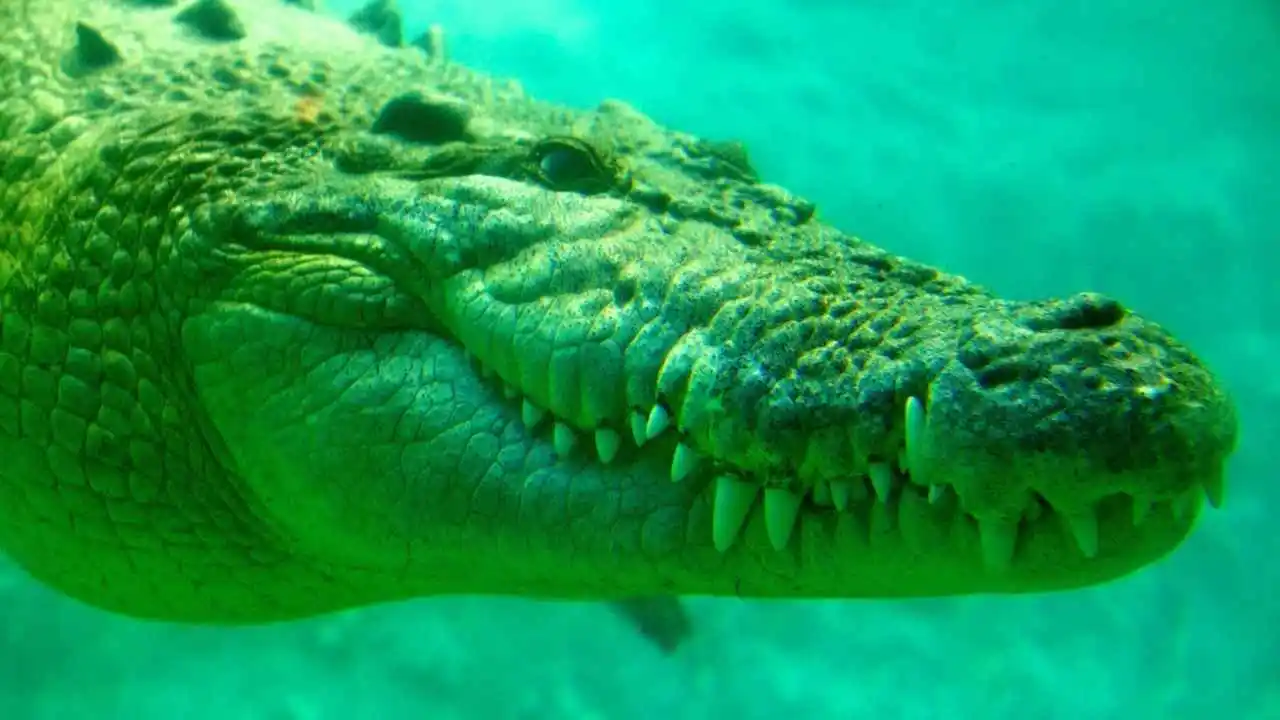
The saltwater crocodile. In a study of all 23 crocodilian species then recognised, Erickson and colleagues measured 83 adults and recorded 16,414 newtons (3,689 lbf) from one saltwater crocodile, which they called “the highest bite force measured in any animal” [1]. Larger saltwater crocodiles, about 6.7 m long, were likely capable of 27,531–34,424 N, the team estimated [1].
That reading still stands as the top live measurement we could find. A newton is the scientist’s unit of force. About 9.8 N is the pull of gravity on 1 kg, so 16,414 N is like having about 1,670 kg pressing down through the crocodile’s teeth. For how saltwater crocodiles compare with their relatives, see our guide to alligators vs crocodiles and which bites harder.
Animal bite force chart: measured bites, ranked
Every bar below is a bite measured in a live animal with a force sensor, not a guess from a skull. Bars are drawn to scale against the record crocodile. Notice how many famous “strong biters” are missing: hippos, jaguars, gorillas and polar bears have never had their bites measured in a published study that we could find.
Strongest bites ever measured in live animals
Highest single bite, in newtons (pounds of force in brackets). Each bar is drawn to scale.
Saltwater crocodile: 16,414 N (3,689 lbf)
American alligator (wild): 13,172 N (about 2,960 lbf)
Mugger crocodile (one adult): 7,295 N (about 1,640 lbf)
Spotted hyena (strongest mammal measured): about 4,500 N (1,011 lbf)
Human record (one man, one test, 1986): 442 kg, about 4,340 N (975 lbf)
Domestic dog, back teeth (under anaesthesia): up to 3,417 N (about 770 lbf)
Nile crocodile (two small adults, 86 kg): up to 3,172 N (about 710 lbf)
Andean spectacled bear: 2,197 N (about 490 lbf)
Lioness, front teeth: 1,594 N (about 360 lbf)
Pet dog, awake (strongest of 22 dogs): 1,394 N (about 310 lbf)
Typical adult human, back teeth: about 446–1,221 N (100–275 lbf)
Sources: Erickson et al. 2012 and 2004; Binder & Van Valkenburgh 2000; Guinness World Records; Ellis et al. 2008; van der Meijden et al. 2023; Lindner et al. 1995; Koc et al. 2010. Pounds of force are our conversions (1 lbf = 4.448 N) except where the paper gives them.
| Rank | Animal | Bite force | How it was found | Source |
|---|---|---|---|---|
| 1 | Saltwater crocodile | 16,414 N (3,689 lbf) | Measured, back teeth, one of 7 tested | Erickson et al. 2012 [1] |
| 2 | American alligator | 13,172 N (about 2,960 lbf) | Measured, wild-caught adults | Erickson et al. 2004 [2] |
| 3 | Mugger crocodile | 7,295 N (about 1,640 lbf) | Measured, one adult of 207 kg | Erickson et al. 2012 [1] |
| 4 | Spotted hyena | about 4,500 N (1,011 lbf) | Measured with a force transducer, captive hyenas | Binder & Van Valkenburgh 2000 [4], as reported in [1] |
| 5 | Human (record) | 442 kg-force, about 4,340 N (975 lbf) | One man, one test, held about 2 seconds | Guinness World Records [10] |
| 6 | Domestic dog | 147–946 N (canines); 524–3,417 N (back teeth) | Measured with muscle stimulation under anaesthesia, 20 dogs | Ellis et al. 2008 [8] |
| 7 | Nile crocodile | 2,914–3,172 N (about 655–710 lbf) | Measured, only two adults of about 86 kg | Erickson et al. 2012 [1] |
| 8 | Andean spectacled bear | 2,197 N (about 490 lbf) | Measured, captive bears biting for a food reward | van der Meijden et al. 2023 [6] |
| 9 | Lion (lioness) | 1,594 N (about 360 lbf) | Measured, one captive lioness, front teeth | van der Meijden et al. 2023 [6] |
| 10 | Pet dogs (awake) | 13–1,394 N; average 256 N | Measured, 22 pet dogs of 7–55 kg | Lindner et al. 1995 [7] |
| 11 | Adult humans (typical) | about 446–1,221 N | Measured with strain-gauge sensors | Koc et al. 2010 review [9] |
Two warnings about this ranking. First, the Nile crocodiles tested weighed only about 86 kg each [1], far smaller than a big wild male, so their place on the list says more about the sample than the species. Second, the human record is a single test by one man in 1986, reported by Guinness World Records, not a study of many people [10].
What is the difference between bite force and bite pressure (psi)?
Bite force is how hard the jaws push, measured in newtons or pounds of force. Pressure (psi, pounds per square inch) is that force divided by the area of tooth touching the prey. The same bite gives huge pressure through a sharp tip and much less through a flat molar. Bite sensors measure force, so a single “psi” number for a whole animal makes little sense.
Erickson’s team did calculate real pressures at single crocodile teeth, and they are enormous: up to 1,388 megapascals, or about 201,312 psi, at the back teeth of the Orinoco crocodile [1]. Those are tooth-tip pressures, not “bite force”. Our page on cane corso bite force explains the same unit problem for dogs.
Where do the famous “psi” numbers come from?
Most of them come from lists that cite no study at all. We traced each number in the old version of this page, and in popular top-10 lists such as Field & Stream’s [18], back as far as we could. Several turn out to be real force measurements in pounds that were relabelled “psi”. The rest have no published measurement behind them that we could find.
| Popular claim | What we found | Verdict |
|---|---|---|
| Saltwater crocodile “3,700 psi” | Erickson’s 2012 record is 16,414 N, which the paper itself converts to 3,689 lbs of force [1] | Real number, wrong unit |
| American alligator “2,980 psi” | A wild alligator bit 13,172 N in a 2004 study [2], which is about 2,960 pounds of force. Likely the same number, mislabelled | Probably real, wrong unit |
| Spotted hyena “1,000” or “1,100 psi” | The measured hyena bite is about 4,500 N, or 1,011 lbs of force [1] | Real number, wrong unit |
| Great white shark “nearly 4,000 psi” | A 2008 computer model estimated about 1.8 tonnes of force [11], roughly 17,700 N or 3,970 lbf (our conversion) | Model estimate, wrong unit |
| Human “162 psi” | In 2003 Erickson’s team put the maximum human bite at about 170 pounds of force [3]; studies with sensors find about 446–1,221 N [9] | Probably a force, wrong unit |
| Hippopotamus “1,800 psi” | Field & Stream says females were measured but names no study [18]. We found no published hippo bite measurement | Unverified |
| Jaguar “1,500 psi” | No measurement found. A 2005 skull model gives about 1,014 N at the canines [5] | No source |
| Gorilla “1,300 psi” | No measurement of a gorilla’s bite found | No source |
| Polar bear “1,200 psi”, grizzly “975 psi” | Neither bear’s bite has been measured. (975 is also the human record in pounds, which may be a coincidence.) | No source |
So when a chart puts a hippo or a gorilla on a list beside a crocodile, it is mixing measured forces with numbers nobody can trace. For the details on each animal, see how strong a jaguar is, how strong gorillas are, how strong a polar bear is and how strong a grizzly bear is.
How do scientists measure bite force?
They put a force sensor, called a transducer, between the teeth and let the animal bite it. Erickson’s team used “sandwich” transducers designed for crocodilians, placed at the back teeth [1]. Other teams train captive animals to bite a plate for a food reward [6], or stimulate the jaw muscles of dogs under anaesthesia [8]. When none of this is possible, they estimate force from the skull instead.
The idea is old. A 2010 review credits the scientist Borelli with the first bite-measuring device in 1681: he hung weights on a cord over a person’s back teeth [9]. A device for measuring bite is still called a gnathodynamometer, the name Guinness used for the 1986 human record [10].
Why are estimated bite forces less reliable than measured ones?
Skull models treat the jaw as a lever and guess how big the muscles were. That works for comparing animals, but the absolute numbers can be far off. In dogs, two standard lever models gave only 39–61% of the force the same dogs actually produced [8]. Models also badly underestimated the measured bites of spectacled bears [6].
That is why our chart keeps measured and estimated figures apart. Here are the most-quoted skull estimates for big carnivores, from Wroe and colleagues’ 2005 study [5]. Treat them as careful estimates, not readings from live animals.
| Animal | Body mass in the model | Estimated canine bite | Bite force quotient |
|---|---|---|---|
| Lion | 295 kg | 1,768 N (about 400 lbf) | 112 |
| Tiger | 187 kg | 1,525 N (about 340 lbf) | 127 |
| Jaguar | 83 kg | 1,014 N (about 230 lbf) | 137 |
| Spotted hyena | 69 kg | 773 N (about 170 lbf) | 117 |
| Brown bear | 129 kg | 751 N (about 170 lbf) | 78 |
| Grey wolf | 35 kg | 593 N (about 130 lbf) | 136 |
| Tasmanian devil | 12 kg | 418 N (about 95 lbf) | 181 |
| Thylacoleo (extinct marsupial lion) | 109 kg | 1,692 N (about 380 lbf) | 194 |
Notice the hyena: its skull model gives 773 N at the canines, but a live hyena has bitten about 4,500 N [1][5]. The two figures come from different methods, and probably different teeth, which is exactly why mixing them on one chart misleads. More on the cats: how strong a lion is and how strong a tiger is.
Why do bigger animals bite harder, and what is bite force quotient?
Bigger animals have bigger jaw muscles, so they bite harder. Across all living crocodilians, body mass alone explained 92% of the variation in bite force, while jaw shape explained surprisingly little [1]. Bite force quotient (BFQ) removes the size effect: it compares an animal’s bite with what is expected for its weight, where 100 is average [5].
Erickson’s team found that crocodilian bite force rose with body mass at a rate statistically the same as mass to the power of 0.67 [1]. Our own worked example of what that means: double an animal’s weight and its bite rises by about 60% (20.67 ≈ 1.59), not 100%. That is why a 300 kg alligator should out-bite a 150 kg crocodile, as our alligator vs crocodile guide explains.
BFQ tells a different story from raw force. In Wroe’s study the small Tasmanian devil scored 181 and the extinct marsupial lion Thylacoleo 194, far above the lion’s 112 [5]. Among big cats the jaguar scored highest, at 137 [5]. A high BFQ means a bite strong for the body, not the strongest bite overall.
Which shark has the strongest bite?
The great white shark has the strongest bite estimated for any living shark. A 2008 computer model by Wroe and colleagues predicted that large white sharks may bite with more than about 1.8 tonnes of force [11], roughly 17,700 N (our conversion). That is a model, not a measurement: nobody has put a sensor in a great white’s mouth.
The same team noted that, for its huge body mass, the shark’s jaw muscles produce an “unremarkable” force [11]. Its power comes from sheer size and serrated teeth. Read more in great white shark adaptations and how big a great white shark gets.
Which extinct animal had the strongest bite?
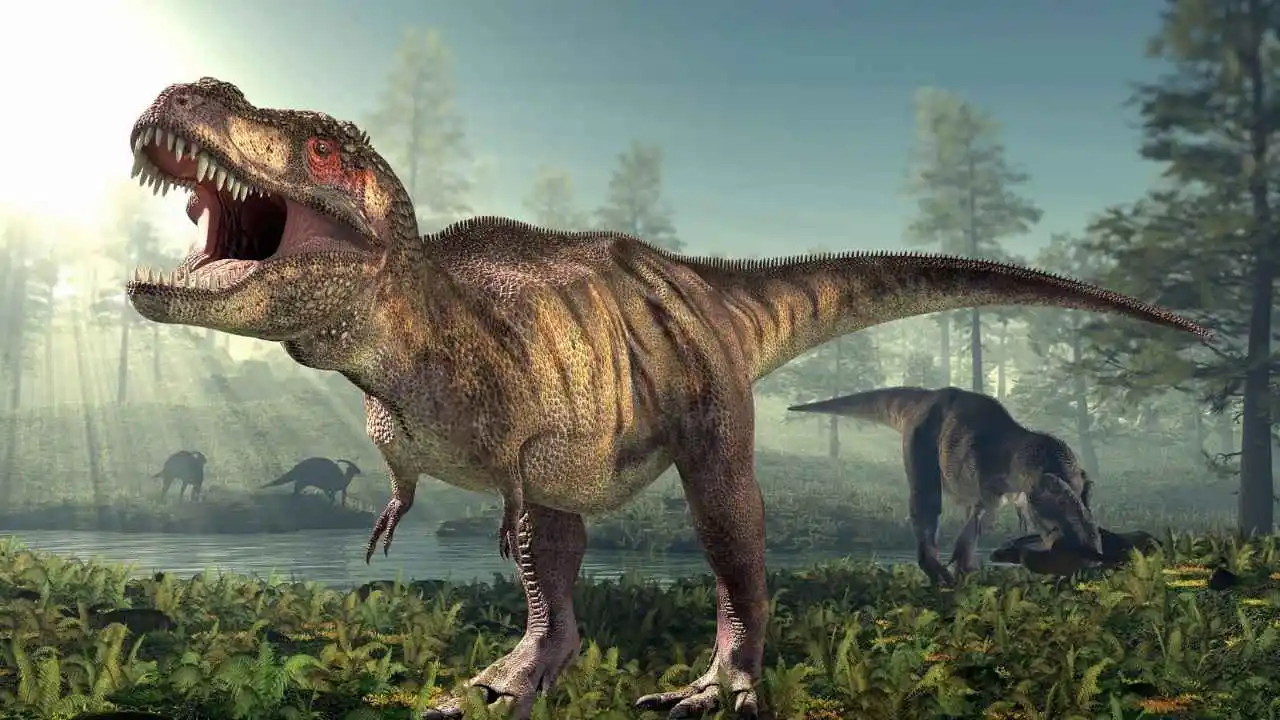
Megalodon holds the record for estimated bite force. The 2008 shark model predicted roughly 108,000–182,000 N for the giant shark, reported as about 10.8 to 18.2 tonnes of force [11][13]. The largest crocodilian, Deinosuchus, is estimated at up to 102,803 N (23,102 lbf) [1]. Tyrannosaurus rex estimates run from 8,526 to 57,000 N [14][15]. All are estimates from fossils.
Estimated bites of giants (not measured)
Model estimates in newtons, drawn to scale against the top megalodon figure. The paler part of a bar shows the range between low and high estimates. The measured saltwater crocodile is included for comparison.
Megalodon (2008 model): about 108,000–182,000 N
Deinosuchus, 11 m extinct crocodilian: up to 102,803 N (23,102 lbf)
Tyrannosaurus rex (two studies): 8,526–57,000 N
6.7 m saltwater crocodile (estimate): 27,531–34,424 N
Great white shark (2008 model): about 17,700 N
Saltwater crocodile (measured, for comparison): 16,414 N
Sources: Wroe et al. 2008; Erickson et al. 2012; Bates & Falkingham 2012; Gignac & Erickson 2017.
The two T. rex studies differ a lot. Bates and Falkingham’s 2012 muscle model gave 35,000–57,000 N at a single back tooth, which they called the highest bite estimated for any land animal [14]. Gignac and Erickson’s 2017 study gave 8,526–34,522 N, along with tooth pressures high enough to shatter bone [15]. That bite explains why T. rex could pulverise and digest bones, something most reptiles cannot do [15].
Megalodon is even harder to pin down, because scientists study it mostly from fossil teeth and vertebrae [16]. It went extinct about 3.6 million years ago, according to a 2019 study reported by National Geographic [16]. Treat its bite figure as a rough, model-based guess.
How strong is a human bite compared with animals?
Weak, for our size. Studies using bite sensors on adults have recorded maximum bites from about 446 to 1,221 N [9], and men usually bite harder than women [9]. The record crocodile bit about 13 times harder than the top of that range. The strongest human bite on record is 442 kg (975 lb), by Richard Hofmann in 1986 [10].
Guinness World Records reports that Hofmann, of Lake City, Florida, held that bite for about two seconds on a gnathodynamometer at the University of Florida’s College of Dentistry, more than six times a normal bite [10]. It is one test of one person, so treat it as a record, not an average. For full-body strength comparisons, see you vs a chimpanzee.
Picture it: how hard is 16,414 newtons?
- The weight of about 24 adults. 16,414 N ÷ 9.81 ≈ 1,673 kg of weight. Divided by 70 kg per adult, that is about 24 people.
- About 13 strong human bites at once. 16,414 N ÷ 1,221 N (the top of the normal human range) ≈ 13.4.
- A hyena and a record human are almost tied. About 4,500 N for the hyena against about 4,340 N for Hofmann (442 kg × 9.81). The hyena does it every day; he did it once.
- Megalodon would beat the crocodile about 11 times over. 182,000 N ÷ 16,414 N ≈ 11, if the top 2008 estimate is right.
Calculations are ours, using the figures in the tables above. The 70 kg adult is a round number chosen for the comparison.
What is the strongest dog bite?
Measured dog bites top out at about 1,394 N in awake pet dogs and 3,417 N at the back teeth of dogs under anaesthesia [7][8]. The best predictors of a dog’s bite included body weight and skull measurements [8]. No study we found has measured breed records, so viral breed figures in psi are not reliable.
In the 1995 pet-dog study, most bites were gentle: 77% were under 400 N, and the average was 256 N [7]. Dogs rarely bite as hard as they can. Our page on cane corso bite force uses these studies to estimate what a large mastiff-type dog can really do.
Why does bite force matter in nature?
A bite’s strength matches the job it does. Spotted hyenas are famous for crushing and eating bones [4], so their bite opens up food that only real force can reach. Crocodilians have dominated the predator roles where water meets land for over 85 million years [1], and their bite lets them seize and hold large prey. Gentle feeders need almost no bite at all.
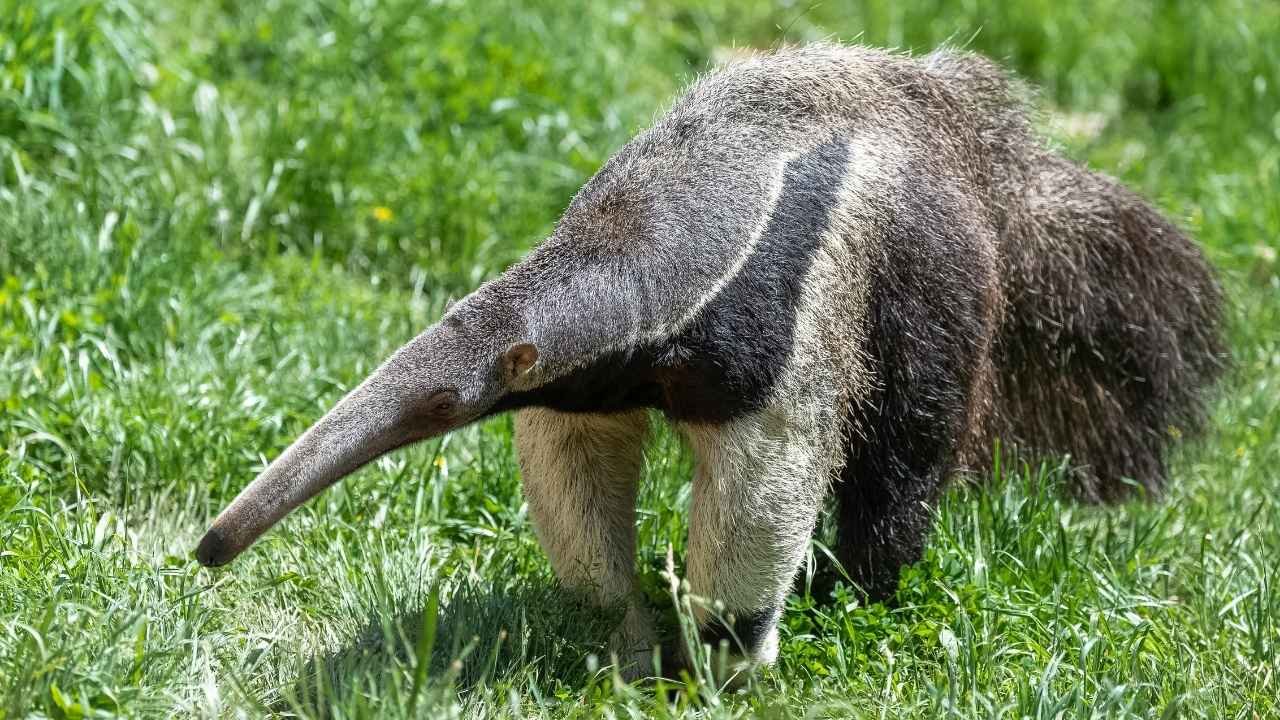
The giant anteater is the clearest example: it has no teeth, and it feeds on ants and termites with a tongue about 60 cm (2 ft) long that can flick in and out up to 150 times a minute, says the Smithsonian’s National Zoo [17]. Strong bites and toothless tongues are two answers to the same question: how to get food from what is around you. Explore more species in our animal directory, or see what eats crocodiles despite that bite.
Myths about bite force
Myth: A saltwater crocodile bites at 3,700 psi.
Fact: The measured record is 16,414 N, which is 3,689 pounds of force, not pounds per square inch [1]. Why people believe it: the number is real, but somewhere along the way the unit was swapped, and the mistake has been copied ever since.
Myth: The hippo has the strongest bite of any mammal, at 1,800 psi.
Fact: We found no published measurement of a hippo’s bite. The strongest mammal bite actually measured is the spotted hyena’s, at about 4,500 N [1][4]. Why people believe it: hippos have huge mouths and are genuinely dangerous, so a big number sounds right.
Myth: Crocodiles with narrow snouts bite much more weakly than broad-snouted alligators.
Fact: Across all living crocodilians, jaw shape had “surprisingly little correlation” with bite force; body size explained almost everything [1]. Only the fish-eating gharial bites clearly weaker than expected for its size [1]. Why people believe it: a broad, heavy snout looks more powerful.
Test yourself
1. Which animal has the strongest bite ever measured?
The saltwater crocodile: 16,414 N (3,689 lbf).
2. Why is “psi” the wrong unit for an animal’s bite?
Psi is pressure (force spread over an area). Bite sensors measure force, in newtons or pounds of force.
3. Which mammal has the strongest measured bite?
The spotted hyena, at about 4,500 N (1,011 lbf).
Where to next?
➡️ Go wider: how strong a tiger is, from bite to drag⬆️ Go deeper: alligator vs crocodile, the science of the record bite🔀 Go sideways: you vs a chimpanzee, by the numbers
Frequently asked questions
What animal has the strongest bite in psi?
No animal has a reliable “psi” bite figure, because scientists measure bite force, not pressure. The famous “3,700 psi” for the saltwater crocodile is really 3,689 pounds of force (16,414 N), measured by Erickson’s team in 2012. Real pressures at a single tooth tip are far higher, up to about 201,000 psi.
What has a stronger bite than a crocodile?
No living animal has a stronger measured bite. A large great white shark may come close, with a 2008 model estimate of about 1.8 tonnes of force, but that is not a measurement. Extinct megalodon, Deinosuchus and Tyrannosaurus rex are all estimated to have bitten harder.
Which mammal has the strongest bite?
The spotted hyena has the strongest bite measured in a mammal, about 4,500 N (1,011 lbf), recorded with a force transducer in captive hyenas. Hippos, gorillas and bears are often said to bite harder, but we found no published measurements of their bites to support that.
What is the average human bite force?
Studies with bite sensors record maximum adult bites of about 446 to 1,221 N (100 to 275 lbf), with men usually biting harder than women. The record is 442 kg (975 lb) for about two seconds, by Richard Hofmann in 1986, according to Guinness World Records.
Which animal has the weakest bite?
Nobody has ranked the weakest bites, but some animals hardly need one. The giant anteater has no teeth at all, according to the Smithsonian’s National Zoo. It laps up ants and termites with a sticky tongue about 60 cm (2 ft) long instead of biting them.
Sources
- Erickson, G.M. et al. (2012). Insights into the ecology and evolutionary success of crocodilians revealed through bite-force and tooth-pressure experimentation. PLOS ONE 7(3): e31781.
- Erickson, G.M., Lappin, A.K., Parker, T. and Vliet, K.A. (2004). Comparison of bite-force performance between long-term captive and wild American alligators (Alligator mississippiensis). Journal of Zoology 262: 21-28.
- University of Florida News (2003). Research: alligator is animal kingdom’s champion chomper.
- Binder, W.J. and Van Valkenburgh, B. (2000). Development of bite strength and feeding behaviour in juvenile spotted hyenas (Crocuta crocuta). Journal of Zoology 252: 273-283.
- Wroe, S., McHenry, C. and Thomason, J. (2005). Bite club: comparative bite force in big biting mammals and the prediction of predatory behaviour in fossil taxa. Proceedings of the Royal Society B 272.
- van der Meijden, A. et al. (2023). Measurement of voluntary bite forces in large carnivores using a semi-automated reward-driven system. Journal of Experimental Biology 226(7): jeb245255.
- Lindner, D.L. et al. (1995). Measurement of bite force in dogs: a pilot study. Journal of Veterinary Dentistry 12.
- Ellis, J.L. et al. (2008). Calibration of estimated biting forces in domestic canids: comparison of post-mortem and in vivo measurements. Journal of Anatomy.
- Koc, D., Dogan, A. and Bek, B. (2010). Bite force and influential factors on bite force measurements: a literature review. European Journal of Dentistry 4.
- Guinness World Records. Strongest human bite.
- Wroe, S. et al. (2008). Three-dimensional computer analysis of white shark jaw mechanics: how hard can a great white bite? Journal of Zoology 276: 336-342.
- UNSW Newsroom (2008). Great white’s mighty bite revealed.
- Discover (2008). Ancient “big tooth” shark had the mightiest bite in history.
- Bates, K.T. and Falkingham, P.L. (2012). Estimating maximum bite performance in Tyrannosaurus rex using multi-body dynamics. Biology Letters 8.
- Gignac, P.M. and Erickson, G.M. (2017). The biomechanics behind extreme osteophagy in Tyrannosaurus rex. Scientific Reports 7.
- National Geographic (2019). News report on the 2019 megalodon extinction study.
- Smithsonian’s National Zoo & Conservation Biology Institute. Giant anteater.
- Field & Stream (2026). 10 most powerful animal bites on the planet. Cited only as an example of where the unsourced psi figures circulate.
Corrections: on 14 October 2026 we rewrote this article. The earlier version listed bite forces in “psi” without sources, mislabelled the crocodile record, and gave unsourced figures for T. rex, megalodon, hippos, gorillas and humans. Those have been corrected or removed.
Sources checked 14 October 2026.

Keep the conversation curious