
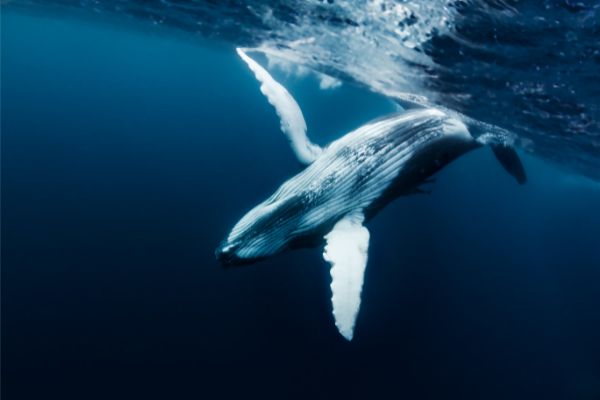
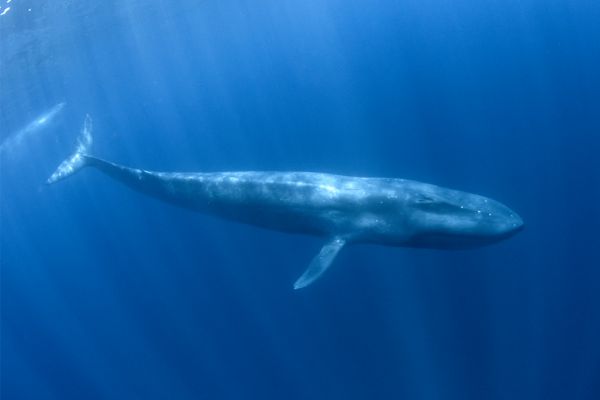
A long blue-grey shape slides under a whale-watching boat. It keeps coming, and coming. By the time its small fin appears, the head is already far past the bow.
A blue whale is the biggest animal known to have lived. The largest, around Antarctica, reach about 33 m (108 ft), the longest reliably measured. They weigh up to about 150 tonnes (330,000 lb), says NOAA Fisheries. Females are generally bigger than males, and blue whales in the North Atlantic and North Pacific are smaller, growing to about 27 m (90 ft).
Key takeaways
- Length: usually up to about 27 m (90 ft) in the north; up to about 33 m (108 ft) for rare Antarctic giants.
- Weight: up to about 150 tonnes (330,000 lb). No whole blue whale has ever been weighed.
- Females are bigger: on average about 27 m for females and 25 m for males.
- The heart: about 180 kg (400 lb) and smaller than a Volkswagen Beetle, not “the size of a car”.
How big is a blue whale? Sizes by population
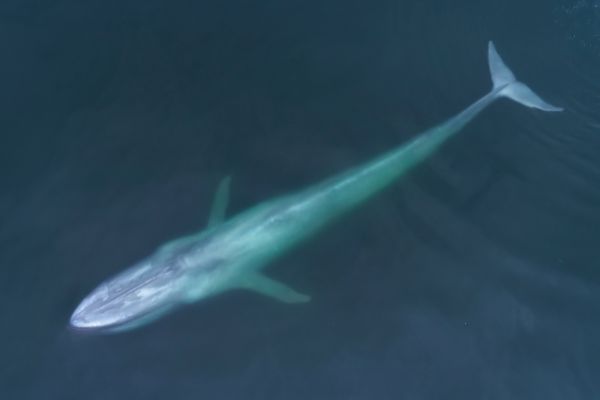
It depends where the whale lives. Antarctic blue whales are the giants, reaching about 33 m and 150 tonnes. Northern blue whales top out near 27 m (90 ft) and over 45 tonnes (100,000 lb), says NOAA. Pygmy blue whales, a smaller subspecies, grow to about 24 m. So the honest answer is a range.
| Group | Length | Weight | Source |
|---|---|---|---|
| Antarctic blue whale | Up to about 33 m (108 ft) reliably measured; NOAA rounds to 110 ft | Up to about 150 t (330,000 lb) | NOAA Fisheries; McClain et al. 2015 |
| North Atlantic and North Pacific | Up to about 27 m (90 ft) | Over 45 t (100,000 lb) | NOAA Fisheries |
| Pygmy blue whale (Indian Ocean and around Australia) | Up to 24.1 m (79 ft) | No reliable figure found | Australian Government |
| Average adult female | About 27 m (89 ft) | Not given | Animal Diversity Web |
| Average adult male | About 25 m (82 ft) | Not given | Animal Diversity Web |
| Longest reliable record | 33 m (108 ft), measured by whalers | No whole blue whale has ever been weighed | McClain et al. 2015 |
| Heaviest estimates | Not applicable | 190 and 199 t (whalers’ estimates); about 270 t (2024 calculation) | McClain et al. 2015; Motani & Pyenson 2024 |
| Newborn calf | About 7 m (23 ft) | 2.3 to 2.7 t (5,000 to 6,000 lb) | US National Park Service |
| Calf at weaning (6 months) | Over 15.8 m (52 ft) | Not given | US National Park Service |
The Australian Government records the pygmy blue whale growing to 24.1 m, while Antarctic blue whales grow to over 30 m. That subspecies explains much of the size difference between regions.
Are female blue whales bigger than males?
Yes. Female blue whales are generally larger than males, says NOAA Fisheries. The Animal Diversity Web at the University of Michigan gives average lengths of about 27 m (89 ft) for females and 25 m (82 ft) for males.
A bigger body may help a mother. She carries her calf for about 10 to 12 months, NOAA says, and then feeds it rich milk until it is weaned at about six months. Weight differences between the sexes have not been reliably measured, because whole whales are so hard to weigh.
Picture it: a blue whale beside things you know
Lengths drawn to scale. The longest bar is the 33 m record whale.
Average US man: 1.75 m
Smart car (one of the smallest cars): 2.69 m
London double-decker bus: about 11.2 m
Newborn blue whale calf: about 7 m
Average adult male blue whale: about 25 m
Average adult female blue whale: about 27 m
Longest reliably measured blue whale: 33 m
So a big female is about as long as two and a half buses, ten small cars or fifteen men lying head to toe. Sources: CDC; Smart fortwo specifications; NPS; Animal Diversity Web; McClain et al. 2015. The bus length is a rounded design figure for the New Routemaster.
How long is a blue whale in feet and metres?
A big adult blue whale is about 25 to 27 m (82 to 89 ft) long, and the longest reliably measured one was 33 m (108 ft). You’ll often see “110 feet” or “33.58 metres” given as the record. That 33.58 m whale was measured more than a century ago, and scientists don’t fully trust it.
A 2015 review in PeerJ, led by Craig McClain, looked at whaling records. It gives 33 m as the longest reliable length, from a whale caught in Antarctic waters. Some early whalers may have measured in Norwegian feet, which are slightly longer than ordinary feet, or along the curve of the body. The review found that 95% of caught whales were shorter than 27.1 m (about 89 ft).
How much does a blue whale weigh?
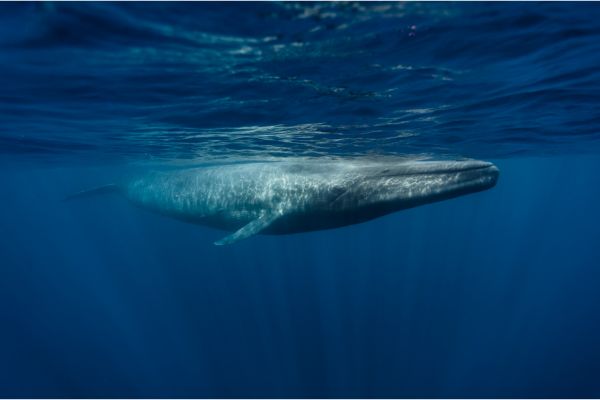
The biggest Antarctic blue whales weigh up to about 150 tonnes (330,000 lb), says NOAA. But nobody has ever put a whole blue whale on a scale, according to the 2015 PeerJ review. Every weight you read is an estimate, worked out from whalers’ records or from a formula. Here is what we have:
- NOAA’s figure: up to 330,000 lb (about 150 tonnes). The National Park Service gives about 160 US tons (145 tonnes) for a 30 m (100 ft) adult.
- Whalers’ estimates: the two highest are 190 and 199 tonnes. Whalers cut whales into pieces and added up what went into their cooking tanks.
- A formula: in 2024, Ryosuke Motani and Nicholas Pyenson calculated that the largest blue whales could have weighed about 270 tonnes, reports UC Davis. That number comes from maths, not a scale.
How big is a blue whale compared to a human?
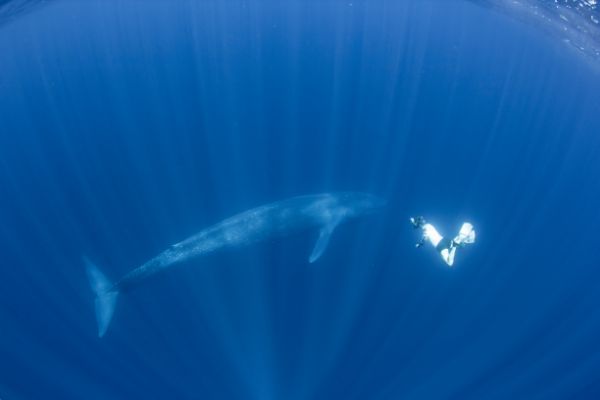
You would need about 17 average men lying head to toe to match a 30 m (100 ft) blue whale. The average US man is 175 cm (5 ft 9 in) tall and weighs 90 kg (199 lb), says the CDC. A 150-tonne whale weighs about as much as 1,650 of those men, or about 1,900 average US women (78 kg each).
| Compared with | Its size | How it stacks up |
|---|---|---|
| Average US man | 175 cm (5 ft 9 in), 90 kg (199 lb) | About 17 men long; about 1,650 men in weight |
| SUE, the largest known T. rex | More than 12 m (40 ft) long | About 2.5 SUEs nose to tail |
| Adult Asian elephant | 2,750 to 5,420 kg (6,000 to 12,000 lb) | About 28 to 55 elephants in weight |
| Boeing 737-8 airliner | 39.5 m (129 ft 6 in) | The plane is about 9.5 m (31 ft) longer |
Comparisons are rounded. Other sizes are from the Field Museum, Smithsonian’s National Zoo and Boeing.
How big are baby blue whales, and how fast do they grow?
A newborn blue whale is about 7 m (23 ft) long and weighs 2.3 to 2.7 tonnes (5,000 to 6,000 lb), says the US National Park Service. On its mother’s rich milk, it gains up to 4.5 kg (10 lb) an hour, or over 113 kg (250 lb) a day. It is weaned at six months old, when it is already over 15.8 m (52 ft) long.
Blue whales can live about 80 to 90 years, NOAA estimates, and become adults at 5 to 15 years old.
How big is a blue whale’s heart?
A blue whale’s heart weighs about 180 kg (400 lb) and is roughly 1.5 m (5 ft) across, 1.2 m (4 ft) high and 0.9 m (3 ft) deep. Those are the measurements of the only blue whale heart ever preserved, reported by CBC News. That makes it big, but nowhere near the size of a family car.
The heart came from a whale that washed up at Rocky Harbour, Newfoundland, in 2014. Scientists from the Royal Ontario Museum cut it out, sent it to Germany to be preserved, and put it on display. When they measured it, CBC reported, the heart turned out to be “slightly smaller than a Volkswagen Beetle”. It is shown next to a Smart car, which is about the same size.
So where does “the size of a car” come from? Even the US National Park Service still says the heart is the size of a Volkswagen Beetle. That claim was made before anyone had measured a real one. Now that we have, the honest version is: a very small car at most, and lighter than three average men.
That giant heart beats very slowly. In a 2019 study in PNAS, Jeremy Goldbogen’s team stuck a heart-monitoring tag to a wild blue whale with suction cups. On feeding dives its heart usually beat 4 to 8 times a minute, and sometimes only twice. At the surface it sped up to 25 to 37 beats a minute.
Was any animal ever bigger than a blue whale?
Not as far as we know, and that includes every dinosaur. In 2023, a fossil whale from Peru called Perucetus colossus challenged the title, with a first mass estimate of about 180 tonnes. In 2024, Motani and Pyenson re-ran the numbers, UC Davis reports, and estimated 60 to 70 tonnes for a 17 m animal.
That is well below the biggest blue whales, so for now the blue whale keeps the crown.
Why are blue whales so big?
Because they eat krill, tiny shrimp-like animals that gather in huge swarms. Adults can eat 3 to 4 tonnes of krill a day, says the Animal Diversity Web. The PeerJ review links giant size to filter feeding: a huge body takes enormous mouthfuls and stores energy for long trips between feeding areas.
To see how the mouth manages it, read how long a blue whale’s tongue is.
What does a giant whale do for the ocean?
A blue whale is a fertiliser pump. Whales feed in deep water and release floating plumes of poo near the surface. In a 2010 study in PLOS ONE, Joe Roman and James McCarthy showed this brings nitrogen up to the sunlit water, where tiny plants called phytoplankton grow. Those plants feed the krill that whales and many other animals eat.
Fewer whales means less of this mixing. Commercial whaling killed hundreds of thousands of blue whales, and NOAA lists the species as Endangered under the US Endangered Species Act. Even after death a whale feeds the deep sea; see what happens when a whale dies.
Myths about blue whale size
Myth: A blue whale’s heart is the size of a car.
Fact: The one measured heart weighed about 180 kg and was slightly smaller than a Volkswagen Beetle, about the size of a Smart car or a bumper car. Why people believe it: the comparison was repeated for years before anyone measured a real heart.
Myth: Blue whales weigh 200 tons.
Fact: NOAA gives up to about 150 tonnes. The highest whalers’ estimates, 190 and 199 tonnes, were rare giants, and no whole blue whale has been weighed.
Myth: Male blue whales are the biggest.
Fact: Females are generally larger, by about 2 m on average. Why people believe it: in many mammals, males are bigger.
Test yourself
1. Which are bigger, male or female blue whales?
Females, by about 2 m on average.
2. About how much did the preserved blue whale heart weigh?
About 180 kg (400 lb).
3. Has a whole blue whale ever been weighed?
No. Every weight is an estimate.
Where to next?
➡️ Go wider: how big whale sharks are, the biggest fish⬆️ Go deeper: how long a blue whale’s tongue is🔀 Go sideways: what eats a blue whale
Frequently asked questions
How big is a blue whale in feet?
Northern blue whales grow up to about 90 feet. The largest Antarctic blue whales reach about 100 to 108 feet, and NOAA rounds the top figure to 110 feet. In whaling records, 95% of blue whales were under about 89 feet, so a typical adult is smaller than the record.
Is a blue whale bigger than a dinosaur?
Yes, by weight. SUE, the largest known T. rex, is more than 12 m (40 ft) long, less than half a big blue whale’s length. Some long-necked dinosaurs were longer than blue whales, but their bodies were much lighter. No dinosaur is known to have come close to a blue whale’s weight.
Could a person swim through a blue whale’s arteries?
No. The National Park Service says the main blood vessel, the aorta, is large enough for a person to crawl through, but scientists who dissected the preserved heart found the vessels were not big enough to swim in, CBC reported. It is a big heart, not a swimming pool.
How do scientists know how big blue whales are?
Most length records come from whalers, who measured tens of thousands of whales in the last century. Weights are harder, because no whole blue whale has ever been weighed. Scientists combine whalers’ records, measurements of stranded whales, and formulas that estimate weight from length.
Sources
- NOAA Fisheries. Blue whale (Balaenoptera musculus) species profile.
- McClain, C. R. et al. (2015). Sizing ocean giants: patterns of intraspecific size variation in marine megafauna. PeerJ 3: e715.
- Animal Diversity Web, University of Michigan. Balaenoptera musculus.
- US National Park Service. Blue whale.
- Australian Government. Balaenoptera musculus: Species Profile and Threats Database.
- CBC News (2015). Heart of blue whale beached in Rocky Harbour being dissected, preserved.
- Royal Ontario Museum. Blue whale heart arrives at the ROM.
- Goldbogen, J. A. et al. (2019). Extreme bradycardia and tachycardia in the world’s largest animal. PNAS 116(50): 25329-25332.
- Roman, J. and McCarthy, J. J. (2010). The whale pump: marine mammals enhance primary productivity in a coastal basin. PLOS ONE 5(10): e13255.
- University of California, Davis (2024). Slimming down a colossal fossil whale.
- CDC National Center for Health Statistics. FastStats: body measurements.
- Field Museum. SUE the T. rex.
- Smithsonian’s National Zoo. Asian elephant.
- Boeing. 737 MAX.
- Caradisiac. Smart fortwo technical specifications (length 2.69 m).
Sources checked 12 October 2026.
Keep the conversation curious