
Early morning in a northern marsh. Something dark lifts its head out of the water, and keeps lifting. By the time it stands up on the bank, its shoulders are higher than your head.
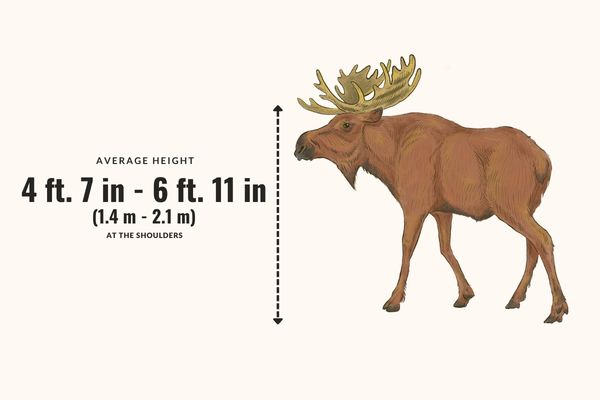
How tall is a moose? An adult moose stands about 1.5 to 2.1 m (5 to 7 ft) at the shoulder, says the US National Park Service, and the biggest reach about 2.3 m (7.5 ft). Large bulls weigh up to about 680 kg (1,500 lb). Moose are the largest members of the deer family, and below you will see how they measure up against you.
Key takeaways
- Height: about 1.5 to 2.1 m (5 to 7 ft) at the shoulder, up to about 2.3 m (7.5 ft).
- Weight: bulls about 360 to 600 kg (790 to 1,320 lb), cows about 270 to 400 kg (600 to 880 lb); large bulls up to about 680 kg (1,500 lb).
- Length: about 2.4 to 3.1 m (8 to 10 ft) for bulls and 2.3 to 3.0 m for cows.
- Antlers: up to about 1.5 m (5 ft) across, with a record spread of about 2 m (6 ft 9 in).
Picture it: a moose next to you
Shoulder heights drawn to the same scale (1 m = 60 px). The person is an average US man, 175 cm (5 ft 9 in), from CDC data. A moose’s head and antlers rise above its shoulder.
1.75 m
1.5–2.1 m
about 2.3 m
Sources: National Park Service; Animal Diversity Web; CDC. The paler top of the middle bar shows the range between small and large adults.
How tall is a moose at the shoulder?
Most adult moose stand between 1.5 and 2.1 m (5 and 7 ft) high at the shoulder, according to the National Park Service at Rocky Mountain National Park. The tallest moose reach about 2.3 m (7.5 ft), says the Animal Diversity Web at the University of Michigan. Shoulder height is the standard measure, because the head moves up and down.
So a big moose’s back is higher than most people’s heads. Its long legs help it wade through deep snow and swim in deep water, the Park Service says.
| Measurement | Bull (male) | Cow (female) | Source |
|---|---|---|---|
| Shoulder height | About 1.5–2.1 m (5–7 ft); up to about 2.3 m | NPS; ADW | |
| Length | About 2.4–3.1 m (8–10 ft) | About 2.3–3.0 m (7.5–10 ft) | ADW |
| Weight | About 360–600 kg (790–1,320 lb); large bulls up to 680 kg (1,500 lb) | About 270–400 kg (600–880 lb); roughly three-quarters of a bull | ADW; NPS |
| Antler spread | Up to about 1.5 m (5 ft); record about 2 m | Antlers are a male trait | NPS; ADW |
| Newborn calf | Average about 16 kg (36 lb) | ADW | |
How big is a moose compared to a human?
A moose is much taller than a person once you count its head. The average US man is about 175 cm (5 ft 9 in) tall, says the CDC. A typical adult moose’s shoulder is at about the same height or higher, and its head and antlers sit above that.
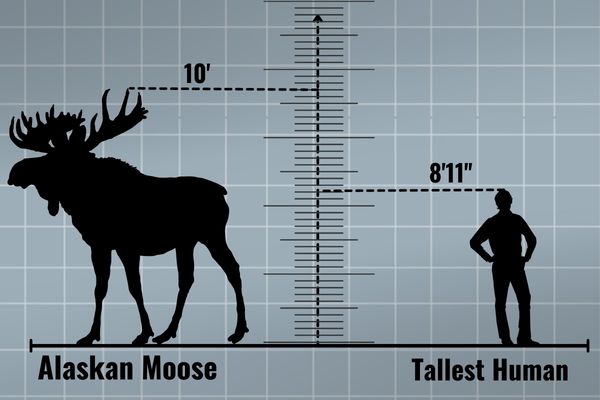
In weight, there is no contest. A large bull at about 680 kg (1,500 lb) weighs as much as several adult people put together. That bulk is one reason moose deserve plenty of space if you meet one.
How much does a moose weigh?
Bull moose weigh about 360 to 600 kg (790 to 1,320 lb) and cows about 270 to 400 kg (600 to 880 lb), says the Animal Diversity Web. The National Park Service says large males can reach 680 kg (1,500 lb), with females roughly three-quarters of that. Weight changes a lot with age, region and season.
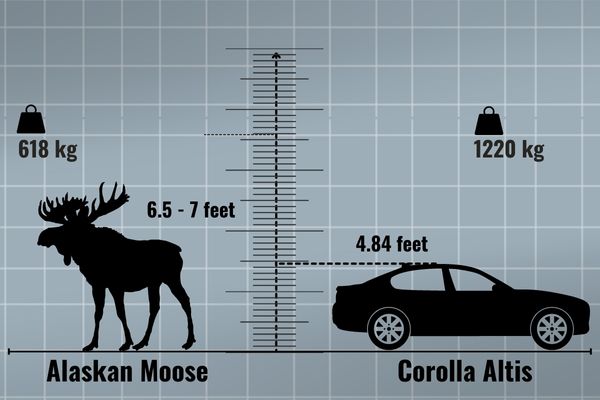
All that weight runs on plants. A moose can eat up to 32 kg (70 lb) of food a day, says the Park Service, mostly leaves, stems, buds and bark of shrubs and trees. In summer they also wade in to eat water plants.
How long is a moose?
A bull moose is about 2.4 to 3.1 m (8 to 10 ft) long, and a cow about 2.3 to 3.0 m (7.5 to 10 ft), according to the Animal Diversity Web. That is roughly the length of a small sofa plus a coffee table, but on legs that lift it above your head.
How big are moose antlers?
Bull moose antlers can reach about 1.5 m (5 ft) across and weigh up to about 35 kg (77 lb), says the National Park Service. The widest spread on record is 2,048 mm, just over 2 m (6 ft 9 in), according to the Animal Diversity Web. Moose carry the largest antlers of any mammal.
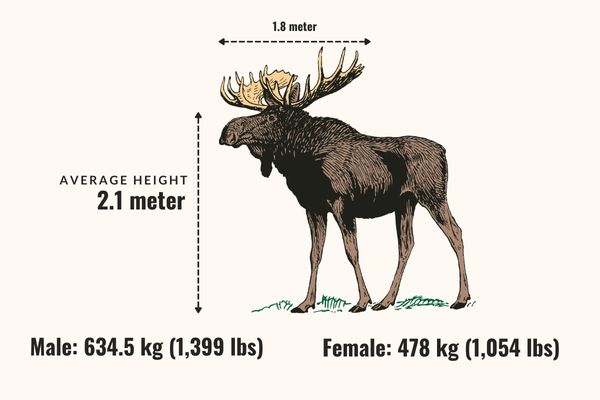
Those antlers are not permanent. They grow in spring and are shed in winter every year, the Animal Diversity Web says. So a bull builds and drops one of the heaviest structures in the animal world, every single year.
Is a moose bigger than a horse?
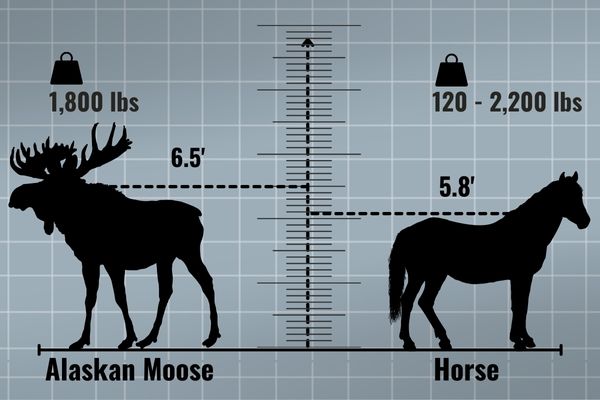
A big moose is usually taller at the shoulder than most horses, and its antlers make it look even bigger. Horse breeds vary hugely in size, though, so the honest answer depends on the horse. A large bull moose at up to 680 kg (1,500 lb) is in the same weight class as many big horses.
How fast can a moose run and swim?
Faster than you might think. The National Park Service gives moose top speeds of about 56 km/h (35 mph), and the Animal Diversity Web reports a clocked maximum of 56 km/h. Moose are strong swimmers too, recorded swimming up to 20 km (12 miles) and at up to 9.5 km/h (6 mph).
Why does a moose’s size matter to the forest?
A moose is big enough to change its habitat. By browsing, trampling and leaving droppings, moose affect which plants grow, how forests change over time and how nutrients such as nitrogen return to the soil. For this reason the Animal Diversity Web says moose are considered a keystone species.
Size is also their defence. Adult moose are hard to kill, but they are still hunted by gray wolves, brown bears and cougars, and calves are most at risk. To see how moose are doing worldwide, read are moose endangered.
Myths about moose size
Myth: Moose are slow and clumsy.
Fact: Moose can run at about 56 km/h (35 mph) and swim long distances. Why people believe it: they spend much of their time standing and browsing, and their long legs look awkward. Source: National Park Service; Animal Diversity Web.
Myth: A bull keeps the same antlers all his life.
Fact: Moose grow new antlers each spring and shed them each winter. Why people believe it: antlers are often confused with horns, which are permanent. Source: Animal Diversity Web.
Test yourself
1. How tall is a typical adult moose at the shoulder?
About 1.5 to 2.1 m (5 to 7 ft).
2. How wide can bull moose antlers be?
Up to about 1.5 m (5 ft), with a record of just over 2 m.
3. Which family is the moose the biggest member of?
The deer family.
Where to next?
➡️ Go wider: explore more animals and how big they get⬆️ Go deeper: are moose endangered, and what threatens them🔀 Go sideways: how much a bison weighs, North America’s heaviest land mammal
Frequently asked questions
How tall is a moose in feet?
About 5 to 7 ft at the shoulder, says the National Park Service. The biggest moose reach about 7.5 ft (2.3 m), according to the Animal Diversity Web. With the head raised and antlers on top, a big bull stands taller still.
Is a moose bigger than an elk?
Yes. Moose are the largest members of the deer family, according to the National Park Service, so they are bigger than elk. A large bull moose can weigh up to about 680 kg (1,500 lb).
How heavy is a baby moose?
Moose calves are born at an average weight of about 16 kg (36 lb), says the Animal Diversity Web. Cows usually have one or two calves in early summer after a pregnancy of about eight months, according to the National Park Service.
Do female moose have antlers?
Antlers are a male trait in moose. Bulls carry the largest antlers of any mammal, growing them in spring and shedding them in winter, according to the Animal Diversity Web. Cows normally do not grow them.
Sources
- National Park Service, Rocky Mountain National Park. Moose.
- Animal Diversity Web, University of Michigan Museum of Zoology. Alces alces.
- CDC National Center for Health Statistics. FastStats: body measurements (2021–2023 data).
Sources checked 12 October 2026.

Keep the conversation curious