

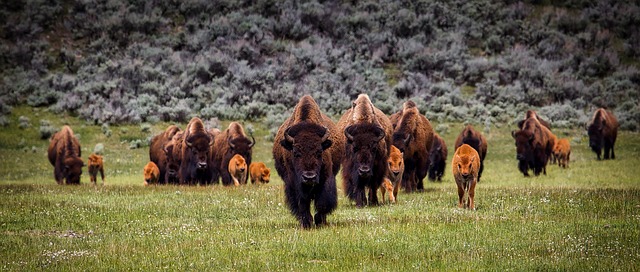
A low rumble crosses the valley floor. A herd of bison is on the move, and each animal in it weighs about as much as a small car.
How much does a bison weigh? An adult male bison weighs up to about 900 kg (2,000 lb) and a female about 500 kg (1,000 lb), says the National Park Service at Yellowstone. A big bull stands about 1.9 m (6 ft) high at the hump. That makes the bison the largest land mammal in North America. Here is how that size compares with you.
Key takeaways
- Males (bulls): up to about 900 kg (2,000 lb), about 1.7 to 2 m (5.5 to 6.5 ft) at the hump.
- Females (cows): about 500 kg (1,000 lb), about 1.5 m (5 ft) at the hump.
- Length: bulls 2.7 to 3.8 m (9 to 12.5 ft), cows 2.2 to 3.2 m (7 to 10 ft).
- Record holder: the largest land mammal in North America.

Picture it: a bison next to you
Heights at the hump drawn to the same scale (1 m = 60 px). The person is an average US man, 175 cm (5 ft 9 in), from CDC data.
1.75 m
about 1.5 m, 500 kg
about 1.9 m, 900 kg
Weight, drawn to scale:
Average US man, about 90 kg (CDC)
Cow bison, about 500 kg
Bull bison, up to about 900 kg
Sources: National Park Service; Smithsonian’s National Zoo; CDC.
How much does a male bison weigh?
A bull bison weighs up to about 900 kg (2,000 lb), according to the National Park Service at Yellowstone. The Smithsonian’s National Zoo gives a range of 816 to 1,088 kg (1,800 to 2,400 lb) for mature bison. Bulls are much bigger than cows, with a tall hump of muscle over the shoulders and a huge head.
That is close to the weight of ten average men. The CDC puts the average US man at about 90 kg (199 lb).
How much does a female bison weigh?
A cow bison weighs about 500 kg (1,000 lb), says the National Park Service. That is roughly half the weight of a big bull. Cows stand about 1.5 m (5 ft) at the hump and are 2.2 to 3.2 m (7 to 10 ft) long, according to the Smithsonian’s National Zoo.
Cows and their calves live together in herds. Calves are born reddish-tan after a pregnancy of 9 to 9.5 months, the Park Service says, and darken as they grow.
| Measurement | Bull (male) | Cow (female) | Source |
|---|---|---|---|
| Weight | Up to about 900 kg (2,000 lb) | About 500 kg (1,000 lb) | NPS |
| Weight (mature adults) | 816–1,088 kg (1,800–2,400 lb), not split by sex | Smithsonian | |
| Height at hump | About 1.7–2 m (5.5–6.5 ft) | About 1.5 m (5 ft) | Smithsonian |
| Length | 2.7–3.8 m (9–12.5 ft) | 2.2–3.2 m (7–10 ft) | Smithsonian |
| Top speed | About 48–56 km/h (30–35 mph) | Smithsonian; NPS | |
| Lifespan | 15–20 years | Smithsonian | |
How tall is a bison?
A mature bull stands about 1.7 to 2 m (5.5 to 6.5 ft) high at the hump, and a cow about 1.5 m (5 ft), says the Smithsonian’s National Zoo. The hump is the highest point because of the strong muscles that hold up the bison’s heavy head.
So a big bull’s hump is level with, or higher than, the head of an average man. But a bison is built long and deep rather than tall, which is why its weight is so impressive.
How long is a bison?
Bulls are 2.7 to 3.8 m (9 to 12.5 ft) long and cows 2.2 to 3.2 m (7 to 10 ft), according to the Smithsonian’s National Zoo. A big bull is longer than two adults lying head to toe.
How fast can a heavy bison run?
Despite their weight, bison can run at about 48 km/h (30 mph), says the Smithsonian’s National Zoo. The Yellowstone page gives figures of 30 to 35 mph (up to 55 km/h). That is faster than any human sprinter. Treat the exact top speed as an estimate.
This mix of weight and speed is why the Park Service tells visitors to stay at least 23 m (25 yards) from bison at all times, according to its Yellowstone safety page.
What does a bison eat to stay so heavy?
Bison are grazers that eat mainly grasses, plus flowering plants and other greens when they can find them, says the Smithsonian’s National Zoo. Each day a bison eats about 1.6% of its body weight in dry plant material. For a 900 kg bull, that is about 14 kg (32 lb) of dry food a day. Bison also need to drink every day.
Why does a bison’s size matter to the prairie?
Bison are big enough to shape the land they live on. The National Park Service says bison create high-quality food by how they move and graze. They also roll in the dirt, called wallowing, to keep off biting flies and shed old fur.
Their size feeds other animals too. Birds such as magpies and cowbirds eat insects on or near bison, and dead bison are an important source of food for scavengers and other carnivores, says the Park Service. Yellowstone’s herd was estimated at nearly 5,300 animals in 2025. See also how big a moose is, another giant of North America.
Myths about bison size
Myth: Bison are too heavy to move fast.
Fact: Bison can run at about 48 to 56 km/h (30 to 35 mph). Why people believe it: they usually graze slowly, and heavy animals look slow. Source: Smithsonian’s National Zoo; National Park Service.
Myth: A calm bison is safe to walk up to.
Fact: The Park Service says to stay at least 23 m (25 yards) away from bison at all times. Why people believe it: grazing bison look peaceful, but a 900 kg animal that can sprint is dangerous at close range. Source: National Park Service.
Test yourself
1. About how much does a bull bison weigh?
Up to about 900 kg (2,000 lb), says the National Park Service.
2. Which is the largest land mammal in North America?
The bison.
3. How far should you stay from a bison in Yellowstone?
At least 23 m (25 yards).
Where to next?
➡️ Go wider: explore more animals and how big they get⬆️ Go deeper: how much a grizzly bear weighs, another Yellowstone heavyweight🔀 Go sideways: how tall is a moose
Frequently asked questions
How much does a bison weigh in tons?
A big bull weighs up to about 0.9 tonnes (2,000 lb, or one US ton), says the National Park Service. The Smithsonian’s National Zoo gives mature bison 816 to 1,088 kg, so the heaviest are just over a tonne. Cows weigh about half a tonne.
Is a bison heavier than a moose?
Usually, yes. A bull bison weighs up to about 900 kg (2,000 lb), while large bull moose reach about 680 kg (1,500 lb), according to the National Park Service. Moose are taller at the shoulder, but bison are heavier.
How long do bison live?
Bison live about 15 to 20 years, according to the Smithsonian’s National Zoo. They reach their full adult size over several years, and bulls keep getting heavier than cows as they grow.
Is a bison the biggest animal in North America?
It is the largest land mammal in North America, says the National Park Service. Some whales off the coast are far bigger, but on land nothing in North America outweighs a big bull bison.
Sources
- National Park Service, Yellowstone. Bison.
- National Park Service, Yellowstone. Safety in the park.
- Smithsonian’s National Zoo & Conservation Biology Institute. American bison.
- National Park Service, Rocky Mountain National Park. Moose.
- CDC National Center for Health Statistics. FastStats: body measurements (2021–2023 data).
Sources checked 12 October 2026.

Keep the conversation curious