
An adult male polar bear is usually 2.4–2.6 m (7.9–8.5 ft) long and 1–1.5 m (3.3–4.9 ft) tall at the shoulder. Standing up, he reaches about 3 m (10 ft). He weighs 350–600 kg (770–1,320 lb), and females weigh about half that, say WWF and Hinterland Who’s Who.
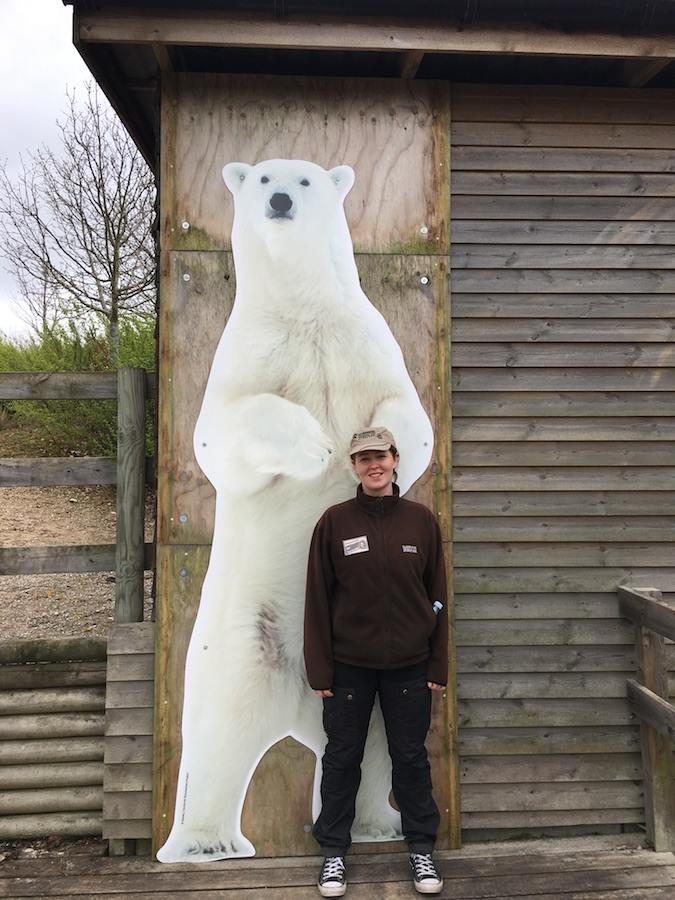
That makes the polar bear one of the two biggest bears alive, level with the Kodiak brown bear. But “how big” depends on what you measure: length, height on all fours, height standing up or weight. Males and females are so different in size that they need separate numbers, so the table shows both, with typical sizes next to the records.
How big is a polar bear? Males vs females
| Measurement | Adult male (typical) | Adult female (typical) | Biggest on record |
|---|---|---|---|
| Weight | 350–600 kg (770–1,320 lb) | 150–295 kg (330–650 lb) | Some males over 770 kg (1,700 lb) (ADFG); a 1960 bear estimated at about 900 kg (1,984 lb), disputed (Guinness) |
| Weight when pregnant | Not applicable | Up to 400–500 kg (880–1,100 lb) before entering the den (HWW) | Not recorded |
| Length, nose to tail | 2.4–2.6 m (7.9–8.5 ft) (HWW) | Shorter than males; most bears of both sexes are 1.8–2.7 m (6–9 ft) (SDZWA) | 3.5 m (11 ft 5 in), measured along the body’s curves, disputed (Guinness) |
| Height at the shoulder | 1–1.5 m (3.3–4.9 ft) (WWF) | No separate figure published; smaller than males | Close to 1.7 m (5.6 ft) in big bears (SDZWA) |
| Height standing up | About 3 m (10 ft) (PBI, WWF) | No reliable figure published | Over 3.7 m (12 ft) (SDZWA) |
| Newborn cub | About 0.5 kg (1 lb), 30–35 cm (12–14 in) | Same as males | Not recorded |
Typical weights come from Polar Bears International (males 350–590 kg, females 150–295 kg) and WWF (males 350–600 kg, females 150–290 kg). Other experts give slightly different ranges. San Diego Zoo Wildlife Alliance gives males 300–635 kg (660–1,400 lb) and females 150–250 kg (330–550 lb). The Alaska Department of Fish and Game gives males 600–1,200 lb (272–544 kg) and females 400–700 lb (181–318 kg).
Why the spread? Bears from different areas grow to different sizes, and one bear’s weight swings a lot through the year. Most bears are weighed when scientists catch them, and a spring bear can be much thinner than the same bear in early summer. So treat every range as “usual”, not as a hard limit.
How tall is a polar bear?
There are two ways to answer, and they give very different numbers.
On all fours: shoulder height
WWF says adult polar bears are usually 1 to 1.5 m (3.3 to 4.9 ft) tall at the shoulder. San Diego Zoo Wildlife Alliance puts most bears close to 1.7 m (5.6 ft). The average American woman is 161 cm (5 ft 3.5 in) tall, according to the CDC. So a big male’s shoulder can be about level with her head while he simply walks along.
How tall is a polar bear standing up?
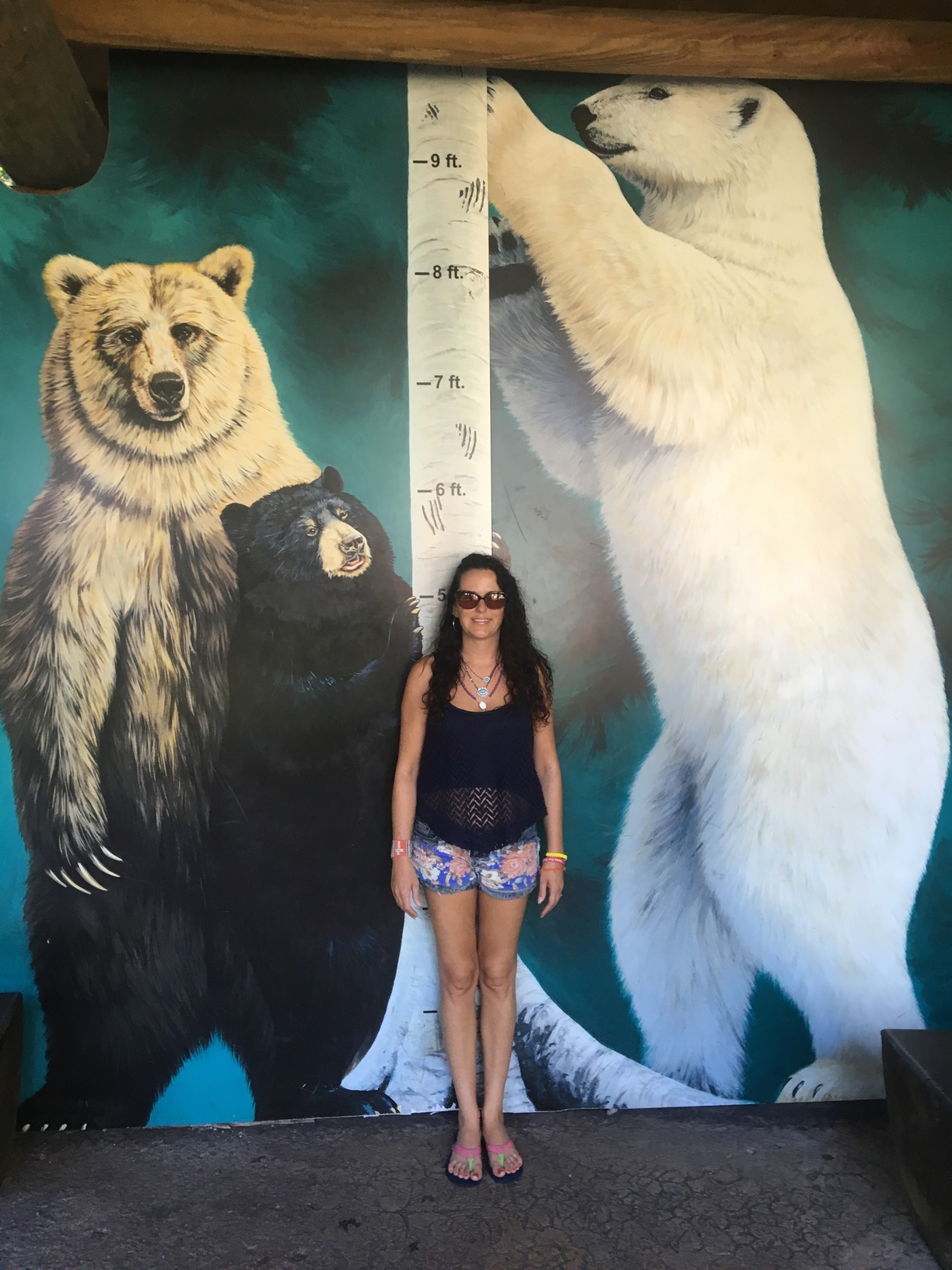
When a male rears up on his hind legs, he is about 3 m (10 ft) tall, says Polar Bears International. WWF says males can reach over 3 m. San Diego Zoo Wildlife Alliance goes further, at over 3.7 m (12 ft). Because sources disagree, treat standing heights as rough.
Even the careful 3 m figure is huge. The average American man is 175 cm (5 ft 9 in) tall (CDC), so a standing male bear is about 1.7 times his height. That is taller than a basketball hoop, which sits 3.05 m (10 ft) off the floor.
Why do polar bears stand on their hind legs?
Standing up most likely gives a bear a better view and helps it catch smells on the wind, as other bears do. Males also rear up when they fight. We could not find a study that measures how often wild polar bears stand, so take this as the likely reason rather than a proven one.
How much does a polar bear weigh?
An adult male usually weighs 350–600 kg (770–1,320 lb). That is about as much as six and a half average American men, who weigh 90 kg (199 lb) each (CDC). An adult female usually weighs 150–295 kg (330–650 lb), roughly half a male.

The biggest bears are heavier still. The Alaska Department of Fish and Game says some males weigh more than 1,700 lb (770 kg). Hinterland Who’s Who says males can reach 800 kg (1,760 lb).
Females have their own heavy season. A pregnant female can weigh 400 to 500 kg (880 to 1,100 lb) just before she enters her maternity den, says Hinterland Who’s Who. She needs that fat. She will not eat for months while she gives birth and feeds her cubs in the den.
Why does a polar bear’s weight change so much?
Polar bears live on a feast-and-fast cycle. When seal hunting is good, a bear can eat more than 45 kg (100 lb) of blubber in one sitting, says Polar Bears International. Much of that becomes body fat.
When the sea ice melts, the feast ends. In a 2024 study near western Hudson Bay, Canada, 20 bears spent three weeks on land in summer. All but one lost about 1 kg (2.2 lb) a day on average, reports Polar Bears International. The one exception found a dead marine mammal to eat. Our page on what polar bears eat explains why berries and grass cannot fill the gap.
How long is a polar bear?
Hinterland Who’s Who says adult males measure 240 to 260 cm (7.9 to 8.5 ft) from nose to tail. The Alaska Department of Fish and Game gives 8 to 10 ft (2.4 to 3 m) for males. San Diego Zoo Wildlife Alliance says most polar bears, males and females together, are 1.8 to 2.7 m (6 to 9 ft) long. A big male lying down would stretch across most of a family car.
Their tails add very little. A polar bear’s tail is short, which helps it lose less heat; see do polar bears have tails.
How big is a baby polar bear?
Polar bear cubs start out tiny. Polar Bears International says newborns weigh a little more than half a kilogram (about 1 lb) and are about 30 to 35 cm (12 to 14 in) long. The Alaska Department of Fish and Game gives 1 to 2 lb at birth. Cubs are usually twins, born in December or January inside a snow den (ADFG).
Growing up takes years. Hinterland Who’s Who says females reach adult size in their fifth or sixth year. Males keep growing until they are 8 to 10 years old. The polar bear life cycle and how long polar bears live cover the stages from den to old age.
What is the biggest polar bear ever recorded?
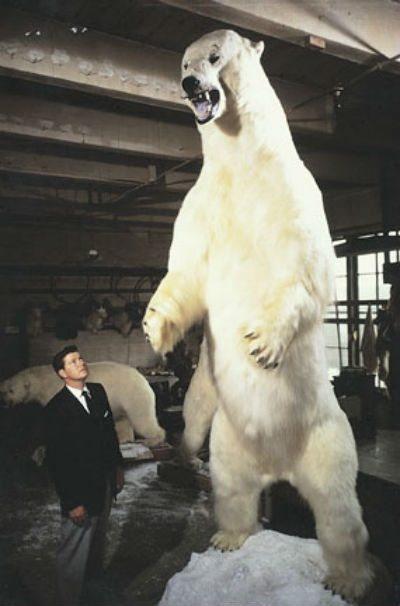
The most famous claim is a male shot in 1960 on the sea ice of the Chukchi Sea, west of Kotzebue, Alaska. Guinness World Records says it was estimated at about 900 kg (1,984 lb). It measured 3.5 m (11 ft 5 in) from nose to tail, measured along the curves of its body. Its paws were 43 cm (16.9 in) around.
Guinness notes that these figures have been disputed. You will often see this bear listed online at 1,002 kg (2,209 lb) and “3.39 m tall”. We could not find either number in any scientific, government or Guinness source. Also, the 3.5 m figure is a length, not a standing height.
Why are polar bears so big?
A big, round body loses heat more slowly than a small one, because it has less skin for each kilogram of body inside. That helps in a place where winter drops to −40 °C or lower, says Polar Bears International. The same page notes that small ears and a short tail cut heat loss too.
Size also comes from food. Seal blubber is packed with energy, and a big body can store huge amounts of it as fat for lean times. Big paws help carry the weight. They can measure up to 30 cm (12 in) across, which spreads a bear’s weight on thin ice (PBI). You can read more in polar bear adaptations.
Are polar bears bigger than grizzly bears?
Usually, yes. Bear weights change with season and place, so each row in this table uses one named source.
| Animal | Shoulder height | Standing height | Typical weight | Source |
|---|---|---|---|---|
| Average US man | Not applicable | 175 cm (5 ft 9 in) | 90 kg (199 lb) | CDC |
| Average US woman | Not applicable | 161 cm (5 ft 3.5 in) | 78 kg (172 lb) | CDC |
| Polar bear, adult male | 1–1.5 m (3.3–4.9 ft) | Over 3 m (10 ft) | 350–600 kg (770–1,320 lb) | WWF |
| Polar bear, adult female | Smaller than males | Smaller than males | 150–290 kg (330–640 lb) | WWF |
| Brown or grizzly bear | 0.9–1.5 m (3–5 ft) | Almost 2.7 m (9 ft) for very large bears | 91–454 kg (200–1,000 lb) | US National Park Service |
| Kodiak bear, adult male | Not given | Not given | 272–635 kg (600–1,400 lb) | US Fish and Wildlife Service |
| Kodiak bear, adult female | Not given | Not given | 136–318 kg (300–700 lb) | US Fish and Wildlife Service |
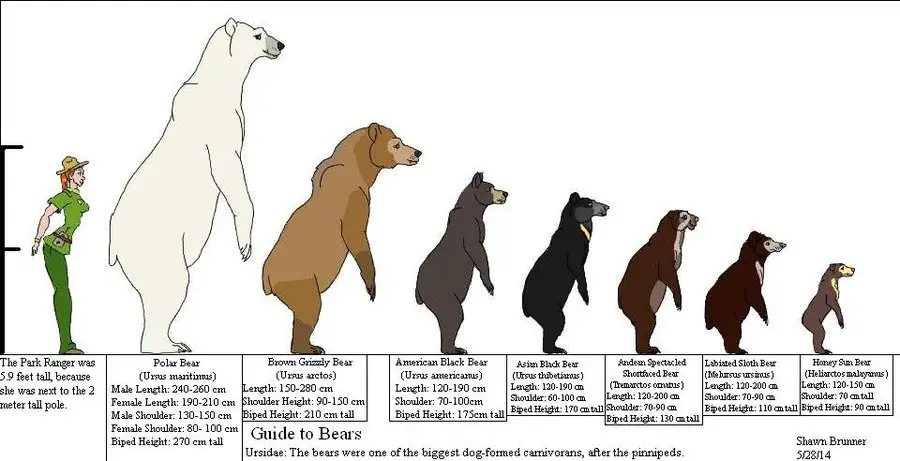
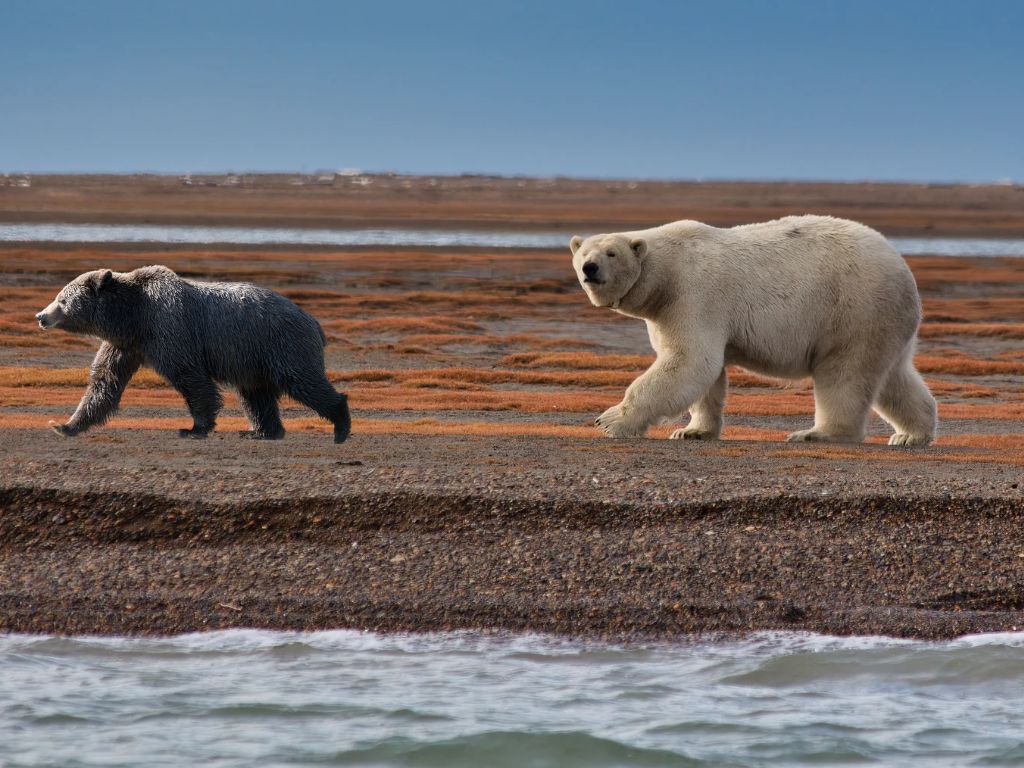
The National Park Service says brown and grizzly bears weigh 200 to 1,000 lb, so most are lighter than a big male polar bear. Kodiak bears, a kind of brown bear from Alaska, are the only real rival. The US Fish and Wildlife Service gives male Kodiaks 600 to 1,400 lb, almost the same as San Diego Zoo Wildlife Alliance’s 660 to 1,400 lb for male polar bears. Call it a tie.

For the full head-to-head, see polar bears vs grizzly bears: size, how big is a Kodiak bear and the biggest bear in the world. The two species can even mate; that story is in grizzly polar bear hybrids.
Frequently asked questions
How tall is a polar bear compared to a human?
On all fours, a big male's shoulder can be about as high as an average woman's head, around 1.5 to 1.7 m. Standing on his hind legs, he reaches about 3 m (10 ft). That is about 1.7 times the height of an average American man, who is 175 cm (5 ft 9 in) tall, according to the CDC.
How much does a male polar bear weigh in pounds?
Usually 770 to 1,320 lb (350 to 600 kg), according to WWF and Polar Bears International. The Alaska Department of Fish and Game says the biggest males top 1,700 lb (770 kg). Weights swing through the year, because bears fatten up on seals in spring and lose weight when the ice melts.
How big are polar bear paws?
Very big. Polar Bears International says a polar bear's paws can measure up to 30 cm (12 in) across. That spreads the bear's weight on thin ice, a bit like snowshoes. Guinness World Records says the paws of the disputed 1960 record bear measured 43 cm (16.9 in) around.
When is a polar bear fully grown?
Females reach adult size in their fifth or sixth year. Males keep growing until they are about 8 to 10 years old, according to Hinterland Who's Who. That is one reason old males are so much bigger than females: they spend twice as long growing.
Is the polar bear the biggest bear in the world?
It shares the title. Male polar bears and male Kodiak brown bears weigh about the same, with top weights around 1,400 lb (635 kg) for both in US Fish and Wildlife Service and San Diego Zoo figures. The polar bear is usually longer. Both are the largest land carnivores alive.
Sources
- Polar Bears International. Polar bear facts.
- Polar Bears International. Adaptations and characteristics.
- Polar Bears International (2024). Can polar bears adapt to longer summers on land? (Pagano & Rode, USGS).
- WWF-UK. Polar bears.
- San Diego Zoo Wildlife Alliance. Polar bear.
- Alaska Department of Fish and Game. Polar bear species profile.
- Hinterland Who's Who (Canadian Wildlife Federation / Environment and Climate Change Canada). Polar bear.
- Guinness World Records. Heaviest carnivore on land.
- CDC National Center for Health Statistics. FastStats: body measurements (2021–2023 data).
- US National Park Service. Brown bears.
- US Fish and Wildlife Service. Kodiak brown bear.
Sources checked 15 September 2026.

Keep the conversation curious