
Nobody knows who would win a tiger vs grizzly bear fight, because the two never meet: grizzlies live in North America and tigers in Asia. On size they are close. A big Amur tiger weighs up to 300 kg (660 lb), says the Smithsonian, and a big male grizzly 200 to 300 kg, says the US Fish and Wildlife Service.

Tiger vs grizzly bear: how do they compare?
Here is what has been measured or carefully estimated. Where a number is only a model, the table says so. Grizzly numbers are mostly from the lower 48 US states and Yellowstone; bears in Alaska and Canada can be bigger.
| Measure | Tiger | Grizzly bear | Source |
|---|---|---|---|
| Adult male weight | Bengal about 220 kg (480 lb); Amur up to 300 kg (660 lb) | 200 to 300 kg (400 to 600 lb); Yellowstone average 187 kg (413 lb) | SeaWorld; Smithsonian; USFWS; NPS |
| Adult female weight | Bengal about 140 kg (300 lb) | 110 to 160 kg (250 to 350 lb) | SeaWorld; USFWS |
| Heaviest in the sources | Bengal males up to 295 kg (650 lb) | Yellowstone male 324 kg (715 lb) | San Diego Zoo; NPS |
| Top speed | Bursts above 56 km/h (35 mph) | 56 to 64 km/h (35 to 40 mph) | National Geographic; NPS |
| Claws | Up to 10 cm (4 in), curved and sharp | Average 4.5 cm (1.8 in), up to 15 cm (5.9 in), blunt, for digging | SeaWorld; NPS |
| Canine bite (skull model) | 1,525 N | 751 N (from a small 129 kg brown bear) | Wroe et al. 2005 |
| Diet | Meat only | Mostly plants, plus meat and fish | Panthera; NPS |
| Status | Endangered | Threatened in the lower 48 US states | Panthera; USFWS |
On weight, the two are an even match. A grizzly’s claws can be longer, but they are blunt tools for digging roots and dens. A tiger’s claws are hooks made for gripping prey. That difference says a lot about how each animal lives.
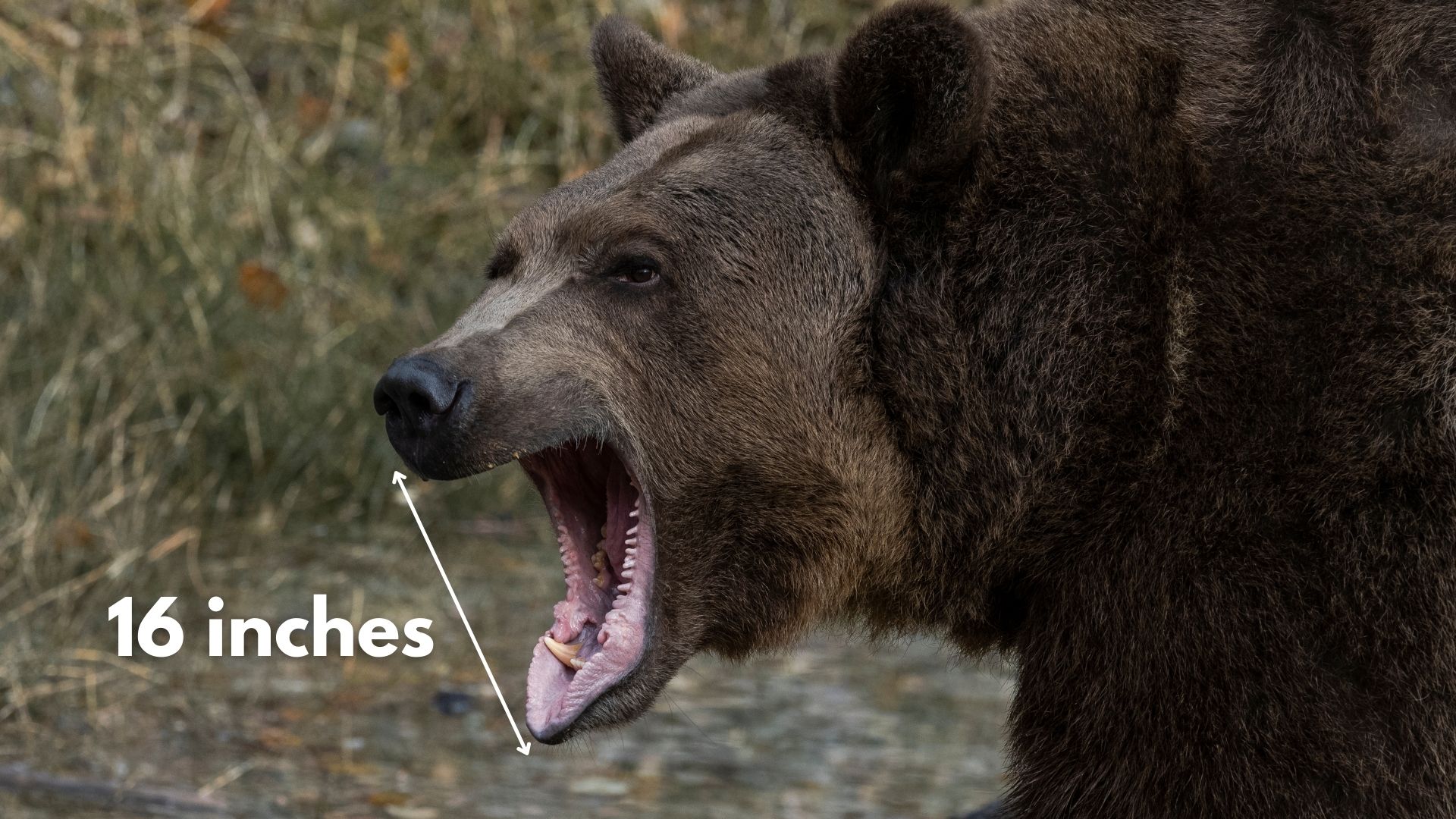
Why the bite force numbers can mislead you
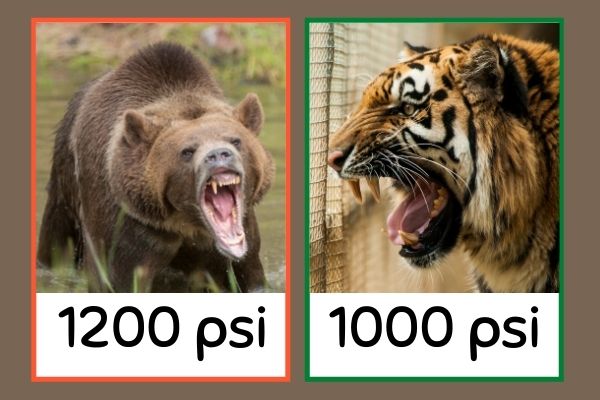
Look at the bite row again. A skull model by Wroe and colleagues gave a brown bear only 751 newtons. But that skull came from a bear of about 129 kg, much smaller than a big grizzly. And models may underestimate bears.
In a 2023 study, scientists measured the bites of live captive bears with a sensor. Spectacled bears bit with up to 2,197 newtons, far more than the 1,236 newtons that models predicted for them. Nobody has measured a grizzly’s bite this way, so its real force is unknown.
Do tigers and bears ever fight in real life?
Grizzlies never meet tigers. But grizzlies are a kind of brown bear, and brown bears do share forests with Amur tigers in Russia’s Far East. There, tigers are reported to kill bears now and then, mostly young ones, and bears sometimes take over a tiger’s kill. We could not open the main study, so we give no numbers.
The Amur tiger is the tiger that would face a grizzly in any made-up match. Read how big a Siberian tiger is for its size. For the bear, see how much a grizzly bear weighs.

Who would win: what we know and what we guess
It helps to split every claim into measured facts and guesses. Weight, speed and claw length are measured. Bite force is modelled. Fighting style and who would give up first are guesses, and no scientist has studied them.
- For the tiger: a hunter that kills big prey by itself, with long canines 6.4 to 7.6 cm (2.5 to 3 in) and sharp hooked claws, says SeaWorld.
- For the grizzly: about the same weight or heavier, thick fur and fat, and a strong digging build. Male grizzlies often fight each other.
- Not known: how either animal would react to a stranger it has never seen, or how much a grizzly’s thick coat would protect it.
Our honest verdict: it’s close to a coin toss, and the heavier animal on the day would likely have the edge. The tiger has better weapons for killing. The grizzly may be better built to take a hit. Anyone who calls it certain is guessing.
Are grizzly bears dangerous to people?
They can be, though most bears try to avoid people. The National Park Service advises staying calm, talking in a low voice and never running. Carry bear spray and learn to use it. If a grizzly attacks, play dead: lie flat on your stomach, hands behind your neck, and keep your pack on. Fight back only if the attack keeps going.
For more on the bear’s power, see how strong a grizzly bear is. For the cat, read how strong a tiger is.
Which is faster, a tiger or a grizzly bear?
They are about equal. Yellowstone’s grizzlies can run 56 to 64 km/h (35 to 40 mph), according to the National Park Service. A tiger can burst above 56 km/h (35 mph), says National Geographic. Neither animal keeps that speed up for long.
Quick facts: tiger vs grizzly
- They never meet: tigers live in Asia, grizzlies in North America.
- Big males of both weigh about 200 to 300 kg (440 to 660 lb).
- Tiger claws: sharp hooks up to 10 cm. Grizzly claws: blunt, up to 15 cm.
- No one has measured a grizzly’s or a tiger’s bite with a sensor.
- No scientific study of a tiger-grizzly fight exists.
Frequently asked questions
Are grizzly bears and brown bears the same?
Yes. A grizzly bear is a brown bear, Ursus arctos, living in North America. Its full name is Ursus arctos horribilis. Brown bears also live across Europe and Asia, including the Russian Far East, where they share forests with Amur tigers.
Is a Siberian tiger bigger than a grizzly bear?
They are about the same. Amur (Siberian) tiger males reach about 300 kg (660 lb), says the Smithsonian, and male grizzlies in the lower 48 US states weigh 200 to 300 kg (400 to 600 lb), says the US Fish and Wildlife Service. Coastal brown bears in Alaska are bigger than both.
Are grizzly bears endangered?
Grizzly bears in the lower 48 US states are listed as Threatened under the US Endangered Species Act, says the US Fish and Wildlife Service. About 714 live in the Greater Yellowstone area, says the National Park Service. Many more live in Alaska and Canada.
Can a grizzly bear kill a tiger?
Grizzlies never meet tigers. In Russia, brown bears share forests with Amur tigers, and bears are reported to sometimes take over tiger kills. Whether bears kill healthy adult tigers there is not well documented, and we found no numbers we could check.
Sources
- US Fish and Wildlife Service. Grizzly bear (Ursus arctos horribilis).
- National Park Service. Yellowstone grizzly bear facts.
- National Park Service. Bear safety.
- Smithsonian's National Zoo and Conservation Biology Institute. Tiger.
- SeaWorld Parks and Entertainment. Tiger: physical characteristics.
- Proceedings of the Royal Society B (author copy hosted by the University of Tennessee) (2005). Bite club: comparative bite force in big biting mammals and the prediction of predatory behaviour in fossil taxa (Wroe, McHenry & Thomason, doi:10.1098/rspb.2004.2986).
- Journal of Experimental Biology (2023). Measurement of voluntary bite forces in large carnivores using a semi-automated reward-driven system (van der Meijden et al., doi:10.1242/jeb.245255).
- National Geographic. Tigers: can they survive?.
- San Diego Zoo Wildlife Alliance. Tiger.
- Panthera. Tiger.
Sources checked 15 September 2026.
Hi I think they would both scare the Hell out of me!
Respectfully tigers are beasts upon their normal day prey
Unless we’re talking about a Himalayan bear which is much smaller then any bear (200 lbs} and tiger breed, the tiger wouldnt have a chance against a bear after they
start weighing around 4 – 500lbs, and this is less then half the weight of a normal bear and we all know a tiger wouldn’t even stick around a bear unless the bear was physically smaller then it.
The bear isn’t a full-time carnivore, so it doesn’t have the killer instinct of a tiger? That may be true of “other” bears, but who doesn’t know the grizzly bear is basically the “psycho” of the bear world.