
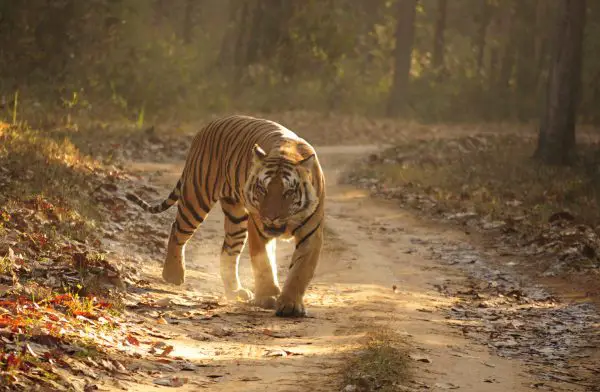
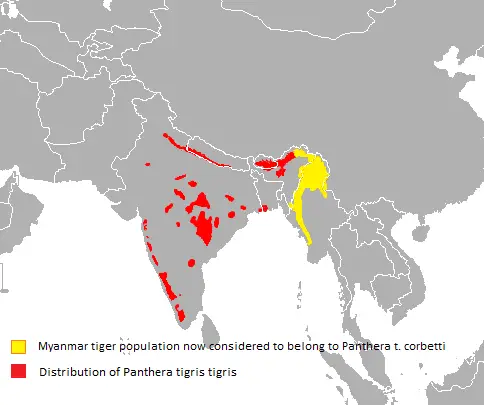
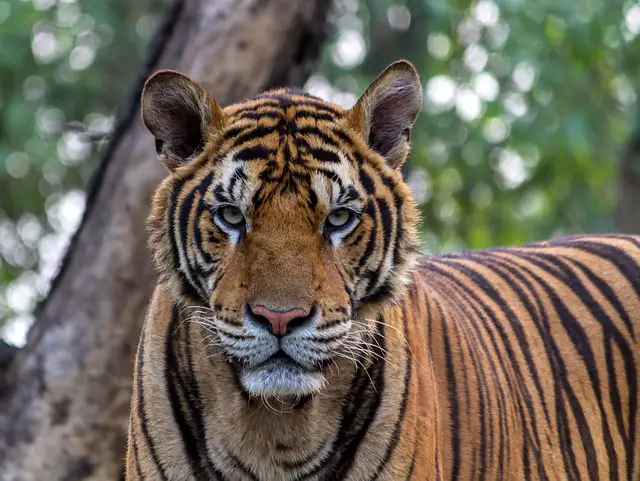
Bengal tigers live in India, Nepal, Bangladesh and Bhutan. India has most of them: at least 3,167 in its 2022 count, and more than 70% of the world’s wild tigers, says India’s National Tiger Conservation Authority. They live in forests, grasslands and mangrove swamps, from near sea level to above 4,000 m.
Where do Bengal tigers live today?
“Bengal tiger” is the everyday name for the tigers of the Indian subcontinent. Scientists now group all mainland Asian tigers into one subspecies, as our page on how much a tiger weighs explains. But the Bengal name is still used for tigers in these four countries.
Each country counts its own tigers, mostly with camera traps. The counts use different methods and years, so treat the table as a snapshot rather than one neat total.
| Country | Wild tigers | Count year | Main tiger areas | Source |
|---|---|---|---|---|
| India | At least 3,167 | 2022 | Five tiger landscapes, from the Himalayan foothills to the Western Ghats and the Sundarbans | National Tiger Conservation Authority |
| Nepal | 429 | 2026 | Chitwan, Bardiya, Parsa, Banke and Shuklaphanta national parks | IUCN |
| Bhutan | 131 adults | 2021–2022 | From southern foothills to mountains above 4,000 m | Bhutan Foundation; IUCN |
| Bangladesh | 125 | 2023–2024 | Sundarbans mangrove forest | Mongabay, reporting the Bangladesh Forest Department survey |
Where do Bengal tigers live in India?
India’s tiger count splits the country into five tiger landscapes. In 2022, camera traps photographed 3,080 different tigers, and the minimum estimate was 3,167 (NTCA). The number of tigers photographed in each landscape shows where they are:
- Central India and Eastern Ghats: 1,161 tigers photographed, in dry and moist forests of states such as Madhya Pradesh and Maharashtra.
- Western Ghats: 824 tigers. The Nilgiri area here holds the largest single tiger population in the world, says the NTCA.
- Shivalik hills and Gangetic plains: 804 tigers, in the forests and grasslands below the Himalayas.
- Sundarbans: 100 tigers, in the mangroves of West Bengal.
- North East hills and Brahmaputra plains: a small population with unique genes, estimated at 219 in 2018.
Tiger numbers rose in the Shivalik and Gangetic landscape, Central India, the North East and the Sundarbans. They fell in parts of the Western Ghats. The NTCA also reports that tigers have died out locally in some Central Indian reserves.
Where do Bengal tigers live in Nepal?
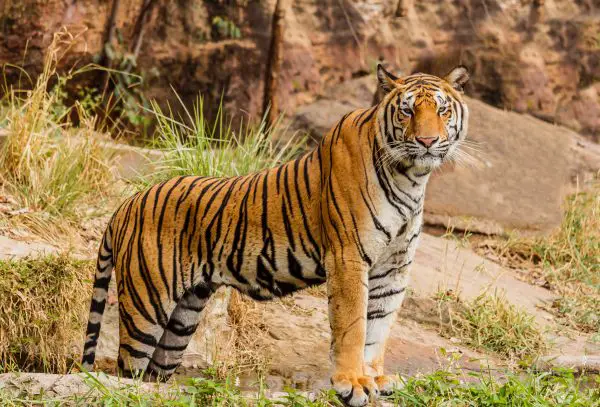
Nepal’s tigers live along the Terai Arc, a strip of lowland forest and tall grassland at the foot of the Himalayas. Its 2026 census found 429 tigers, up from 121 in 2009 and 355 in 2022, reports the IUCN. Chitwan has the most, with 145. Bardiya has 112, Parsa 71, Banke 51 and Shuklaphanta 50.
Tigers there also use the buffer zones, forests and wildlife corridors that link the parks. Bardiya was the only park where numbers fell, from 125 to 112.
Do Bengal tigers live in the Sundarbans mangroves?
Yes, and the Sundarbans is one of the strangest tiger homes on Earth. It is a huge mangrove forest of muddy islands and tidal rivers, shared by India and Bangladesh. The whole forest covers 10,277 km², and 6,017 km² of it lies in Bangladesh, reports Mongabay.
Bangladesh’s latest survey counted 125 tigers, up from 106 in 2015 and 114 in 2018. That is about 2.6 tigers for every 100 km². The Indian side had 100 tigers photographed in 2022 (NTCA).
Here tigers hunt spotted deer, wild pigs and rhesus monkeys, according to the NTCA. They are strong swimmers with partly webbed toes, says San Diego Zoo Wildlife Alliance, which helps them cross the channels. For more on their meals, see what Bengal tigers eat.
Do Bengal tigers live in the mountains?
In Bhutan they do. Tigers there have been recorded from about 100 m up to 4,400 m on camera traps, with footprints found at 4,600 m in Wangchuck Centennial National Park, says the IUCN. That is snow leopard country. One tiger was photographed in both the warm lowlands and the snowy highlands.
Bhutan’s second national survey, in 2021 and 2022, counted 131 adult tigers, 27% more than in 2015, reports the Bhutan Foundation. More than 72% of Bhutan is forest, which gives tigers room to move (IUCN).
What habitat do Bengal tigers need?
Three things: cover, water and big prey. Tigers live in forests, mangrove swamps and grasslands, says Smithsonian’s National Zoo. They hunt by ambush, using their stripes to hide in tall grass and shade.
San Diego Zoo Wildlife Alliance says tigers are seldom far from water, and they often cool off in it. They also need plenty of deer and wild pigs. When forests shrink or prey is poached, tigers disappear even if some trees are left. Read adaptations of a tiger for how their bodies suit these places.
Do tigers live in Africa or the Amazon?
No. Wild tigers live only in Asia: South and Southeast Asia, China and the Russian Far East, says Smithsonian’s National Zoo. Their range today is just 7% of what it once was. Africa’s big cats are lions, leopards and cheetahs. The big spotted cat of the Amazon is the jaguar.
Are Bengal tigers endangered?
Yes. The tiger is Endangered on the IUCN Red List (2022 assessment), with 3,726 to 5,578 left in the wild, says the IUCN. The main threats are poaching of tigers, hunting of their prey, and forests broken up by farms and settlements. The good news is that counts in India, Nepal, Bhutan and Bangladesh have all risen. Read why Bengal tigers are endangered for the full story.
Frequently asked questions
Do Bengal tigers live in the jungle?
Many do. Bengal tigers live in tropical forests, but also in tall grasslands, mangrove swamps and mountain forests. What they need is thick cover for ambush, water nearby and plenty of deer and wild pigs to hunt. A patch of jungle without prey will not keep a tiger.
How many Bengal tigers are left in the wild?
Adding the latest national counts gives roughly 3,850 or more: at least 3,167 in India (2022), 429 in Nepal (2026), 131 in Bhutan and 125 in Bangladesh. India's figure is a minimum. The IUCN gives 3,726 to 5,578 wild tigers of all kinds worldwide (2022).
Can Bengal tigers swim?
Yes, and well. San Diego Zoo Wildlife Alliance calls tigers excellent, powerful swimmers with partly webbed toes. In the Sundarbans, tigers swim across tidal channels between mangrove islands. Tigers are seldom far from water and often lie in it to cool off on hot days.
Why are they called Bengal tigers?
The name comes from Bengal, a region of South Asia now split between India's state of West Bengal and the country of Bangladesh. The Sundarbans, home to many of these tigers, lies in both. Tigers of the same kind also live in Nepal, Bhutan and most of India.
Sources
- National Tiger Conservation Authority and Wildlife Institute of India (2023). Status of tigers, co-predators and prey in India 2022: summary report.
- IUCN (2026). Tiger census: Nepal's tiger number increases to 429.
- Mongabay (2024). Tiger population census in Bangladesh shows a hopeful upward trend in the Sundarbans.
- Bhutan Foundation (2023). Latest Bhutan national tiger survey report finds a surging tiger population.
- IUCN (2017). High hopes for the mountain tigers of Bhutan.
- Smithsonian's National Zoo and Conservation Biology Institute. Tiger.
- San Diego Zoo Wildlife Alliance. Tiger.
- IUCN (2022). Migratory monarch butterfly now Endangered: IUCN Red List (includes the 2022 tiger reassessment).
Sources checked 15 September 2026.
Keep the conversation curious