
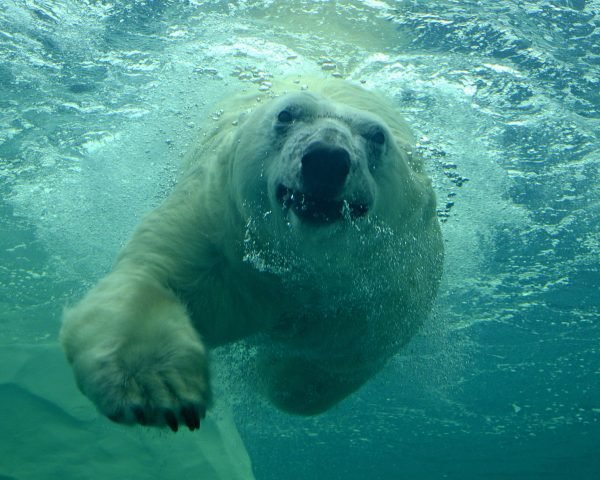
A polar bear can swim at about 10 km/h (6.2 mph), says SeaWorld; San Diego Zoo Wildlife Alliance gives up to 6 mph. That is a top speed. On long trips polar bears swim much more slowly. One tracked female covered 687 km (426 mi) in nine days, which averages about 3 km/h (2 mph).
For comparison, a relaxed adult swimmer doing lengths in a pool moves at very roughly 2 to 3 km/h. So a polar bear on a long trip swims at about your pace, but it can keep going for days in water near freezing. Its real skill is endurance, not speed.
Polar bear swimming speed and distance: the numbers
| Measure | Figure | How it was measured | Source |
|---|---|---|---|
| Top swimming speed | About 10 km/h (6.2 mph) | Widely quoted estimate; original measurement not published | SeaWorld; San Diego Zoo Wildlife Alliance (up to 6 mph) |
| Average speed on the record swim | About 3.2 km/h (2 mph) | Our calculation: 687 km in 9 days | National Geographic, on a USGS study |
| Longest tracked swim | 687 km (426 mi), over 9 days | GPS collar on an adult female, Beaufort Sea | National Geographic |
| Long swims seen in tracked bears | 100 km (62 mi) without stopping | Tracking | SeaWorld |
| Longest dive | 3 min 10 s, covering 45–50 m (148–164 ft) | Filmed in Svalbard, 2014 | Polar Bears International; SeaWorld |
| Previous dive record | 72 seconds | Observed in 1973, Canadian High Arctic | Polar Bears International |
| Dive depth | Probably no deeper than 6 m (20 ft) | One researcher’s estimate | SeaWorld |
| Fat layer | Up to 11 cm (4.3 in) | Body measurements | SeaWorld |
One honest warning about the top speed. The 10 km/h figure appears on zoo and aquarium pages, but we could not find the study that first timed it. Nobody seems to have measured a wild polar bear’s sprint in water with instruments. The distance records are much firmer, because they come from GPS collars.
Can polar bears swim?
Yes, and very well. WWF calls them strong swimmers that can keep going for several hours to get from one piece of ice to another. Their scientific name, Ursus maritimus, means “sea bear”. They spend much of their lives on sea ice floating over the ocean, so swimming between floes is part of everyday life.
Polar bears swim mainly to travel, not to hunt. They catch most of their seals from the ice, at breathing holes and ice edges. Our guide to what polar bears eat explains how that works.
How do polar bears swim?
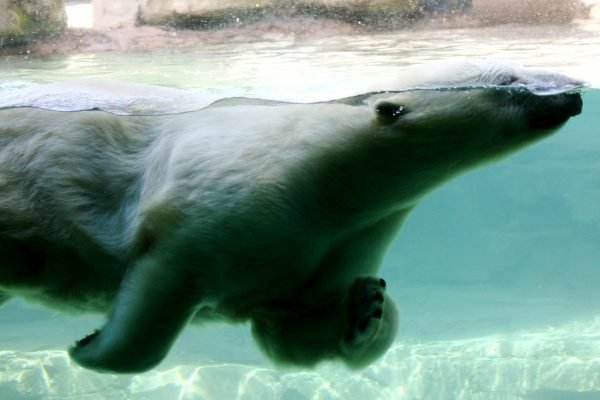
Like a big dog. A polar bear’s front paws push it through the water dog-paddle style, while the hind feet and legs are held flat and used as rudders, says SeaWorld. Hinterland Who’s Who describes the large front paws as powerful oars.
Those paws are huge, up to 30 cm (12 in) across, says Polar Bears International. That is about the width of a school ruler. A wide, flat paw pushes more water with each stroke.
A few other features help:
- Nostrils that close. A polar bear’s nostrils close when it goes under water (SeaWorld).
- A thick layer of fat. Up to 11 cm (4.3 in) of fat keeps the bear warm in cold water (SeaWorld).
- Two layers of fur. A dense underfur and longer guard hairs trap warmth (PBI).
You can read about the rest of the polar bear’s cold-weather toolkit in polar bear adaptations.
How far can a polar bear swim?
Hundreds of kilometres. The record belongs to an adult female in the Beaufort Sea, north of Alaska. Wearing a GPS collar, she swam 687 km (426 mi) over nine days straight in 2008. That is about the distance from London to Edinburgh.
It cost her a lot. She lost 22% of her body weight, reports National Geographic on the US Geological Survey study led by George Durner. Across the study, which tracked bears from 2004 to 2009, five of the 11 mothers that started long swims with cubs lost their young.
Why swim so far? In years when the summer sea ice pulled back far from the coast, bears had to cross wide stretches of open sea to reach it. The IUCN names the loss of sea ice as the most serious threat to polar bears across their range (IUCN Polar Bear Specialist Group). More open water means longer, riskier swims. Read more in are polar bears endangered.
Can polar bears breathe underwater?
No. Like all mammals, polar bears breathe air, so they hold their breath when they dive. Hinterland Who’s Who says they can stay under for over a minute.
The longest dive on record lasted 3 minutes and 10 seconds. A thin bear in Svalbard, Norway, was filmed in 2014 stalking three bearded seals lying at the edge of an ice floe. It slipped under water, swam out of sight, and burst out onto the ice. The seals escaped. Ian Stirling and Rinie van Meurs published it in the journal Polar Biology in 2015, reports Polar Bears International.
Before that, the longest known dive was 72 seconds, seen in 1973. During the record dive the bear covered 45 to 50 m (148 to 164 ft) under water (SeaWorld). Polar bears are shallow divers. One researcher estimates they dive no deeper than about 6 m (20 ft).
What is an aquatic stalk?
It is the hunting trick behind that record dive. The bear swims toward seals resting on the ice, often under water where they cannot see it. Then it surges out of the water at the ice edge to grab one, says Polar Bears International. It does not always work, as the Svalbard bear found out.
Is a polar bear faster on land or in water?
On land. Swimming is slow work for any big mammal, and a polar bear is much quicker running across the ice than paddling through water. Polar bears also overheat quickly when they run, so they rarely run far (PBI). See how fast a polar bear can run for the land numbers.
In the water, polar bears are no match for the animals that live there full-time. Seals swim and dive far better, which is why bears catch them on the ice. Killer whales are faster still, though there is no record of an orca eating a polar bear; see what eats polar bears.
Frequently asked questions
Can polar bear cubs swim?
Yes, but long swims are hard on them. In a US Geological Survey study from 2004 to 2009, five of the 11 mothers that set off on long swims with cubs lost their young, reports National Geographic. Cubs have less fat than adults, so cold water and long distances are riskier for them.
How long can a polar bear swim without stopping?
The record is about nine days. A GPS-collared female in the Beaufort Sea swam 687 km (426 mi) in 2008 before reaching ice, and lost 22% of her body weight. Most swims are much shorter, from one ice floe to the next or across a stretch of open water.
How long can a polar bear hold its breath?
Usually about a minute or so. The longest dive on record lasted 3 minutes and 10 seconds. It was filmed in Svalbard, Norway, in 2014 while a hungry bear stalked seals, and was confirmed in the journal Polar Biology. Before that, the record was 72 seconds.
Why do polar bears swim so far?
To reach sea ice, where they hunt seals. When the summer ice retreats far from the coast, bears that want to follow it must cross wide stretches of open water. Longer swims burn a lot of energy, which is one reason sea-ice loss is the biggest threat to polar bears.
Sources
- SeaWorld (United Parks & Resorts). All about polar bears: adaptations.
- San Diego Zoo Wildlife Alliance. Polar bear.
- Polar Bears International. How long can a polar bear stay underwater? (on Stirling & van Meurs 2015, Polar Biology 38:1301–1304).
- National Geographic (2011). Longest polar bear swim recorded: 426 miles straight (on Durner et al., USGS).
- WWF-UK. Polar bears.
- Hinterland Who's Who (Canadian Wildlife Federation / Environment and Climate Change Canada). Polar bear.
- Polar Bears International. Adaptations and characteristics.
- IUCN SSC Polar Bear Specialist Group (2015). IUCN Red List: polar bear (Vulnerable).
Sources checked 15 September 2026.

Keep the conversation curious