

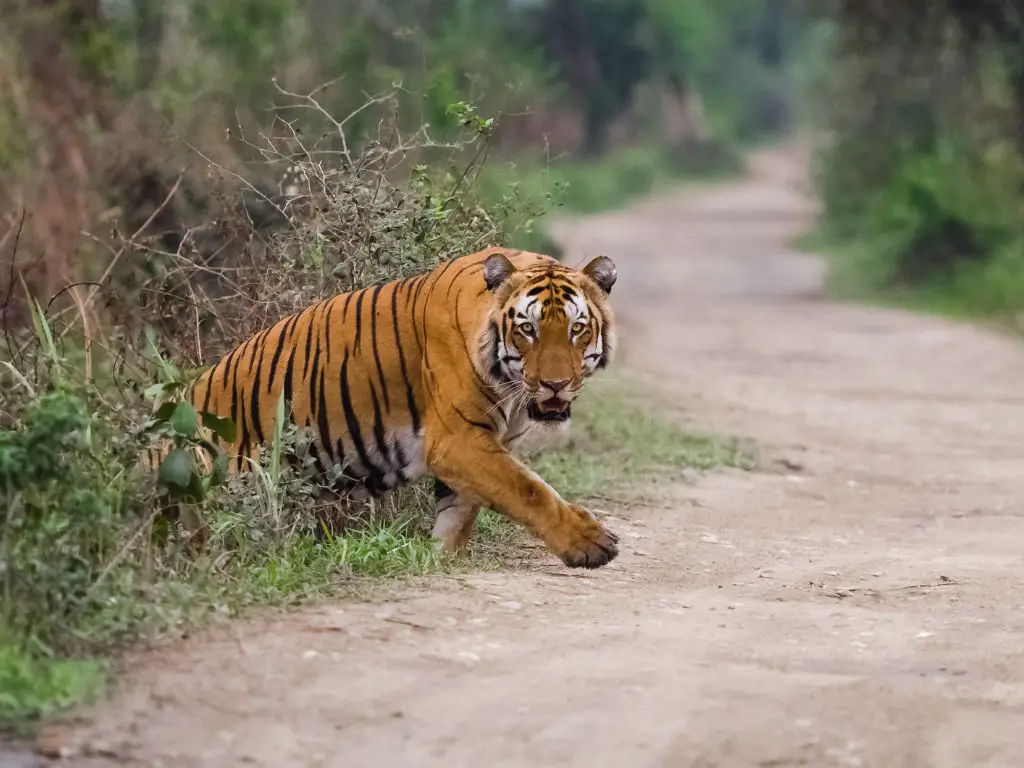
In the long grass at dusk, a tiger has spent twenty minutes creeping towards a herd of deer. It is now close enough to hear them breathe. Then, for about three seconds, it becomes one of the fastest animals in the forest.
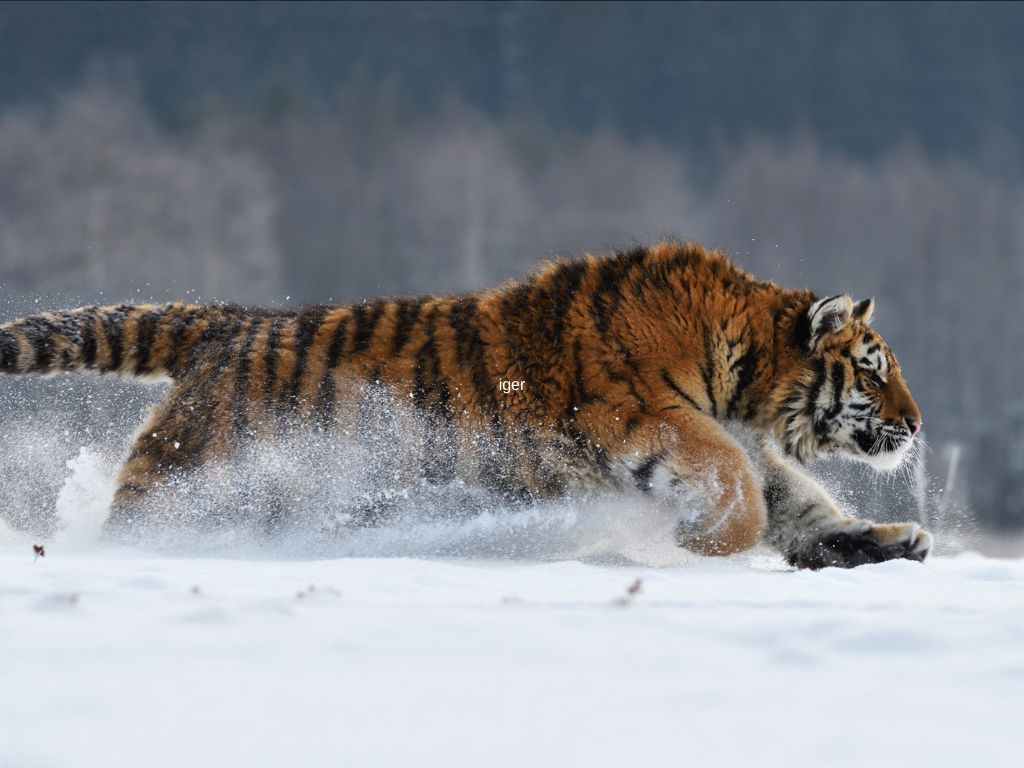
A tiger can run at about 49 to 65 km/h (30 to 40 mph), but only in a short burst. National Geographic puts its sprints at more than 56 km/h (35 mph). That is faster than the fastest human ever timed, but far behind the cheetah, whose fastest measured speed in the wild is 93 km/h (58 mph).
Key takeaways
- Top speed: about 49–65 km/h (30–40 mph), held for only a few seconds.
- Faster than people: even Usain Bolt’s peak of about 44 km/h is slower than the bottom of the tiger’s range.
- An estimate, not a record: no tiger has ever been timed with GPS, so treat any exact figure with care.
How fast can a tiger run compared with other big cats?
Few big cats have ever been properly timed. Most speeds come from observers or old records, not from stopwatches or GPS. The zoologist Theodore Garland, who gathered running speeds for more than 100 mammals, called the figures for tigers and leopards more or less anecdotal in his 1983 study. Only the cheetah has been measured with modern tracking collars in the wild.
| Cat | Top speed | What kind of figure | Source |
|---|---|---|---|
| Cheetah | 93 km/h (58 mph) | Measured with GPS collars on 5 wild cheetahs in Botswana | Wilson et al. 2013 |
| Leopard | About 60 km/h (37 mph) | Old estimate, called anecdotal | Garland 1983 |
| Lion | Up to 53 km/h (33 mph) for a lioness; 59 km/h (37 mph) in older records | Estimates | San Diego Zoo; Garland 1983 |
| Tiger | About 49–65 km/h (30–40 mph); bursts above 56 km/h (35 mph) | Estimates, never GPS-timed | National Geographic; Garland 1983 (56 km/h) |
| Jaguar | Not reliably measured | No published measurement | See how fast a jaguar can run |
So treat any exact tiger speed with care. The honest answer is a range. For the cheetah, Alan Wilson and colleagues fitted GPS collars to five wild cheetahs and recorded a top speed of 93 km/h (58 mph). Most of their hunts were much slower than that.
Is a tiger faster than a lion?
They are about the same. San Diego Zoo Wildlife Alliance says a lioness can sprint at up to 53 km/h (33 mph), and a lion can run the length of a football field in about six seconds (San Diego Zoo). Garland’s table gives 59 km/h for lions and 56 km/h for tigers. The gap is smaller than the error in these estimates.
Lions and tigers also never race in the wild. Tigers live in Asia and nearly all wild lions live in Africa. For a size and strength match-up, see tiger vs lion.
How long can a tiger run at top speed?
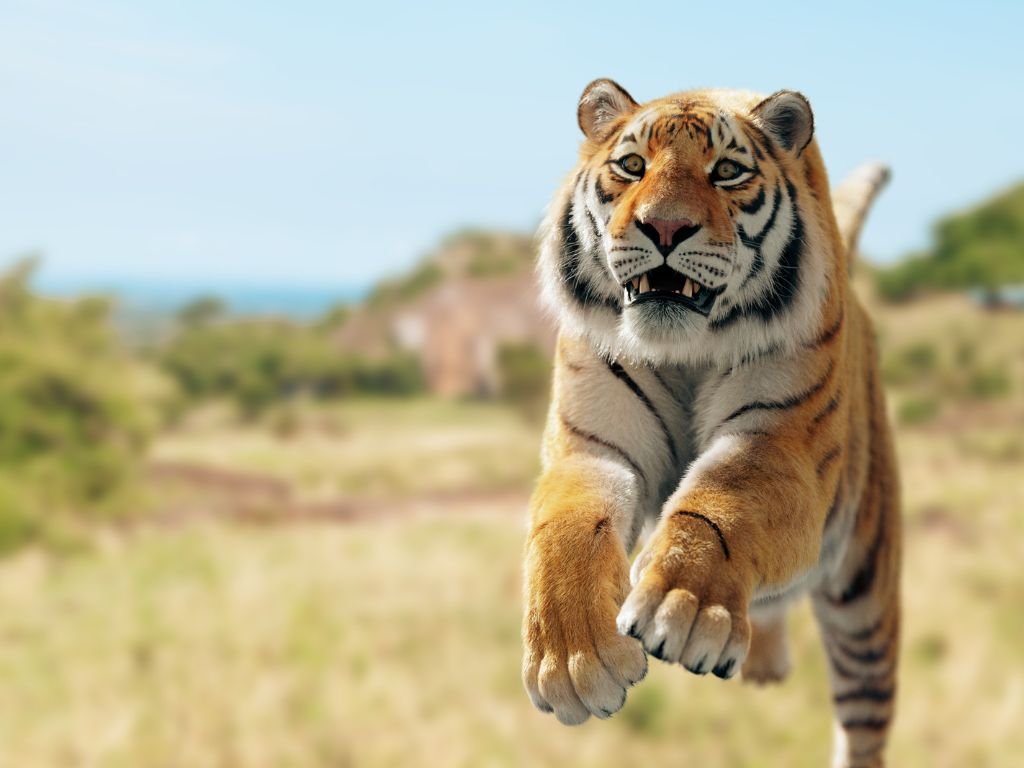
Not long. Tigers are built for strength, not staying power, says National Geographic. A tiger’s top speed lasts only a few seconds. Nobody has measured exactly how far a tiger can sprint, so be wary of any precise distance you read online.
Even cheetahs keep their runs short. The collared cheetahs in Botswana chased prey an average of just 173 m (190 yd) per run, according to the study team. A tiger, which is heavier and less built for running, needs to start its rush from much closer than that.
How do tigers use their speed to hunt?
Speed is the last step, not the first. A tiger stalks its prey from behind, using cover to get close, then rushes in and bites the neck or throat, says SeaWorld. Tigers hunt mostly by sight and hearing.
The rush ends in a jump. Tigers can leap forward up to 10 m (33 ft), close to the length of a school bus, says SeaWorld. National Geographic reports a tiger filmed jumping about 4 m (13 ft) straight up to attack a ranger riding an elephant.
Grip matters more than top speed. The cheetah study found that grip and quick turns, not top speed, were key to catching prey. Tigers make up for their shorter sprint with raw strength: a tiger can kill and drag prey five times its own weight, says National Geographic. See how strong a tiger is.
Why doesn’t a tiger need to be as fast as a cheetah?
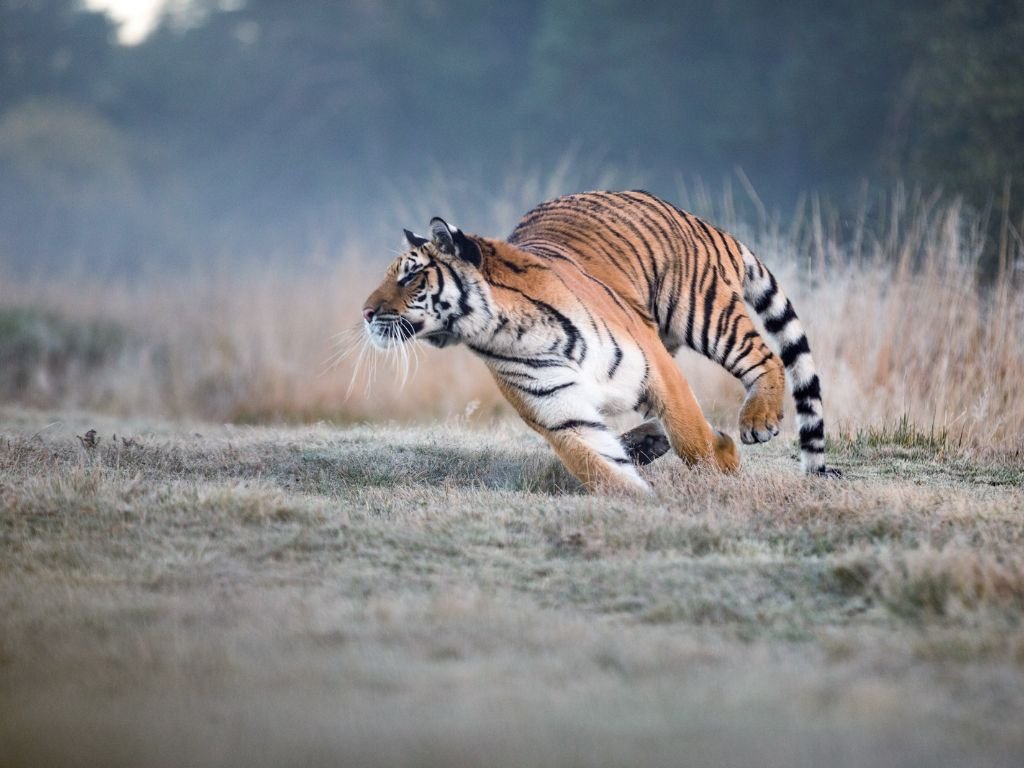
Because the tiger is an ambush predator, not a chaser. Tigers are apex predators that mainly hunt large hoofed animals such as deer and wild boar, says the Smithsonian’s National Zoo. Prey like that can be caught from a few strides away, so a tiger spends its effort on getting close unseen rather than on a long chase.
That role matters for the whole forest. As apex predators, tigers sit at the top of the food chain, and their hunting affects the deer and wild boar below them. The IUCN Red List names the loss of this prey to hunting by people as one of the main threats to tigers. Meet the whole animal on our tiger page.
Can you outrun a tiger?
No. The fastest human ever timed, Usain Bolt, reached just over 12 m per second, or about 44 km/h (27 mph), in the fastest parts of his best 100 m races, according to an analysis by Mackala and Mero. Even the slowest estimate for a tiger, 49 km/h, is faster than that. And a tiger only needs a few strides.
Picture the race: you vs the big cats
Top sprint speeds in km/h. Each bar is drawn to scale.
Usain Bolt (fastest human ever timed): about 44
Tiger (estimate, low end to high end): 49–65
Lioness: 53
Leopard (old estimate): about 60
Cheetah (GPS-measured): 93
Sources: Mackala & Mero 2013; National Geographic; San Diego Zoo; Garland 1983; Wilson et al. 2013. The paler end of the tiger bar shows how uncertain its top speed is.
Tigers mostly avoid people, and your chance of ever meeting one on foot is tiny. In tiger reserves in India and Nepal, visitors stay inside vehicles and follow the guides and forest department rules. Those rules keep both people and tigers safe. Tigers are Endangered, with 3,726 to 5,578 left in the wild, according to the 2022 IUCN Red List assessment.
Can tigers swim fast?
Tigers are strong swimmers, and unlike many cats they readily go into water to cool off or chase prey, says SeaWorld. Nobody has published a measured swimming speed for tigers, though. Our page on tiger adaptations covers their swimming and climbing.
Myths about tiger speed
Myth: A tiger is about 13 km/h (8 mph) faster than a lion.
Fact: The best estimates for the two cats overlap, and the difference between them is smaller than the error in the figures. Why people believe it: the claim is copied from site to site with no measurement behind it.
Myth: Jaguars can run at 80 km/h (50 mph).
Fact: No published study has measured a jaguar’s top speed. Why people believe it: speeds for one big cat are often borrowed for another. See how fast a jaguar can run.
Myth: A tiger can jump 5 m (16 ft) straight up.
Fact: The best-documented upward leap is about 4 m (13 ft), reported by National Geographic. Tigers jump much farther forwards, up to about 10 m, than they do upwards.
Test yourself
1. About how fast can a tiger sprint?
About 49–65 km/h (30–40 mph), and only for a few seconds.
2. Which big cat is the only one measured with GPS collars in the wild?
The cheetah, at 93 km/h (58 mph).
3. Could Usain Bolt outrun a tiger?
No. His peak of about 44 km/h is below even the lowest estimate for a tiger.
Where to next?
➡️ Go wider: the fastest animals in the world⬆️ Go deeper: what makes the cheetah a true speed specialist🔀 Go sideways: how much a tiger weighs, and why size slows it down
Frequently asked questions
What is the fastest big cat?
The cheetah. GPS collars on wild cheetahs in Botswana recorded a top speed of 93 km/h (58 mph), in a study by Wilson and colleagues published in Nature in 2013. That is much faster than any tiger, lion or leopard, though cheetahs only hold top speed for a short dash.
How far can a tiger jump?
A tiger can leap forward up to 10 m (33 ft), according to SeaWorld. Upward jumps are smaller: one tiger was filmed leaping about 4 m (13 ft) up to attack a ranger on an elephant, reports National Geographic. Old claims of 5 m (16 ft) high jumps are not supported.
How fast is a tiger in mph?
About 30 to 40 mph at full sprint. National Geographic says tigers reach bursts above 35 mph. In kilometres per hour, that is roughly 49 to 65 km/h. Tigers have never been timed with GPS, so these are estimates rather than measured records.
Is a tiger faster than a jaguar?
Nobody knows for sure, because neither cat has been properly timed at top speed. Both are ambush hunters that rely on a short rush rather than a long chase. The 80 km/h (50 mph) figure often given for jaguars has no published measurement behind it.
Sources
- National Geographic. A cry for the tiger.
- ScienceDaily (Royal Veterinary College news release) (2013). Wild cheetahs accelerate fast and reach speeds of up to 58 miles per hour during a hunt (on Wilson et al., Nature 498: 185-189, doi:10.1038/nature12295).
- Journal of Zoology via University of California, Riverside (1983). The relation between maximal running speed and body mass in terrestrial mammals (Garland, Journal of Zoology 199: 157-170).
- Mackala, K. and Mero, A. (2013). A kinematics analysis of three best 100 m performances ever. Journal of Human Kinetics 36: 149-160.
- Smithsonian’s National Zoo & Conservation Biology Institute. Tiger.
- San Diego Zoo Wildlife Alliance. Lion.
- SeaWorld Parks (United Parks & Resorts). All about tigers: physical characteristics.
- SeaWorld Parks (United Parks & Resorts). All about tigers: diet and eating habits.
- SeaWorld Parks (United Parks & Resorts). All about tigers: behavior.
- Goodrich, J. et al. (2022). Panthera tigris. The IUCN Red List of Threatened Species 2022: e.T15955A214862019. doi:10.2305/IUCN.UK.2022-1.RLTS.T15955A214862019.en.
Sources checked 12 October 2026.

Keep the conversation curious