
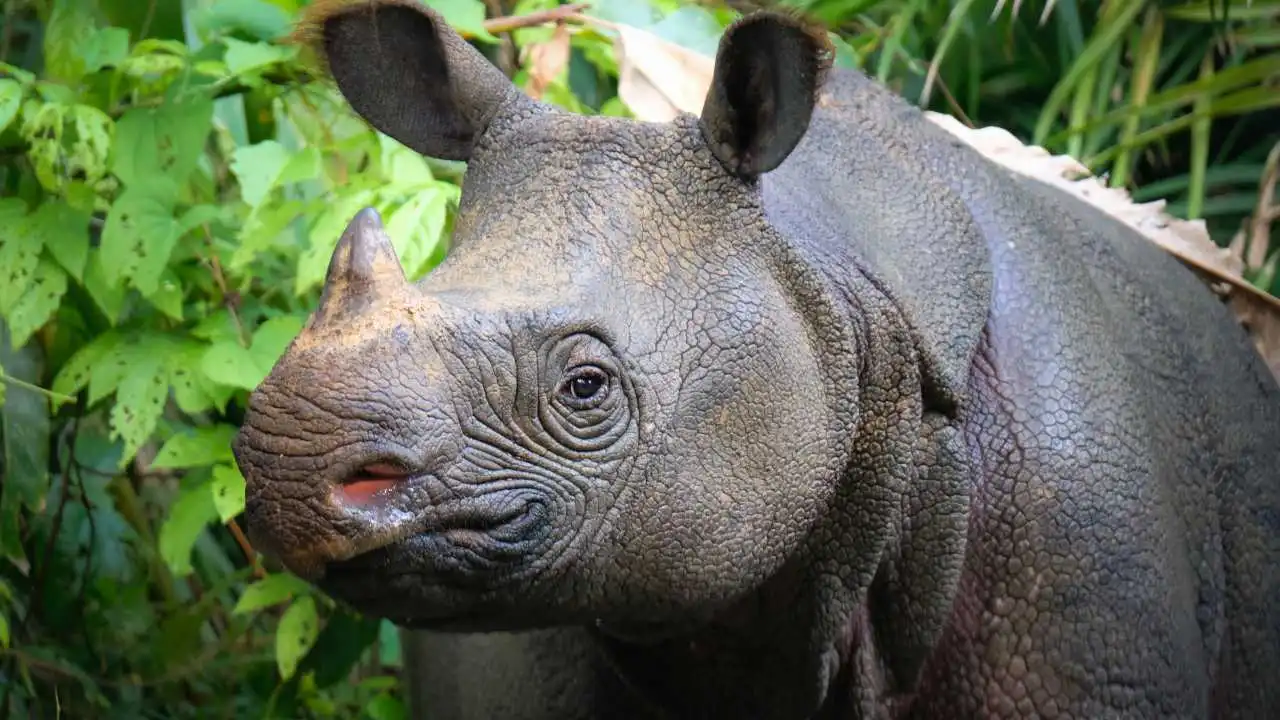
How many Javan rhinos are left? About 50, and every one lives in Ujung Kulon National Park, on the western tip of the Indonesian island of Java, according to the IUCN‘s 2025 rhino update. Poachers killed 26 of them between 2019 and 2023. The species is Critically Endangered.

That number fell fast. Rangers track Javan rhinos with camera traps, because the animals are shy and the forest is thick. Earlier camera-trap counts suggested more than 70 rhinos, notes the International Rhino Foundation (IRF). You will still see “about 70” on some pages, including San Diego Zoo Wildlife Alliance‘s rhino page, which calls the Javan the rarest of the five rhino species.
Then police found that one poaching gang had confessed to killing 26 rhinos inside the park. The population fell by about a third from 2019 to 2023, says the IRF’s State of the Rhino report.
How many Javan rhinos are left in the wild?
All of them. Every known Javan rhino lives in the wild in Ujung Kulon, so the wild count and the world count are the same: about 50. Having the whole species in one park is risky. A single disease outbreak, tsunami or poaching gang can hit every animal at once.
The Javan rhino once had other homes. Vietnam had a tiny population, but its last Javan rhino was lost around 2010–2011, the IRF says. Since then Ujung Kulon has been the only place left.
How do Javan rhino numbers compare with other rhinos?
Javan rhinos are the rarest rhino with a firm estimate. Sumatran rhinos may be just as rare, but their count is less certain. Here are the latest figures from the IUCN rhino specialist groups.
| Species | Where | Latest estimate | Earlier figure |
|---|---|---|---|
| Javan rhino | Java, Indonesia | About 50 (early 2025) | 26 killed by poachers, 2019–2023 |
| Sumatran rhino | Sumatra and Borneo, Indonesia | 34–47 (early 2025) | 280–320 (2007) |
| Greater one-horned rhino | India and Nepal | 4,075 (early 2025) | 2,565 (2007) |
| Black rhino | Africa | 6,788 (end of 2024) | Up 5.2% on 2023 |
| White rhino | Africa | 15,752 (end of 2024) | Down 11.2% on 2023 |
Add them up and there are roughly 26,700 wild rhinos of all five species. Javan rhinos make up less than 0.2% of them. For the most common species, see how many white rhinos are left.
Are Javan rhinos endangered?

Yes. The IUCN lists the Javan rhino as Critically Endangered, its highest risk category for animals still alive in the wild. The IRF’s 2025 report warns that computer models of the population forecast that Javan rhinos could go extinct within the next five decades.
Several problems stack up, the IRF says:
- Poaching. Gangs kill rhinos for their horns, which are sold illegally.
- Too few females. There are about two males for every female, so fewer calves are born.
- Low genetic variety. With so few animals, relatives breed with each other, which can weaken the population.
- A full home. The park may already hold as many rhinos as it can feed.
- Natural disasters. One tsunami or volcanic eruption could hit the only population.
Javan rhinos also breed slowly. A pregnancy lasts about 15–16 months, and a female has one calf every two to three years. So it takes many years to replace even a few lost adults.
Why are Javan rhinos poached?
For their horns. Rhino horn is made of keratin, the same protein as your fingernails, yet it sells for high prices on the black market. A male Javan rhino’s horn is only about 25 cm (10 in) long, and many females have just a small knob. Even so, poachers target them.
Indonesian authorities have been investigating and prosecuting the gangs behind the Ujung Kulon killings, the IRF reports. Our page on whether rhino horns grow back explains what horn is and why cutting it off is used to protect some African rhinos.
How big is a Javan rhino?

A Javan rhino weighs 900–2,300 kg (2,000–5,060 lb) and stands 1.5–1.7 m (5–5.5 ft) at the shoulder, the IRF says. That is about as heavy as one or two cars. It has one horn, and its skin hangs in thick folds that look like armour plates. Scientists think they can live 30–40 years, but nobody knows for sure.
Can Javan rhinos be saved?
There is still a chance. The greater one-horned rhino shows what protection can do: its numbers grew from 2,565 in 2007 to 4,075 by early 2025, says the IUCN. The Javan rhino needs the same things. It needs poaching stopped, the gangs punished and, in time, a second safe home so the whole species is not in one place.

Big animals across Asia face the same pressures. Read why Asian elephants are endangered for another example.
Quick facts: Javan rhino numbers
- Left in the world: about 50 (IUCN, 2025).
- Where: Ujung Kulon National Park, Java, Indonesia, only.
- Killed by poachers 2019–2023: 26.
- IUCN status: Critically Endangered.
- Calves: one every two to three years.
Frequently asked questions
Are there any Javan rhinos in zoos?
No zoo is known to keep a Javan rhino today. The IRF lists Ujung Kulon National Park in Java as the species' only home. That means there is no captive backup population if something goes wrong in the park, which is one reason experts want a second safe site.
How many Javan rhinos were killed by poachers?
A poaching gang confessed to killing 26 Javan rhinos in Ujung Kulon National Park between 2019 and 2023, according to the International Rhino Foundation. That is about a third of the population, and it is why the estimate fell to around 50.
Are Javan rhinos extinct in Vietnam?
Yes. Vietnam's small population of Javan rhinos died out, with the last animal lost around 2010–2011, according to the International Rhino Foundation. Since then, the only Javan rhinos left live in Ujung Kulon National Park in Indonesia.
How many rhinos are left in the world in total?
Roughly 26,700 wild rhinos of all five species, adding up the IUCN's latest estimates: 15,752 white, 6,788 black, 4,075 greater one-horned, about 50 Javan and 34–47 Sumatran rhinos. More than four in five of them live in Africa.
Sources
- IUCN (2025). Poaching of African rhinos down – but drought and other threats drive losses globally.
- International Rhino Foundation. Javan rhino.
- International Rhino Foundation. State of the Rhino.
- San Diego Zoo Wildlife Alliance. Rhinoceros.
Sources checked 15 September 2026.
Good but need more info.