
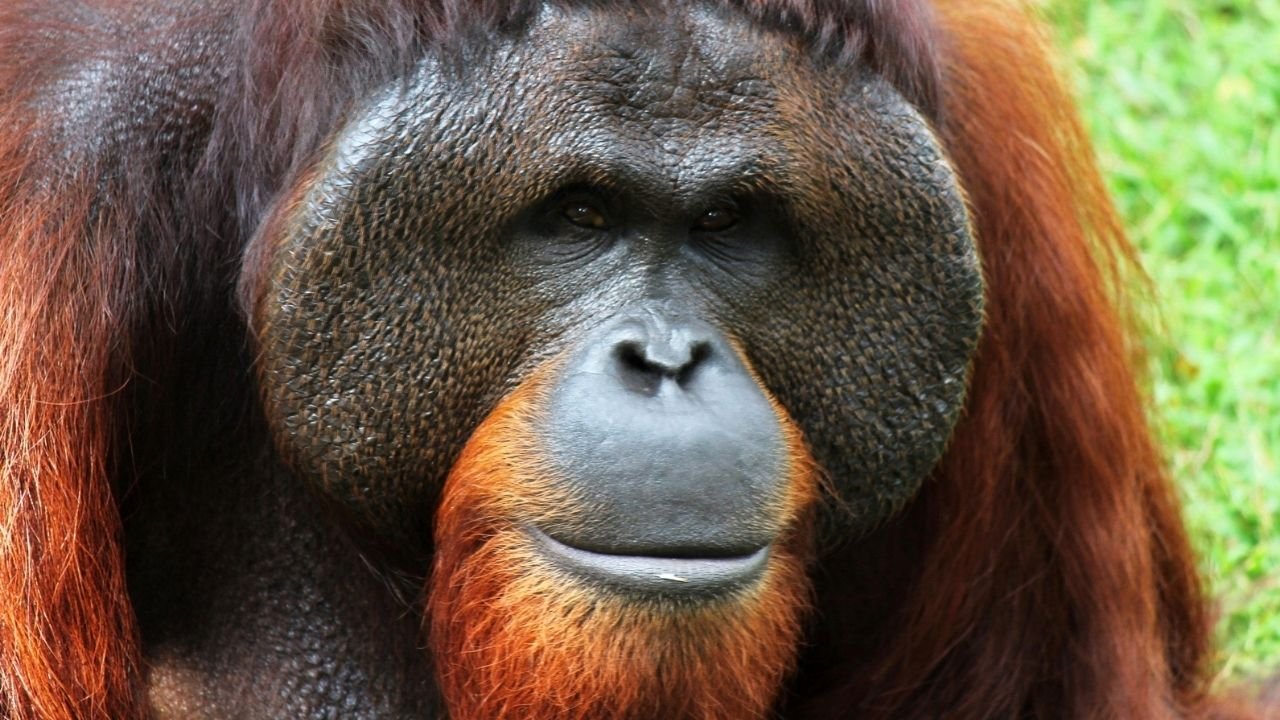
How strong are orangutans? Very strong for their size, but nobody has measured it. A wild adult male weighs 77–100 kg (170–220 lb), says the Smithsonian’s National Zoo, and hauls that weight through treetops on arms alone. The popular claims that orangutans are “seven times stronger than humans” have no published study behind them.
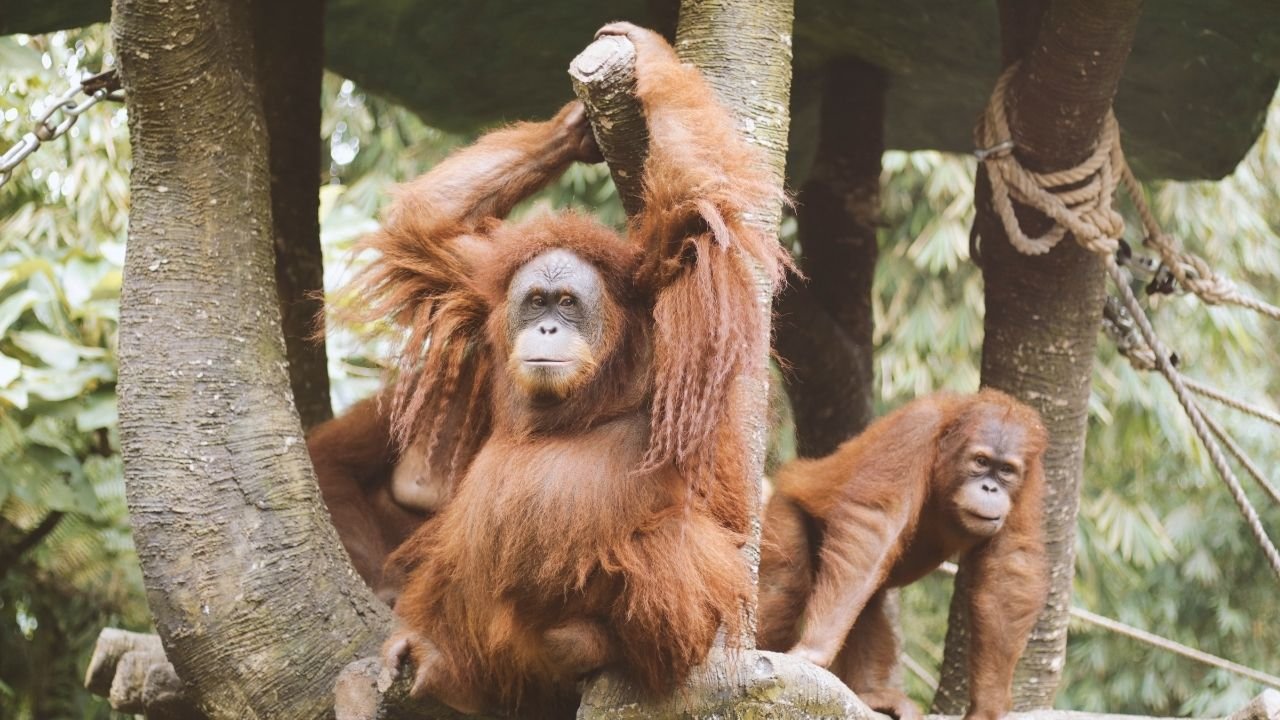
So where does their strength show? In the trees. Orangutans are the largest mammals that live mainly in trees, says San Diego Zoo Wildlife Alliance (SDZWA).
Their arms stretch over 2 m (7 ft) from fingertip to fingertip. That is wider than a family car is tall. Their fingers are long and strong, and their feet can grip like hands.
How strong are orangutans, really?
The honest answer comes in two parts: what we know, and what gets made up.
What we know. An orangutan can hang from one hand and move through the forest with its full body weight on its arms. The Smithsonian says their arms are much longer than their legs. Their main way of moving is “arboreal clambering”: climbing, reaching and walking along big branches. Every day, that is a workout no human could keep up for long.
What gets made up. Many websites say an orangutan can lift 225 kg (500 lb), has a grip of “600 psi” or is five to seven times stronger than a person. We searched zoo, museum and research pages and found no measurement behind any of these numbers. No one has put a wild orangutan on a strength machine, and zoos do not test apes this way.
How strong is an orangutan compared to a human?
The closest real test comes from a relative, the chimpanzee. In 2017, a team led by Matthew O’Neill compared chimp and human leg muscle in the journal PNAS. Chimp muscle made about 1.35 times more force and power than the same amount of human muscle, reports the University of Arizona news release. The main reason is that chimps have about twice as many fast-twitch fibres.
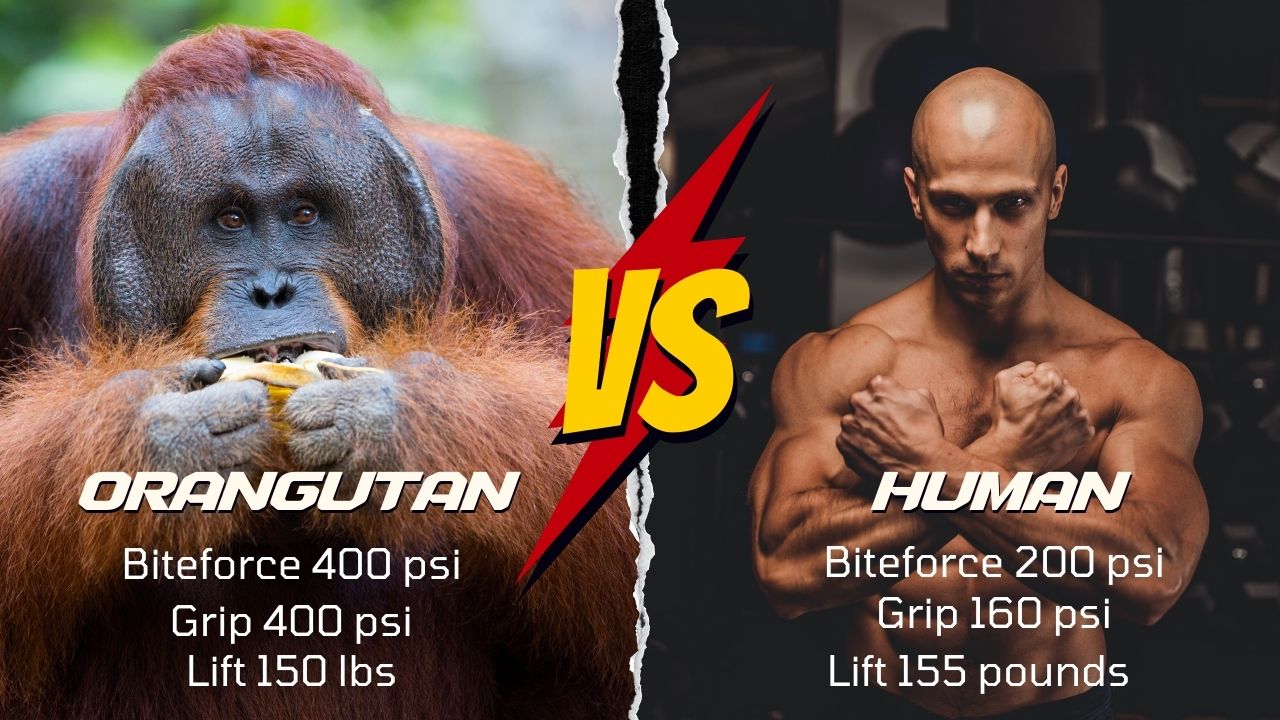
Orangutans were not in that study. But they are apes with a similar build, so a similar edge is likely. Add their long arms and a lifetime of climbing, and a big male would easily win any pulling contest with a strong adult. The same researchers said the old “several times stronger” claims were exaggerated. That is a good reason to doubt the even bigger numbers online.
Humans have our own strength. The same news release says human muscle is built for endurance, which suits walking and running long distances. Apes are built for short, powerful efforts.
| Animal | Typical adult weight | Height | What the evidence says |
|---|---|---|---|
| Orangutan, wild male | 77–100 kg (170–220 lb) | About 136 cm (54 in) | No measured strength data |
| Orangutan, wild female | 36–54 kg (80–120 lb) | About 114 cm (45 in) | No measured strength data |
| Gorilla, male | 136–181 kg (300–400 lb) | Up to 1.75 m (5.7 ft) | Largest living ape |
| Chimpanzee, male | 40–55 kg (90–120 lb) | About 0.9 m (3 ft), head to rump | Muscle about 1.35 times as powerful as human muscle |
| Average US man | 90 kg (199 lb) | 175 cm (5 ft 9 in) | Muscle built for endurance |
Orangutan figures come from the Smithsonian (weights) and SDZWA (heights). Gorilla and chimp figures come from SDZWA’s gorilla and chimpanzee pages. Human figures are from the CDC. Zoo orangutans are often heavier: the Smithsonian says they typically weigh 23–45 kg (50–100 lb) more than wild ones.
How strong are male orangutans?
Males are about twice as heavy as females, so they are much stronger. Fully grown males also grow big cheek pads, called flanges, and a large throat sac. They use the sac to make “long calls” that carry through the forest, says SDZWA.
Weight is a rough guide to strength in apes, because more body means more muscle. A wild male is roughly the weight of a grown man, but with far longer arms and a body shaped for pulling. A male at the Smithsonian’s National Zoo, named Kiko, weighed about 104 kg (230 lb).
Why are orangutans so strong?
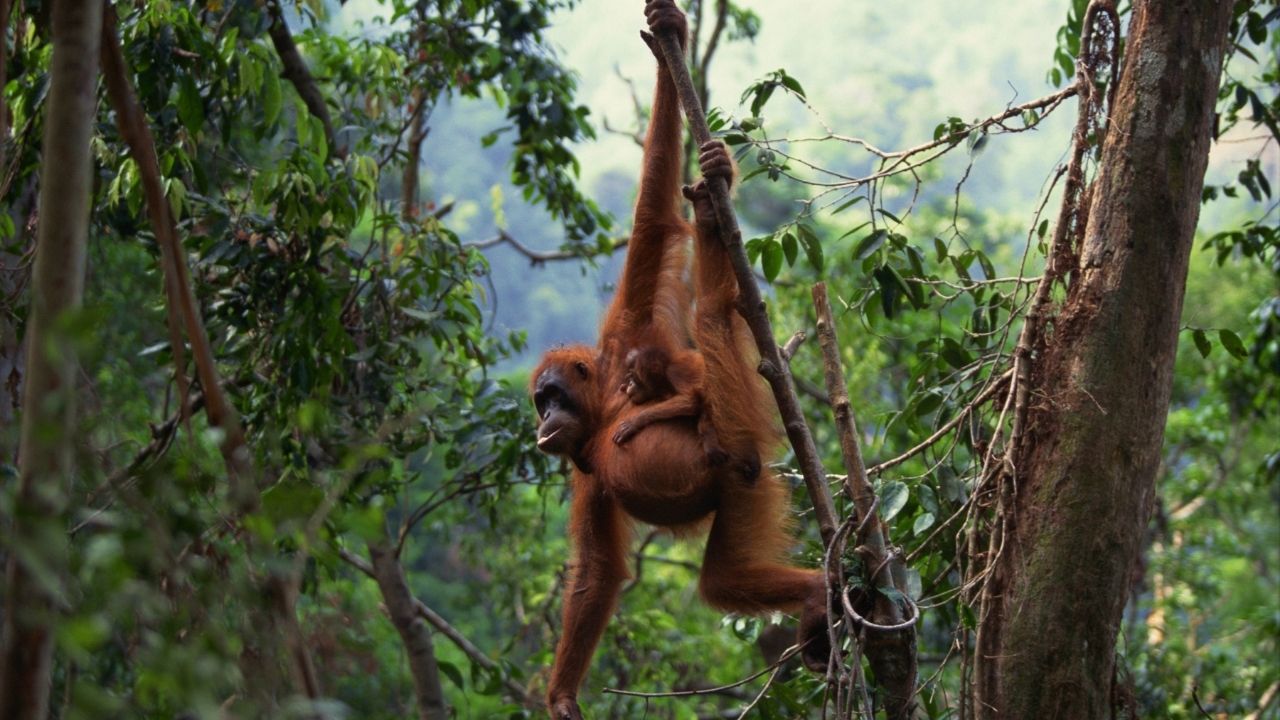
Their bodies are built for life in the trees. SDZWA lists their main tools:
- Long arms. They are longer than the body, so an orangutan can reach the next branch before letting go of the last.
- Hook-like hands. The fingers are long and curve naturally, so the hand wraps around a branch with little effort.
- Hands for feet. Grasping feet let an orangutan hold on with all four limbs.
- A bendy build. A flexible hip joint, a thick neck and bowed legs help it reach in awkward directions.
Every night they also build a fresh nest high in the trees, the Smithsonian says. That means bending and weaving thick branches, which takes real power.
How strong is an orangutan’s bite and punch?
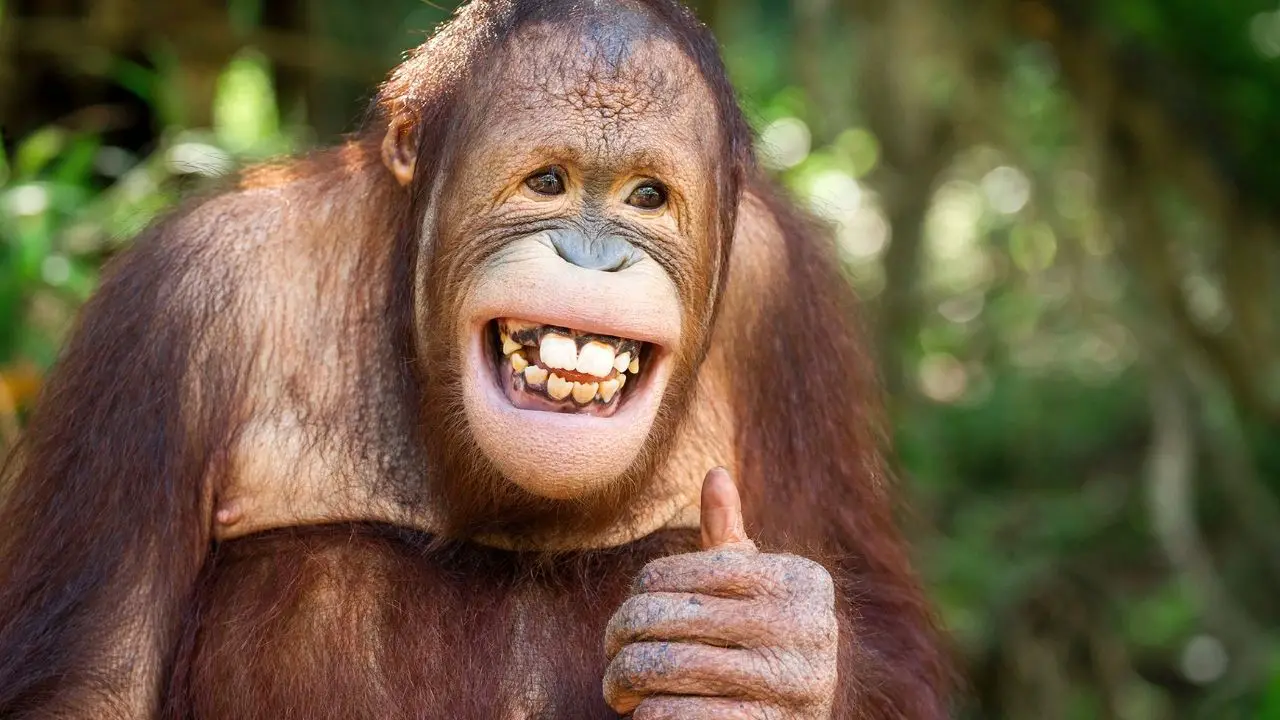
Neither has been measured. Orangutans have big jaws and teeth for cracking hard fruit, seeds and bark. SDZWA calls them the largest fruit-eating animals on Earth. That diet needs a strong bite, but you will not find a trusted bite-force figure for an orangutan anywhere.
As for punching, orangutans do not box. Fighting males grapple and bite. Any “punch force” number you see online is a guess. Our page on which animal has the strongest bite force covers bites that have actually been measured.
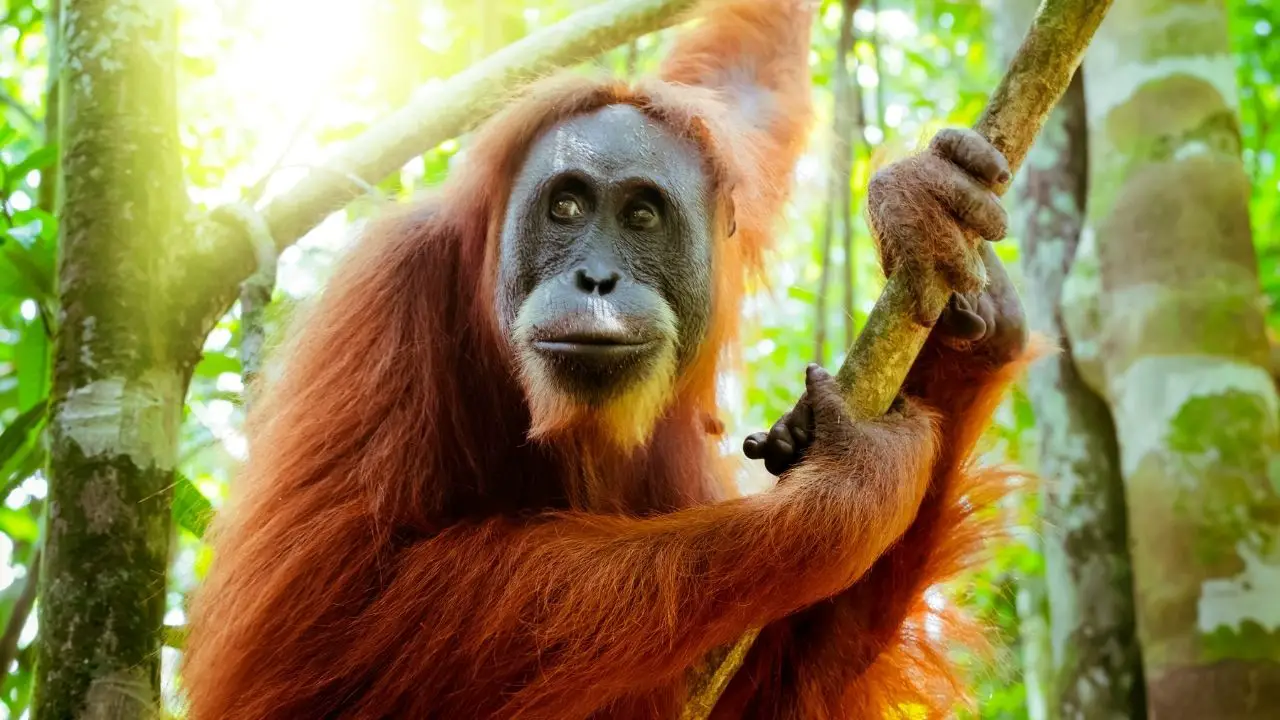
What’s stronger, an orangutan or a gorilla?
A gorilla, almost certainly. A male gorilla weighs 136–181 kg (300–400 lb), which is nearly twice a wild male orangutan. Gorillas and orangutans are both apes with long, strong arms. When two apes have a similar build, the heavier one usually has more muscle. Read more in how strong gorillas are.
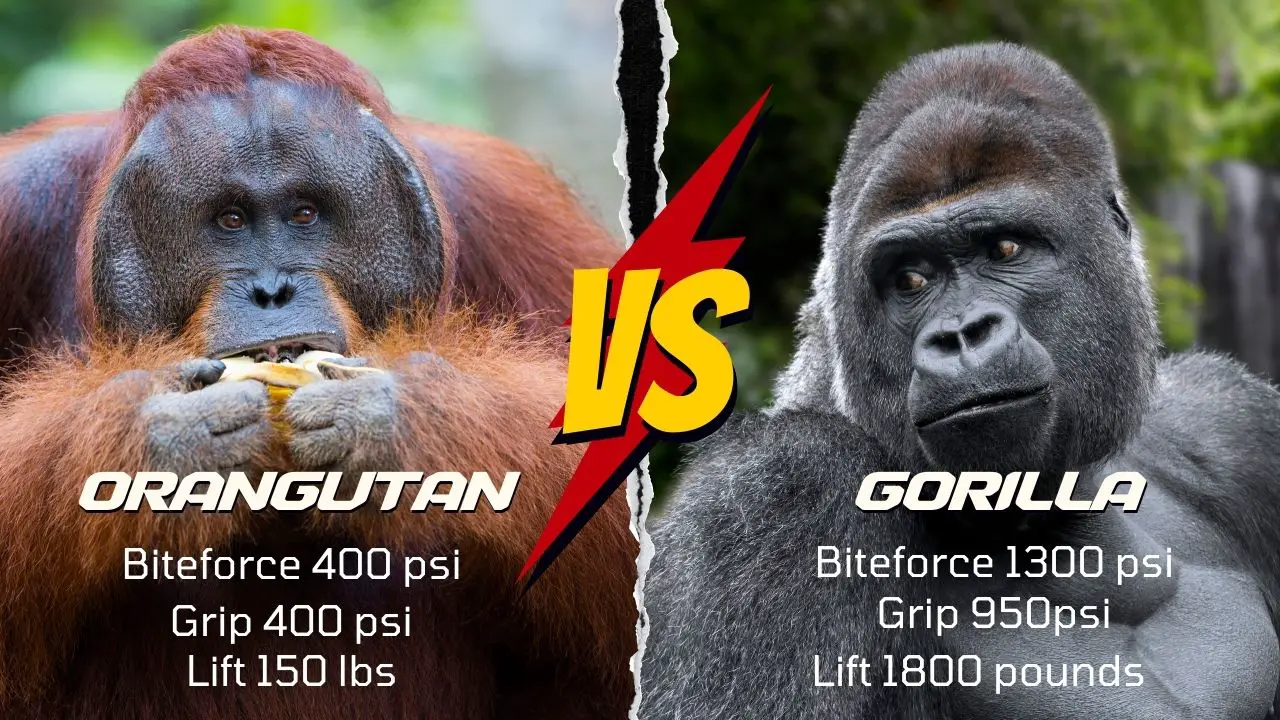
In the wild the two never meet. Gorillas live in Africa, and orangutans live only on the islands of Borneo and Sumatra in Southeast Asia.
Is an orangutan stronger than a chimpanzee?
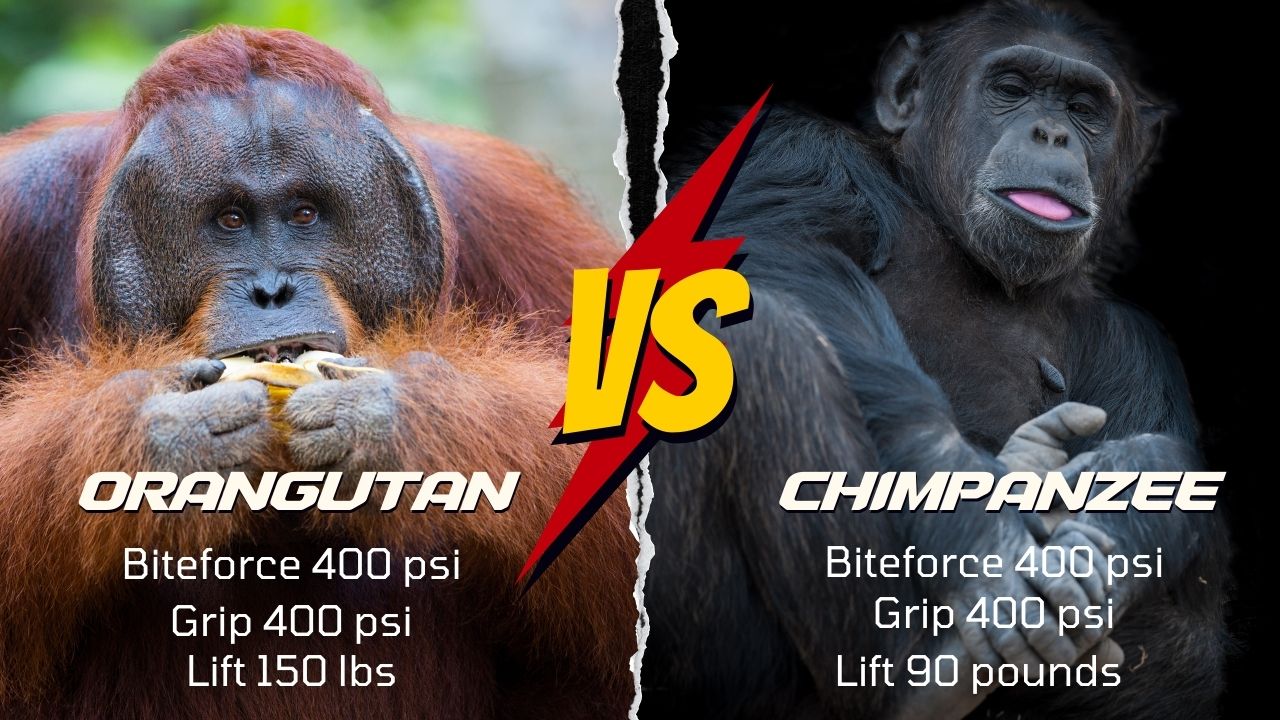
Probably, simply because it is bigger. A male chimp weighs 40–55 kg (90–120 lb), roughly half a wild male orangutan. Chimps are faster on the ground, though, and more likely to fight. See how strong a chimpanzee is for the muscle study in more detail.
Are orangutans dangerous to people?
Wild orangutans are shy and usually move away from people. They spend most of their lives high in the trees. Still, any big ape is strong enough to hurt a person badly, so visitors to their forests should keep their distance and follow rangers’ rules.
People are the bigger danger to orangutans. All three species, Bornean, Sumatran and Tapanuli, are Critically Endangered, says the Smithsonian. Their forests are being cleared for farms, including oil palm plantations. The Tapanuli orangutan has only about 800 animals left.
Quick facts: orangutan strength
- Wild male weight: 77–100 kg (170–220 lb). Female: 36–54 kg (80–120 lb).
- Arm span: over 2 m (7 ft).
- Measured grip, lift or punch strength: none published.
- Nearest real data: chimp muscle is about 1.35 times as powerful as human muscle.
- Status: all three species Critically Endangered.
Frequently asked questions
Can an orangutan rip your arm off?
There is no reliable record of that happening, and no measurement of the force an orangutan can pull with. An adult male is heavy and powerful, and could injure a person badly. Wild orangutans usually avoid people, so the real advice is simple: keep your distance and never feed or approach one.
How strong is an orangutan's grip?
Nobody has measured it. Figures like 600 psi or 270 kg that you see online have no study behind them. What is known is that orangutans have long, curved fingers and grasping feet, and can hang their whole body weight from their hands for long periods.
Are orangutans stronger than humans?
Yes, almost certainly, especially in the arms. A 2017 PNAS study found chimp muscle is about 1.35 times as powerful as human muscle, and orangutans share a similar ape build. But the claim that they are five to seven times stronger is not backed by any published measurement.
How much do orangutans weigh?
Wild males weigh 77–100 kg (170–220 lb) and females 36–54 kg (80–120 lb), according to the Smithsonian's National Zoo. Orangutans in zoos are often 23–45 kg (50–100 lb) heavier than wild ones, because food is always available.
Sources
- Smithsonian's National Zoo and Conservation Biology Institute. Orangutan.
- San Diego Zoo Wildlife Alliance. Orangutan.
- Phys.org / University of Arizona (2017). Chimpanzee 'super strength' and what it might mean in human muscle evolution (news release on O'Neill et al., PNAS, doi:10.1073/pnas.1619071114).
- San Diego Zoo Wildlife Alliance. Gorilla.
- San Diego Zoo Wildlife Alliance. Chimpanzee.
- CDC National Center for Health Statistics. FastStats: body measurements (2021–2023 data).
Sources checked 15 September 2026.

Keep the conversation curious