
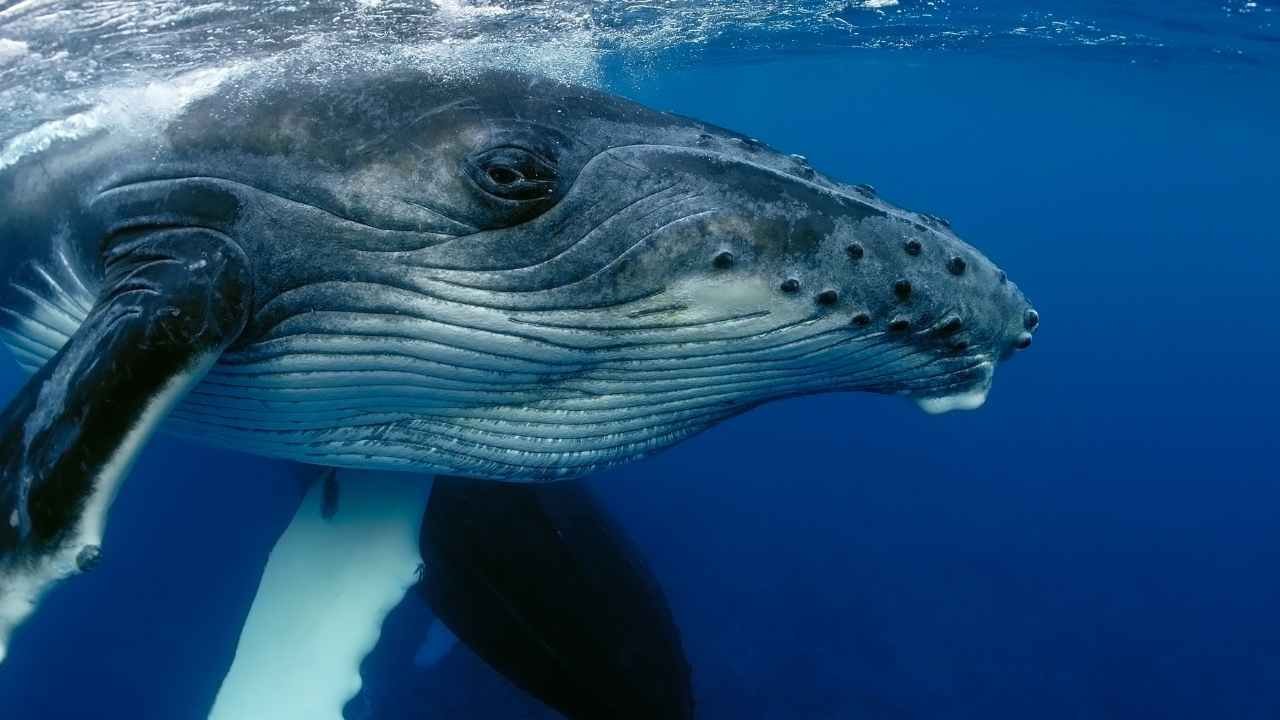
Only killer whales (orcas) are known to hunt and eat blue whales. The first confirmed kills were seen off south-western Australia in 2019 and 2021, when orca pods killed three blue whales, reports ScienceDaily on a study by Totterdell and colleagues. Sharks eat dead blue whales, but no record shows them killing one.

What eats a blue whale?
Almost nothing can. An adult blue whale is the largest animal known. NOAA Fisheries says blue whales grow up to 33.5 m (110 ft) long and weigh up to 150,000 kg (330,000 lb). No single predator comes close to that size.
A killer whale is big for a hunter but small next to a blue whale. The table shows the gap. Orcas make up for it by hunting as a team.
| Animal | Length | Weight | Source |
|---|---|---|---|
| Blue whale, largest | Up to 33.5 m (110 ft) | Up to 150,000 kg (330,000 lb) | NOAA Fisheries |
| Blue whale, typical North Atlantic and Pacific adult | 24–28 m (79–92 ft) | 50–150 tonnes | NAMMCO |
| Blue whale calf at birth | 6–7 m (20–23 ft) | 2–3 tonnes | NAMMCO |
| Killer whale, largest | Up to 9.8 m (32 ft) | Up to 11 tons (about 10,000 kg) | NOAA Fisheries |
To see just how huge an adult is, read how big a blue whale is.
Do orcas eat blue whales?
Yes. For decades, people had seen killer whales chase and bite blue whales, but nobody had seen a kill. That changed in March 2019 in the Bremer sub-basin, off south-western Australia. Researchers and whale-watching crews filmed about 14 killer whales attacking a blue whale, according to ScienceDaily.
Female orcas led the attack. The pod rammed and bit the whale, working to tire it out. One orca pushed into the blue whale’s mouth, probably to eat its tongue.
Afterwards, about 50 killer whales gathered to feed. A second kill came about two weeks later, and a third in 2021. At least 16 of the same orcas took part across the attacks.

The tongue is a prized part. A blue whale’s tongue alone is huge, as our page on how long a blue whale’s tongue is shows. The study was published in Marine Mammal Science in 2022.
How do we know orcas attack blue whales?
From scars, as well as from those three kills. Killer whale teeth leave lines of parallel scratches called rake marks. Scientists photograph whales’ tails to identify them, and the scars show up in the photos.
Up to 25% of photo-identified blue whales off Mexico carry scars from killer whale teeth on their tails, says NAMMCO. There is little sign of such attacks in the North Atlantic or the Southern Ocean.
A 2021 study by Corsi and colleagues compared rake marks on blue, humpback and gray whales off western North America. Blue whales had more scars on the front edge of the tail. The authors say this may fit the idea that blue whales flee rather than fight. Blue whales were also twice as likely as the other two species to have damaged tails.
Which blue whales are most at risk?
The young ones. A calf is born 6 to 7 m (20 to 23 ft) long and weighs 2 to 3 tonnes, says NAMMCO. That is shorter than a big adult orca. Calves drink up to 200 litres of milk a day and gain more than 100 kg a day, so they grow out of danger quickly.
Healthy adults are much harder to kill. Their best defence is size and speed. Our page on what eats a humpback whale shows that orcas also target the calves of other big whales.
Do sharks eat blue whales?
Only dead ones, as far as anyone knows. Great white sharks do feed on whale carcasses. In South Africa, up to 40 white sharks a day were seen scavenging on dead whales, reports a 2013 PLOS ONE study. The whales in that study were Bryde’s and southern right whales. The sharks preferred the fatty blubber.
When a blue whale dies and sinks, deep-sea sharks join the feast too. Pacific sleeper sharks and hagfish are among the first scavengers on whale carcasses on the seafloor, report Smith and Baco (2003). Read what happens when a whale dies to follow the carcass over the next 50 years.

What is the biggest threat to blue whales?
People, not predators. Commercial whaling in the early 1900s cut blue whale numbers to a small fraction of what they had been, says NOAA Fisheries. They got full protection from commercial whaling in 1966.
Today NOAA names ship strikes and tangling in fishing gear as the main dangers. Noise, pollution and climate change are also concerns. Sea ice can kill them too: NAMMCO reports that ice has trapped and killed 40 blue whales in the Northwest Atlantic since 1974.
Blue whales are Endangered on the IUCN Red List, according to the IUCN Cetacean Specialist Group. They are also listed as Endangered in the United States. The good news is that NOAA says populations are growing worldwide.

Is the blue whale at the top of the food chain?
Not quite. Blue whales are hunters, but of tiny prey. They eat krill, small shrimp-like animals. NOAA Fisheries says the biggest may eat up to 6 tons of krill a day.
The top spot in the ocean belongs to the killer whale. The Australian kills showed that orcas can take down even the largest animal on Earth, says ScienceDaily. Blue whales sit one step below: too big for almost anything, but not for a determined orca pod.
Frequently asked questions
Does anything else hunt blue whales besides orcas?
No other predator is known to kill blue whales. Sharks and hagfish eat dead ones, and people hunted them heavily in the early 1900s. Today ship strikes and fishing gear are bigger dangers than any predator, says NOAA Fisheries.
How many orcas does it take to kill a blue whale?
In the first confirmed kill, in March 2019 off Australia, about 14 killer whales attacked. Around 50 gathered afterwards to feed. At least 16 of the same orcas took part in the three kills recorded in 2019 and 2021.
Can a blue whale fight back against orcas?
Blue whales seem to flee rather than fight. A 2021 study found more killer whale scars on the front edge of blue whales' tails, which may fit a fleeing whale. Size and speed are their main defences.
Are blue whale calves eaten by orcas?
Calves are the easiest targets. A newborn is 6 to 7 m long and weighs 2 to 3 tonnes, smaller than a big orca. They grow more than 100 kg a day on their mother's milk, which shortens the risky period.
Sources
- ScienceDaily (2022). First records of killer whales hunting largest animals on Earth (on Totterdell et al. 2022, Marine Mammal Science, doi:10.1111/mms.12906).
- NOAA Fisheries. Blue whale species profile.
- NOAA Fisheries. Killer whale species profile.
- NAMMCO. Blue whale.
- Cascadia Research Collective (2021). Killer whale predatory scarring on mysticetes: blue, humpback and gray whales in the eastern North Pacific (Corsi et al., Marine Mammal Science, doi:10.1111/mms.12863).
- PLOS ONE (2013). White sharks scavenging on whales and its potential role in further shaping the ecology of an apex predator (Fallows et al., doi:10.1371/journal.pone.0060797).
- University of Hawaii (author copy) (2003). Ecology of whale falls at the deep-sea floor (Smith & Baco, Oceanography and Marine Biology: An Annual Review 41: 311–354).
- IUCN SSC Cetacean Specialist Group. Red List status of cetaceans.
Sources checked 15 September 2026.
Keep the conversation curious