
Two spotted cats cross the same African plain on the same day. One walks out at mid-morning, tall and thin, scanning the grass for gazelles. The other has been asleep in a tree since dawn and will not hunt until dark. From a distance they look alike. Up close, they could hardly be more different.
A cheetah (Acinonyx jubatus) is a slim, long-legged sprinter with solid black spots and a black “tear line” running from each eye to its mouth. A leopard (Panthera pardus) is a heavier, more muscular climber whose spots are grouped into rose-shaped rosettes. The cheetah is far faster; the leopard is stronger, and it sometimes kills cheetahs. Below: a side-by-side ID table, a 3-second test, and what the evidence says about who would win.
Key takeaways
- Spots: cheetahs have single solid spots; leopards have rosettes, small rings of black around a darker centre.
- Face: only the cheetah has black tear lines from the eye to the mouth.
- Speed: the fastest cheetah ever measured in the wild reached 93 km/h (58 mph); leopards sprint at about 58 km/h (36 mph).
- Strength: leopards are heavier and can haul a kill heavier than themselves up a tree. They also steal cheetah kills and kill cheetah cubs.
- Status: both are listed as Vulnerable on the IUCN Red List. About 7,100 cheetahs are left in the wild.
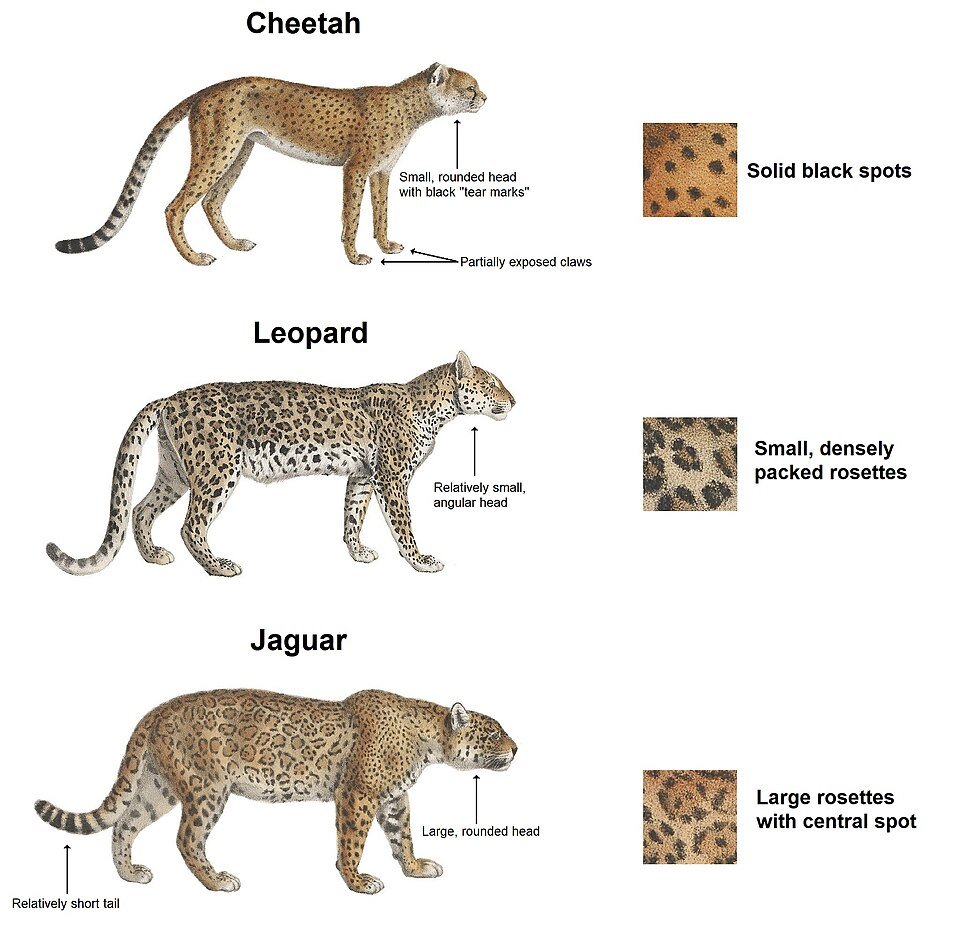
The 3-second ID
1. Look at the face. Black lines from eye to mouth? Cheetah.
2. Look at the spots. Solid dots everywhere? Cheetah. Spots in rings or clusters on the body? Leopard.
3. Look at the shape and the setting. Thin waist, long legs, small head, out on open grass in daylight? Cheetah. Thick neck and shoulders, big head, lying along a branch? Leopard.
What is the difference between a cheetah and a leopard?
The cheetah is built for one explosive chase in daylight, and the leopard for stealth, climbing and power, mostly at night. You can see this in every part of their bodies: spots, face, claws, build, voice and even the time of day they hunt. They are not close relatives either. They belong to different genera (a genus is the group of closest-related species): Acinonyx for the cheetah and Panthera, the roaring big cats, for the leopard.
| Feature | Cheetah | Leopard |
|---|---|---|
| Scientific name | Acinonyx jubatus | Panthera pardus |
| Spots | Small and large solid black spots [3] | Rosettes on the body: black spots around an unspotted centre that is darker than the background; solid spots on legs, belly, face and tail [5] |
| Face markings | Black tear streak from the corner of each eye to the upper lip [3] | No tear lines; small solid spots on the face [5] |
| Build | Slight build, deep narrow chest, flexible “swayback” spine, small rounded head [3]; taller at the head but shorter in body than a leopard [17] | “Large, powerful” cat with robust forequarters and strong limbs [5] |
| Weight | 39–65 kg (86–143 lb) [3] | Males 37–90 kg (82–198 lb); females 28–60 kg (62–132 lb) [5] |
| Head and body length | 112–135 cm (44–53 in) [3] | 91–191 cm (3.0–6.3 ft) [5] |
| Claws | Blunt and only partly retractable, so they grip like running spikes [2][3] | Sharp, curved and fully retractable [5] |
| Top speed | 93 km/h (58 mph), measured with GPS collars [1] | About 58 km/h (36 mph) in bursts [4] |
| Voice | Cannot roar; purrs, chirps and growls [2] | A rasping “sawing” call that can carry up to 3 km (nearly 2 miles) [6] |
| Main hunting time | Daytime, mostly 07:00–10:00 and 16:00–19:00 [7] | Mostly night; 69% of camera-trap photos in one South African study were taken at night [6] |
| Hunting style | Stalks to about 50 m (164 ft), then sprints; chases last about 20 seconds [7] | Stalks or ambushes from cover, often stashes the kill in a tree [6][17] |
| Range | Mainly eastern and southern Africa, plus small groups in North Africa and Iran [2] | Much of sub-Saharan Africa and large parts of Asia, from sea level to 5,200 m (17,060 ft) [8] |
| IUCN status | Vulnerable (2024 version of the assessment) [13] | Vulnerable (2025 version of the assessment) [14][15] |
Numbers in brackets match the numbered sources at the end of this page. The table is our own compilation from those sources. Teachers and writers are welcome to reuse it with the credit “Source: Zooologist.com, cheetah vs leopard ID table” and a link to this page.
Weight compared
Cheetah: 39–65 kg (86–143 lb)
Female leopard: 28–60 kg (62–132 lb)
Male leopard: 37–90 kg (82–198 lb)
Scale: 0 to 90 kg. The heaviest male leopards weigh about 25 kg more than the heaviest cheetahs, roughly the weight of a 25 kg sack of rice. Sources: San Diego Zoo Wildlife Alliance Library fact sheets [3][5].
Cheetah spots vs leopard rosettes: how do you tell them apart?
Look closely at a single spot. A cheetah’s spots are solid black dots, each one filled in. A leopard’s body spots are broken into rosettes: a ring or cluster of small black marks around a patch slightly darker than the rest of the coat. Leopards do have solid spots too, but only on the legs, belly, face and tail [3][5].
Simplified illustration made for this page, not drawn from a photograph. Real patterns are unique to each animal [5][18].
Then check the face. Only the cheetah has the black tear streak that runs from the corner of the eye to the upper lip [3]. It is the fastest single clue, and it works even in a blurry photo.
Spot the difference: test your eye
A spotted cat is lying along a thick branch with a dead antelope draped beside it. Which cat?
Almost certainly a leopard. Leopards often climb trees with a kill to keep it from other predators [6], and they are the largest cats that climb trees regularly [4]. Cheetahs are poor climbers [17].
The cat has black stripes running down its back instead of spots. Is it a leopard?
No, it is a rare “king cheetah”. Its spots merge into blotches and stripes because it inherited a single recessive gene variant from both parents [3][10].
It is midday, and a slim spotted cat is sprinting after a gazelle on short grass. Which cat?
A cheetah. Cheetahs hunt mainly in the morning and late afternoon and catch prey with a short, fast chase [7]. Leopards mostly hunt alone at night [6].
You can see the claws in the cat’s footprints in the mud. Cheetah or leopard?
Probably a cheetah. Its claws stay partly out, like the spikes on running shoes [2]. A leopard pulls its claws in when it walks, which keeps them sharp [5].
Is a cheetah faster than a leopard?
Yes, by a wide margin. GPS collars on five wild cheetahs in Botswana recorded a top speed of 93 km/h (58 mph) across 367 runs, in a study published in Nature [1]. Leopards sprint at about 58 km/h (36 mph), says San Diego Zoo Wildlife Alliance [4], so the fastest cheetah ran about 1.6 times faster than a sprinting leopard.
The leopard figure is an estimate. In a 1983 survey of running speeds, the zoologist Theodore Garland gave about 60 km/h for leopards and noted that such big-cat figures were more or less anecdotal [9]. Our guide to famous animal speeds that were never measured explains why.
Picture it: a 100 m race
If each runner could cross a 100 m running track at its top speed from the very first step, here is how long it would take. Real animals need time to speed up, so treat this as a picture of top speed, not a real race.
Cheetah at 93 km/h (25.9 m per second): 3.9 seconds
Leopard at 58 km/h (16.1 m per second): 6.2 seconds
Usain Bolt’s world record (a real race, from a standing start): 9.58 seconds
Shorter bar = faster. Working: 100 m ÷ 25.9 m/s = 3.9 s; 58 km/h ÷ 3.6 = 16.1 m/s, and 100 m ÷ 16.1 m/s = 6.2 s. Speeds from Wilson et al. 2013 [1] and San Diego Zoo [4]; Bolt’s time from Mackala & Mero 2013 [11].
The cheetah pays for that speed. After a chase its body temperature can reach 41°C (105°F) and it needs about 20 minutes to recover [2]. Its enlarged lungs, heart and nasal openings help [3]. Read more in how fast a cheetah can run and how a cheetah’s body is built for speed.
Are cheetahs or leopards stronger?
Leopards are stronger. They are heavier, with powerful forequarters, and they can climb as high as 15 m (50 ft) into a tree, about the height of a five-storey building, while carrying a fresh kill, even one heavier than themselves [4][5]. One leopard was seen dragging a 100 kg (220 lb) young giraffe into thick bush [4]. No cheetah is known to do anything like that.
The surprise is the bite. A 2005 study by Stephen Wroe and colleagues estimated canine bite force from museum skulls. It gave the cheetah 472 newtons and the leopard 467 newtons, almost exactly the same [12]. But the cheetah skull in that study came from a lighter animal, and much of the leopard’s strength lies in its forequarters: a robust build and an enlarged shoulder blade help it lift prey up trees [6]. These are estimates from dry skulls, not measurements from living cats. For more on bite force, see how strong a jaguar is, which compares the big cats.
| Cat | Body mass estimated from skull | Canine bite force | Bite force quotient (100 = average for size) |
|---|---|---|---|
| Cheetah | 29.5 kg | 472 N | 119 |
| Leopard | 43.1 kg | 467 N | 94 |
Do cheetahs and leopards fight?
Leopards and cheetahs rarely fight as equals. The leopard is the bully. Leopards are among the animals known to drive cheetahs off their kills, and they also kill cheetah cubs [2][7]. In a study in Namibia, cheetahs even turned up in leopards’ diet, alongside African wild cats and bat-eared foxes [16].
Cheetahs avoid trouble by eating fast. A group of four can finish an impala in about 15 minutes [16]. Lions and spotted hyenas are a bigger danger than leopards. In the Serengeti, only 4.8% of 125 cheetah cubs survived to adolescence, and lions were blamed for 78.2% of cub deaths. In South Africa’s Kgalagadi park, by contrast, lions caused only 6.7% of cub deaths [19]. Who kills cheetah cubs depends very much on where they live.
Who would win in a fight, a cheetah or a leopard?
The evidence points to the leopard. Leopards are heavier, have sharp retractable claws and powerful forequarters, and they are recorded taking cheetah kills, killing cheetah cubs and eating cheetahs [2][7][16]. A cheetah’s blunt claws and slim build are made for running, so its best move is to run away, which it does very well.
Nobody stages these fights, and nobody should. Most real encounters end with the cheetah leaving. For another evidence-based match-up, read tiger vs lion.
Can cheetahs and leopards mate?
No. Cheetahs and leopards belong to different genera and are not close relatives. The cheetah sits in the puma lineage with the puma and the jaguarundi, which shared an ancestor in North America about 5 million years ago. The leopard belongs to the roaring big cats, Panthera, whose line split from the other cats near the base of the cat family tree, about 10 to 11 million years ago [18][20].
We found no confirmed record of a cheetah–leopard hybrid. The famous “candidate”, the striped king cheetah, turned out to be an ordinary cheetah carrying a variant of a gene called Taqpep, the same gene that controls tabby stripes in pet cats [10].
Which is more dangerous to people, a cheetah or a leopard?
The leopard. Where leopards live near villages, they often take dogs and occasionally attack people, says National Geographic [21]. In a 43-month study in Kashmir, about 49% of people attacked by leopards died [6]. Cheetahs are very different: toward humans they mostly use bluff threats, which rarely become attacks [7].
That does not make cheetahs pets. Cheetah cubs are taken from the wild for the illegal pet trade, which is one of the threats to wild cheetahs [21]. If you see either cat on safari, stay in the vehicle and follow your guide.
Where do cheetahs and leopards live?
Both live in Africa, often in the same parks, but the leopard’s range is far bigger. Cheetahs live mainly in eastern and southern Africa, with small populations in North Africa and Iran [2]. Leopards live across much of sub-Saharan Africa and in Asia from the Middle East to Russia’s Far East, in rainforest, savanna, desert and mountains up to 5,200 m (17,060 ft) [8].
Even where they share ground, they split it up. Cheetahs prefer open plains where they can see and chase prey [17]. Leopards prefer places with cover, such as woodland, forest and mountains, using trees for resting and storing food [8][17]. In the high mountains of Asia, leopards share some ranges with a different cat altogether, the snow leopard; see what snow leopards eat.
Are cheetahs and leopards endangered?
Both are listed as Vulnerable on the IUCN Red List [13][14]. About 7,100 cheetahs remain in the wild, living in just 9% of their historical range, and 77% of that range lies outside protected areas [22]. Leopards now occupy only 25–37% of their historical range [23]. The researchers behind the cheetah study argued it should be uplisted to Endangered [22].
The threats overlap: lost habitat, lost prey and conflict with farmers. Leopards are also killed for their skins, with an estimated 4,500 to 7,000 killed each year in Africa to meet demand [15]. You can help by choosing wildlife tourism that funds conservation, never buying products made from wild cat skins, and supporting groups that help farmers protect livestock without killing predators.
Hidden gems
- Leopards lose their larder. Storing a kill in a tree is not foolproof: in one study, about 2 of every 3 tree-cached kills were still lost to scavengers [6].
- Cheetah cubs are born fully spotted. That is why newborns look darker than adults [2].
- The tabby connection. The gene that turns a cheetah’s spots into king-cheetah stripes is the same one that sets the tabby pattern in house cats [10].
- Fast, but rarely flat out. In the GPS study, most cheetah hunts used only moderate speeds; the 93 km/h record was the exception [1].
What roles do cheetahs and leopards play in their ecosystems?
Both are top predators, but they do different jobs. Cheetahs are specialists in small and medium antelope. Thomson’s gazelles made up 56–89% of cheetah diets in Serengeti studies, impalas 65% in Kruger National Park and springbok 87% in the Kalahari [16]. Leopards are generalists: 92 prey species have been recorded in sub-Saharan Africa alone, from duikers and monkeys to snakes, birds and fish [4][15].
Both cats also feed other animals. Lions and hyenas often steal cheetah kills, and hyenas scavenge at leopard kills [6][7]. In turn, lions, hyenas and packs of painted dogs can kill leopards in Africa, and tigers can kill them in Asia [4].
What happens when they disappear? Scientists have tracked one ripple for leopards. In parts of sub-Saharan Africa where lion and leopard numbers crashed, baboons, the next predator down, increased. Researchers reported children being kept home from school to guard family gardens from crop-raiding baboons [24]. For cheetahs, the clearest effect is simpler: the cat has vanished from 91% of its old range, taking a specialist gazelle hunter out of those grasslands [22].
Myths about cheetahs and leopards
Myth: The king cheetah is a separate species, maybe a cheetah–leopard cross.
Fact: King cheetahs are ordinary cheetahs. Their blotched, striped coat comes from a single recessive variant of the Taqpep gene [3][10]. Why people believe it: the coat looks so unusual that in 1927 the zoologist Reginald Pocock described it as a new species, Acinonyx rex [25].
Myth: Cheetahs can run at 112 km/h (70 mph) or more.
Fact: The fastest speed measured in wild cheetahs with GPS collars is 93 km/h (58 mph) [1]. Why people believe it: older, unmeasured figures are still repeated widely, even on some zoo pages [2]. See the fastest animals in the world for how other records compare.
Myth: Cheetahs are just a small kind of leopard.
Fact: They are in different genera. The cheetah’s closest living relatives are the puma and the jaguarundi of the Americas [18]. Why people believe it: both are spotted African cats, and both are often filmed in the same parks.
Test yourself
1. A spotted cat has black lines from its eyes to its mouth. Which cat is it?
A cheetah. Leopards have no tear lines.
2. What is the fastest speed measured in a wild cheetah?
93 km/h (58 mph), recorded with GPS collars in Botswana.
3. Why do leopards drag their kills up trees?
To keep them away from lions, hyenas and other thieves, though in one study about two-thirds were still lost to scavengers.
Next time you see a spotted cat in a photo, start with the face. Those two black lines are the signature of an animal that bet everything on one burst of speed, while the rosettes belong to a cat that wins by patience, strength and a good tree. Both strategies work, and both cats need wide, wild spaces to keep working. Browse more big cats and their neighbours in our animal guides.
Coming soon: our leopard vs jaguar guide, for the other spotted cat that people mix up with leopards.
Where to next?
➡️ Go wider: the fastest animals in the world⬆️ Go deeper: the cheetah’s spine, claws and lungs, explained🔀 Go sideways: the snow leopard, a mountain cat with a very different life
Frequently asked questions
How can you tell a cheetah from a leopard?
Check the face and the spots. A cheetah has black tear lines running from each eye to its mouth and solid round spots all over. A leopard has no tear lines, and its body spots are grouped into rosettes. Cheetahs also look thinner and longer-legged, while leopards are stockier, with thicker necks and bigger heads.
Which is bigger, a cheetah or a leopard?
The leopard is usually heavier. Cheetahs weigh 39 to 65 kg (86 to 143 lb), while male leopards weigh 37 to 90 kg (82 to 198 lb), according to San Diego Zoo Wildlife Alliance fact sheets. Cheetahs stand taller at the head, but leopards are longer and much more muscular.
Can a cheetah roar?
No. Cheetahs cannot roar like lions or tigers. Instead they purr, growl, hiss and make a bird-like chirp, which mothers use to call their cubs. Leopards make a deep, rasping “sawing” call that can carry up to 3 km (nearly 2 miles).
Do leopards eat cheetahs?
Sometimes. Cheetahs have been recorded in the diet of leopards in Namibia, and leopards also kill cheetah cubs and steal cheetah kills. Lions and spotted hyenas are usually the bigger threat to cheetahs, though, especially to cubs.
Are there cheetahs and leopards in Asia?
Leopards live across much of Asia, from the Middle East to Russia’s Far East. Wild cheetahs in Asia survive only as a small population in Iran. Cheetahs once lived across the Arabian Peninsula and central India too.
Sources
- Wilson, A.M. et al. (2013). Locomotion dynamics of hunting in wild cheetahs. Nature 498: 185–189.
- San Diego Zoo Wildlife Alliance. Cheetah.
- San Diego Zoo Wildlife Alliance Library. Cheetah fact sheet: physical characteristics.
- San Diego Zoo Wildlife Alliance. Leopard.
- San Diego Zoo Wildlife Alliance Library. Leopard fact sheet: physical characteristics.
- San Diego Zoo Wildlife Alliance Library. Leopard fact sheet: behavior and ecology (citing Hunter et al. 2013, Martins et al. 2011, Nabi et al. 2009, Stander et al. 1997).
- San Diego Zoo Wildlife Alliance Library. Cheetah fact sheet: behavior and ecology.
- San Diego Zoo Wildlife Alliance Library. Leopard fact sheet: distribution and habitat.
- Garland, T. (1983). The relation between maximal running speed and body mass in terrestrial mammals. Journal of Zoology 199: 157–170.
- Kaelin, C.B. et al. (2012). Specifying and sustaining pigmentation patterns in domestic and wild cats. Science 337: 1536–1541.
- Mackala, K. and Mero, A. (2013). A kinematics analysis of three best 100 m performances ever. Journal of Human Kinetics 36: 149–160.
- Wroe, S., McHenry, C. and Thomason, J. (2005). Bite club: comparative bite force in big biting mammals and the prediction of predatory behaviour in fossil taxa. Proceedings of the Royal Society B 272: 619–625.
- IUCN Red List of Threatened Species. Acinonyx jubatus (Durant, S.M. et al., 2024 version), doi:10.2305/IUCN.UK.2024-1.RLTS.T219A259025524.en.
- IUCN Red List of Threatened Species. Panthera pardus (Stein, A.B. et al., 2025 version), doi:10.2305/IUCN.UK.2025-2.RLTS.T15954A286153337.en.
- IUCN SSC Cat Specialist Group. Living species: leopard.
- San Diego Zoo Wildlife Alliance Library. Leopard fact sheet: diet (citing Stander et al. 1997) and Cheetah fact sheet: diet (citing Caro 1994).
- Discover Wildlife (BBC Wildlife). Cheetah vs leopard: what’s the difference?
- San Diego Zoo Wildlife Alliance Library. Cheetah fact sheet: taxonomy and history (citing Johnson et al. 2006; O’Brien and Johnson 2007).
- ScienceDaily (Wiley news release) (2013). Can big cats co-exist? Study challenges lion threat to cheetah cubs (on Mills and Mills, Journal of Zoology, doi:10.1111/jzo.12087).
- Johnson, W.E. et al. (2006). The late Miocene radiation of modern Felidae: a genetic assessment. Science 311: 73–77.
- National Geographic. Leopard and Cheetah.
- Durant, S.M. et al. (2017). The global decline of cheetah Acinonyx jubatus and what it means for conservation. PNAS 114: 528–533.
- Jacobson, A.P. et al. (2016). Leopard (Panthera pardus) status, distribution, and the research efforts across its range. PeerJ 4: e1974.
- Oregon State University (2009). Loss of top predators causing surge in smaller predators, ecosystem collapse (on Prugh et al., BioScience 59: 779–791).
- Pocock, R.I. (1927). Description of a new species of cheetah (Acinonyx). Proceedings of the Zoological Society of London 97: 245–252. Cited from secondary sources.
Sources checked 14 October 2026.
Keep the conversation curious