
On a riverbank in Brazil’s Pantanal, a heavy spotted cat pads along the sand, watching caimans in the shallows. Ten thousand kilometres away, on a branch in an African woodland, another spotted cat lies with an antelope draped beside it. Same family, same golden coat, same black markings. They will never meet.
A jaguar (Panthera onca) is bigger and stockier than a leopard (Panthera pardus), with a broader head, shorter legs and rosettes that often have a black dot inside. Leopards are lighter, longer-tailed climbers whose rosettes have no central dot. Jaguars live only in the Americas; leopards live in Africa and Asia. On the evidence of size and bite force, the jaguar is the stronger cat. Here is how to tell them apart.
Key takeaways
- Rosettes: jaguar rosettes often hold one or more black dots; leopard rosettes do not.
- Build: jaguars have a broader head, deeper chest, bigger paws, shorter legs and a shorter tail.
- Bite: a skull-based estimate puts a jaguar’s canine bite at 1,014 newtons, more than twice a leopard’s 467.
- Where: jaguars live from the US–Mexico border to Argentina; leopards across Africa and Asia. They never meet in the wild.
- Status: jaguars are Near Threatened and leopards are Vulnerable on the IUCN Red List.
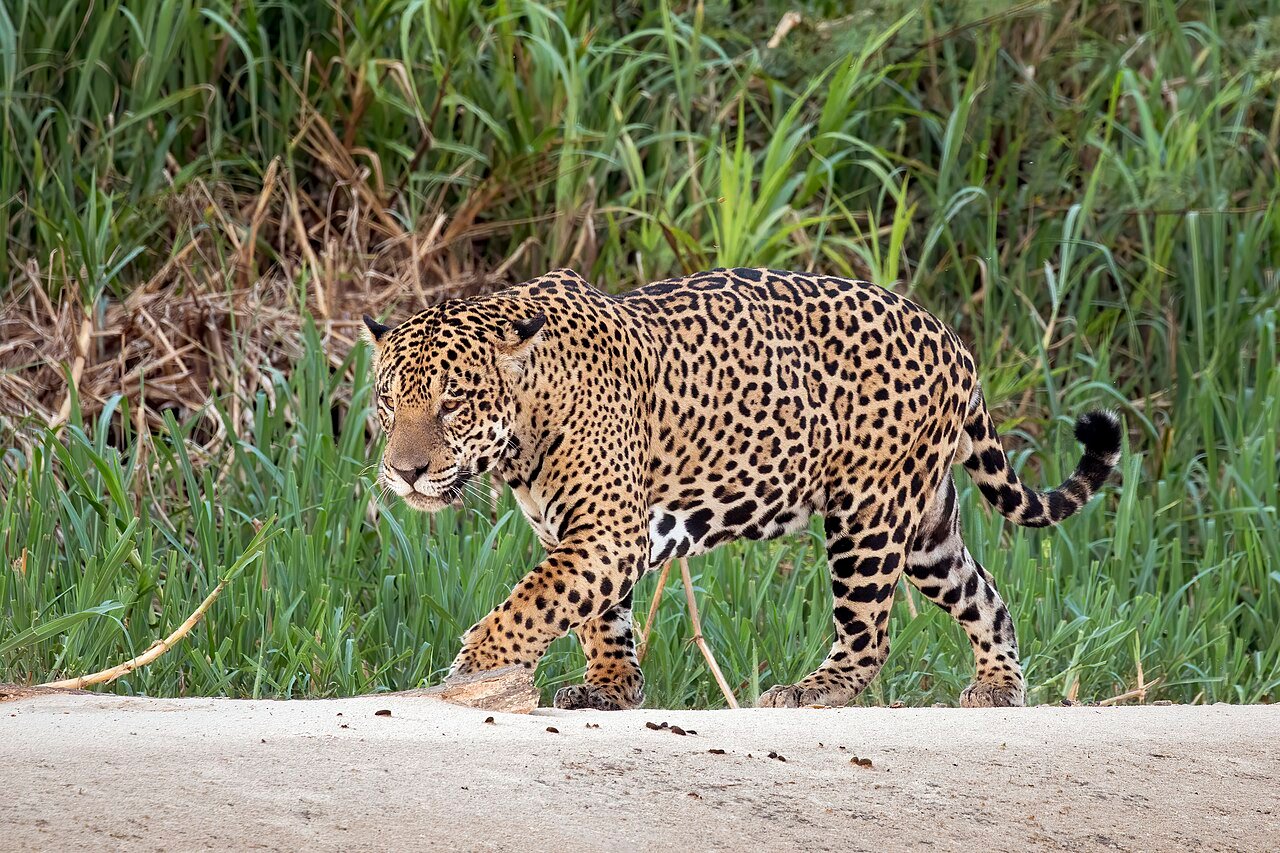
The 3-second ID
1. Where was the photo taken? The Americas? Jaguar. Africa or Asia? Leopard. Zoos aside, this settles it.
2. Look inside the rosettes on the flanks. Black dots in the middle? Jaguar. Empty middles? Leopard.
3. Look at the head and legs. Huge, blocky head, thick short legs, short tail? Jaguar. Smaller head, longer body and tail? Leopard.
What is the difference between a leopard and a jaguar?
Both are spotted big cats in the genus Panthera, but the jaguar is built heavier and lives in the Americas, while the leopard is lighter, more of a climber and lives in Africa and Asia. The jaguar has a broader head, deeper chest, larger paws and shorter tail, and its rosettes often contain central dots [1][2].
| Feature | Leopard | Jaguar |
|---|---|---|
| Scientific name | Panthera pardus | Panthera onca |
| Rosettes | Small black spots around an unspotted centre that is darker than the background; no central dot [2] | Broken black ring around background colour, often with one or more solid black dots inside [1] |
| Head and build | “Large, powerful” cat with robust forequarters [2] | Broader head, deeper chest, larger paws; shortest limbs for its size of any big cat; head circumference usually greater than its shoulder height [1] |
| Weight | 17–90 kg (37–198 lb) [3] | 36–148 kg (79–326 lb) [4] |
| Head and body length | 91–191 cm (3.0–6.3 ft) [3] | 110–170 cm (3.6–5.6 ft) [4] |
| Tail length | 51–101 cm (20–40 in) [3] | 44–80 cm (17–31 in) [4]; shorter than a leopard’s [1] |
| Estimated canine bite force | 467 N; bite force quotient 94 [5] | 1,014 N; bite force quotient 137 [5] |
| Usual kill | Bite to the throat [6] | Bite through the skull, nape or base of the skull [4] |
| Top speed | About 58 km/h (36 mph) in bursts [6] | Never reliably measured [7] |
| Voice | Rasping “sawing” call carrying up to 3 km [8] | Male’s roar sounds like a bark followed by a growl [7] |
| Water | Strong swimmer, but usually avoids water [8] | Excellent swimmer; hunts fish, capybaras and caimans in water [4] |
| Black (melanistic) form | Caused by a recessive variant of the ASIP gene [2][9] | Caused by a dominant variant of the MC1R gene [1][10] |
| Range | Africa and Asia [3] | Southern Arizona to northern Argentina [4] |
| IUCN status | Vulnerable (2025 version of the assessment) [11] | Near Threatened (2017 assessment) [12] |
Numbers in brackets match the numbered sources at the end of this page. The table is our own compilation; teachers and writers are welcome to reuse it with the credit “Source: Zooologist.com, leopard vs jaguar ID table” and a link to this page.
How do you tell leopard rosettes from jaguar rosettes?
Look for dots inside the rings. A jaguar’s rosettes are broken black rings around a patch of background colour, and the centre often holds one or more solid black dots. A leopard’s rosettes are smaller clusters of black spots around a slightly darker centre, with no dot inside [1][2]. Check the flanks, where the rosettes are clearest.
Simplified illustration made for this page. Real rosettes are irregular and unique to each animal [1][2].
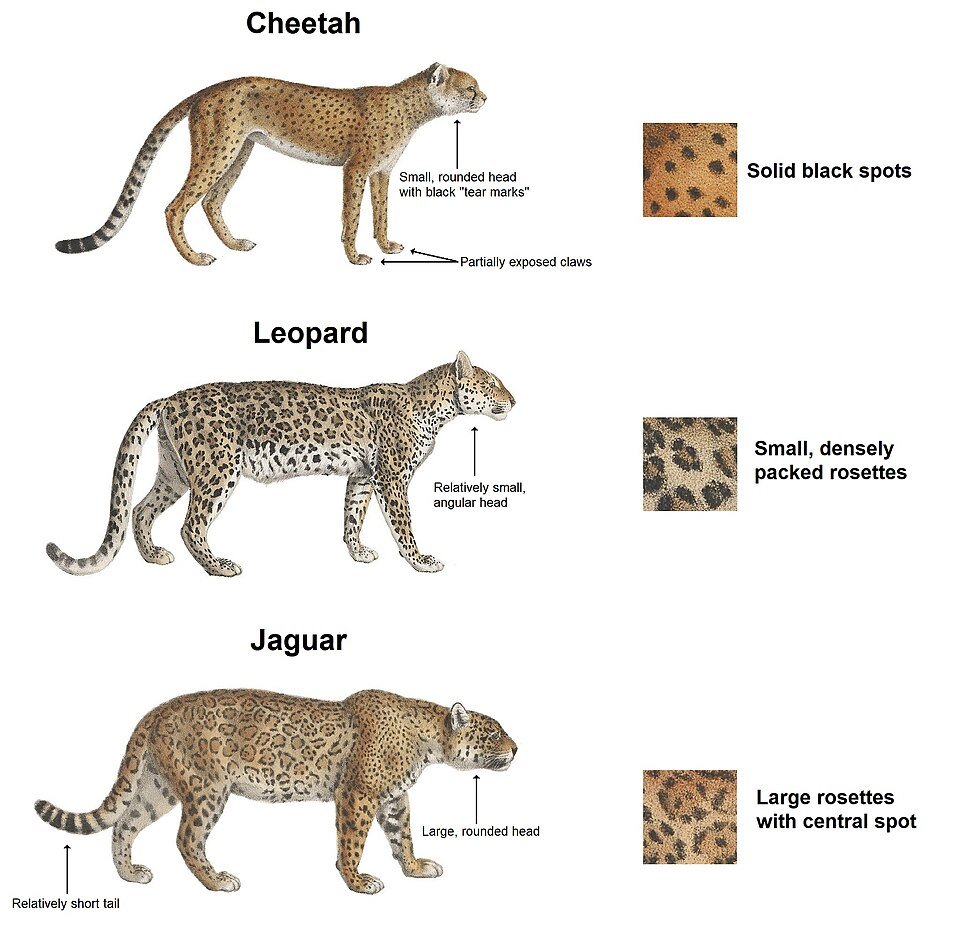
Spot the difference: test your eye
A spotted cat is swimming across a wide river after a caiman. Leopard or jaguar?
Jaguar. Jaguars are excellent swimmers that catch caimans in water [4], and caimans live only in the Americas.
A spotted cat is resting high in a tree with a dead antelope hanging over a branch. Leopard or jaguar?
Leopard. Leopards often climb trees with a kill to keep it from thieves, and they can carry prey heavier than themselves [6][8].
The cat’s rosettes have small black dots in the middle, and its head looks huge for its body. Leopard or jaguar?
Jaguar. Central dots and a massive head are two of its best field marks [1].
A cat is almost completely black, but in the sunlight you can just see spots. Leopard or jaguar?
It could be either. Both species have black forms with faint spots [1][2]. Location is the giveaway: in Southeast Asia it is a leopard; in South America, a jaguar.
Which is bigger, a leopard or a jaguar?
The jaguar is usually bigger and much heavier. The IUCN Cat Specialist Group gives jaguars a weight of 36 to 148 kg (79 to 326 lb) and leopards 17 to 90 kg (37 to 198 lb) [3][4]. Jaguars are the third largest cats in the world, after lions and tigers [7]. Leopards can be longer, though, with a longer tail [1][3].
Picture it: the weight ranges
Leopard: 17–90 kg (37–198 lb)
Jaguar: 36–148 kg (79–326 lb)
Scale: 0 to 148 kg. The heaviest jaguars outweigh the heaviest leopards by about 58 kg. Put another way, a 148 kg jaguar weighs more than two 70 kg people together. Sources: IUCN Cat Specialist Group [3][4].
Size also changes with place. The smallest jaguars live in the Amazon and in Central and North America, and the largest in the open wetlands of the Pantanal and Venezuela’s Llanos, where big prey is common [4]. Leopards vary just as much: Arabian leopards weigh only about 20 to 30 kg, while some African males reach about 90 kg [2][3].
Which is stronger, a leopard or a jaguar?
The jaguar. It is heavier on average, has the shortest and thickest limbs for its size of any big cat, and its estimated bite is more than twice as strong as a leopard’s [1][5]. Leopards are famous for a different kind of strength: carrying prey heavier than themselves as high as 15 m (50 ft) up a tree [6].
Who would win in a fight? Nobody knows from observation, because the two never meet. On the evidence of weight, build and bite force, a jaguar would have the advantage over a leopard of similar age and health. That is a reasoned comparison, not a recorded result. For more match-ups based on evidence, see tiger vs lion, and for the jaguar in depth, how strong a jaguar is.
How strong is a jaguar’s bite compared with a leopard’s?
A 2005 skull study by Stephen Wroe and colleagues estimated the jaguar’s canine bite at 1,014 newtons and the leopard’s at 467 newtons. Adjusted for body size, the jaguar’s bite force quotient was 137, higher than the tiger’s 127 or the lion’s 112, against 94 for the leopard [5]. These are estimates calculated from museum skulls, not measurements from live cats.
| Cat | Body mass estimated from skull | Canine bite force | Bite force quotient |
|---|---|---|---|
| Jaguar | 83.2 kg | 1,014 N | 137 |
| Leopard | 43.1 kg | 467 N | 94 |
| Tiger (for scale) | 186.9 kg | 1,525 N | 127 |
| Lion (for scale) | 294.6 kg | 1,768 N | 112 |
That bite explains the jaguar’s unusual way of killing. It is the only big cat that regularly kills prey by piercing the skull with its canines, says the IUCN Cat Specialist Group [4]. Jaguars also eat hard-shelled reptiles such as river turtles and tortoises [7].
Where does “jaguar bite: 1,500 psi” come from?
We could not trace it to any measurement. The figure appears on many websites without a source, and we found no peer-reviewed study or zoo that reports it. It also mixes up units: psi (pounds per square inch) measures pressure, which depends on how sharp the tooth tip is, while studies of bite strength measure force, in newtons. Treat any psi figure for a jaguar as unverified. For a wider ranking, see which animal has the strongest bite force.
Where do leopards and jaguars live?
On different continents. Jaguars live in the Americas, from southern Arizona through Mexico and Central America to northern Argentina, in rainforest, wetlands, dry forest and grassland [4]. Leopards live in Africa and Asia, from sub-Saharan Africa and the Arabian Peninsula to India, Southeast Asia and Russia’s Far East, at altitudes up to 5,200 m (17,060 ft) [3][13].
Jaguars are the only big cat in the Americas [7]. Today only wandering individuals reach the US, mostly coming north from Mexico [4]. In Asia’s high mountains, leopards share some ranges with a quite different cat, the snow leopard; see what snow leopards eat.
Can leopards and jaguars meet or mate in the wild?
No. Jaguars live only in the Americas and leopards only in Africa and Asia, so wild leopards and jaguars never meet [3][4]. Both belong to Panthera, the genus of roaring big cats. Genome studies show that Panthera species interbred at times in their deep evolutionary past [14].
Leopards have a spotted neighbour in Africa that people confuse them with far more often: the cheetah. Compare them in our cheetah vs leopard guide.
Is a black panther a leopard or a jaguar?
Both. “Black panther” is not a species; it is a name for any black (melanistic) leopard or jaguar. Look closely in good light and you can still see the spots [1][2]. Remarkably, the two cats turn black in different ways. In jaguars, black coats come from a dominant variant of the MC1R gene, so one copy is enough [1][10]. In leopards, they come from a recessive variant of a different gene, ASIP, so a cub needs two copies [2][9].
Black coats have evolved separately again and again in the cat family. Melanism occurs as a normal variation in 11 of 37 cat species, from at least four independent genetic origins [10]. Black leopards are especially common in humid forests: in Peninsular Malaysia and southern Thailand nearly all leopards are black [2][3].
Hidden gems
- Same colour, different genes. Black jaguars and black leopards reached the same look through mutations in two different genes [9][10].
- A head bigger than its height. A jaguar’s head circumference is usually greater than its shoulder height [1].
- Fishing with a tail. San Diego Zoo reports that jaguars sometimes tap the water’s surface with their tails to attract fish [7].
- The leopard’s long-distance call. A leopard’s rasping “sawing” call can carry up to 3 km (nearly 2 miles), and researchers can tell individuals apart by it [8].
Can leopards and jaguars swim and climb?
Both can swim, but the jaguar is the water cat. Jaguars are excellent swimmers that cross wide rivers and catch fish, capybaras and caimans in water [4]. Leopards are strong swimmers too, but they usually avoid water [8], and National Geographic notes they sometimes eat fish or crabs [15].
Climbing is the leopard’s speciality. Leopards are the largest cats that climb trees regularly, and they haul kills into branches to keep them from lions and hyenas [6][8]. Their speed is better known too: about 58 km/h (36 mph) in bursts, while no one has measured a jaguar’s top speed; see how fast a jaguar can run.
Are leopards and jaguars endangered?
Leopards are listed as Vulnerable (2025 version of the assessment) and jaguars as Near Threatened (2017 assessment) on the IUCN Red List [11][12]. Leopards now occupy only 25–37% of their historical range [13]. Jaguars occupy about 51% of theirs, and an estimated 57,000–64,000 jaguars live in the Amazon, about 89% of all jaguars [4].
The threats are similar: habitat loss, loss of prey, killing in revenge for livestock losses, and trade in body parts. An estimated 4,500 to 7,000 leopards are killed each year in Africa for their skins [3], and jaguar bones are sometimes sold as substitutes for tiger bone [4]. You can help by never buying wild cat products, choosing wildlife tourism that benefits local communities, and supporting groups that help ranchers protect livestock without killing big cats.
What roles do leopards and jaguars play in their ecosystems?
Both are top predators with very broad diets. Jaguars eat more than 85 prey species, including capybaras, peccaries, deer, tapirs, caimans and turtles [4][7]. Leopards take 92 prey species in sub-Saharan Africa alone, from duikers and monkeys to birds and fish [3][6]. In Africa, lions, hyenas and packs of painted dogs can kill leopards, and in Asia tigers can [6]. For jaguars, the main threats all come from people [4].
What happens when big predators vanish? On small islands cut off by a reservoir in Venezuela, where predators of vertebrates were missing, howler monkeys, iguanas, rodents and leaf-cutter ants reached 10 to 100 times their mainland densities, and the seedlings and saplings of canopy trees became scarce [16]. For leopards, researchers found that where lions and leopards declined in parts of Africa, crop-raiding baboons increased [17].
Myths about leopards and jaguars
Myth: The black panther is its own species.
Fact: Black panthers are black leopards or black jaguars, with spots still faintly visible [1][2]. Why people believe it: the name sounds like a species, and books and films such as The Jungle Book present the black panther as a character; San Diego Zoo notes that Kipling’s panther is a very dark leopard [6].
Myth: A jaguar’s bite measures 1,500 psi (or more).
Fact: We found no measurement or peer-reviewed study behind any psi figure for jaguars. The best published estimate is about 1,014 newtons of canine bite force, from skull models [5]. Why people believe it: the number is copied from site to site, and psi sounds more precise than it is.
Myth: Jaguars can run at 80 km/h (50 mph).
Fact: No published study has measured a jaguar’s top speed, and San Diego Zoo notes that running is not an important skill for this ambush hunter [7]. Why people believe it: speed figures for one big cat are often borrowed for another.
Test yourself
1. Which cat’s rosettes often have a dot in the middle?
The jaguar’s.
2. On which continents do wild leopards live?
Africa and Asia. Jaguars live only in the Americas.
3. Is a black panther a separate species?
No. It is a black leopard or a black jaguar.
Two cats, two continents, one family resemblance. The leopard solved life on the savanna and in the forest by climbing out of reach; the jaguar solved life in the wetlands by going into the water and biting through armour. Each is the answer its own world needed. Explore more big cats in our animal guides.
Where to next?
➡️ Go wider: cheetah vs leopard, the other spotted-cat mix-up⬆️ Go deeper: the science of the jaguar’s skull-piercing bite🔀 Go sideways: the cheetah, a spotted cat built for speed instead of strength
Frequently asked questions
How can you tell a leopard from a jaguar?
Look inside the rosettes and at the build. Jaguar rosettes often contain one or more black dots, and jaguars have a broader head, deeper chest, shorter legs and a shorter tail. Leopard rosettes have no central dot, and leopards look longer and lighter. Location settles it in the wild: jaguars live in the Americas, leopards in Africa and Asia.
Is a jaguar stronger than a leopard?
Yes, on the evidence available. Jaguars are heavier on average, at up to 148 kg against a leopard’s 90 kg, and a skull study estimated a jaguar’s canine bite at 1,014 newtons, more than twice a leopard’s 467. Leopards excel at climbing, hauling kills heavier than themselves into trees.
Are there leopards in South America?
No. Wild leopards live only in Africa and Asia. The big spotted cat of Central and South America is the jaguar, the only big cat in the Americas.
Which is faster, a leopard or a jaguar?
Probably the leopard, but nobody knows for sure. Leopards sprint at about 58 km/h (36 mph), according to San Diego Zoo Wildlife Alliance. No one has published a measured top speed for a jaguar, which hunts by stalking and ambush rather than long chases.
Which cat is more dangerous to people?
Leopards have a much better documented record of attacking people, especially in parts of Asia; in one 43-month study in Kashmir, about half of the people attacked died. We found no comparable body of data for jaguars. Both cats are best watched from a safe distance with an experienced guide.
Sources
- San Diego Zoo Wildlife Alliance Library. Jaguar fact sheet: physical characteristics.
- San Diego Zoo Wildlife Alliance Library. Leopard fact sheet: physical characteristics (citing Hunter et al. 2013; Kawanishi et al. 2010; Schneider et al. 2012).
- IUCN SSC Cat Specialist Group. Living species: leopard.
- IUCN SSC Cat Specialist Group. Living species: jaguar.
- Wroe, S., McHenry, C. and Thomason, J. (2005). Bite club: comparative bite force in big biting mammals and the prediction of predatory behaviour in fossil taxa. Proceedings of the Royal Society B 272: 619–625.
- San Diego Zoo Wildlife Alliance. Leopard.
- San Diego Zoo Wildlife Alliance. Jaguar.
- San Diego Zoo Wildlife Alliance Library. Leopard fact sheet: behavior and ecology (citing Hunter et al. 2013; Guggisberg 1975; Nabi et al. 2009).
- Schneider, A. et al. (2012). How the leopard hides its spots: ASIP mutations and melanism in wild cats. PLoS ONE 7: e50386.
- Eizirik, E. et al. (2003). Molecular genetics and evolution of melanism in the cat family. Current Biology 13: 448–453.
- IUCN Red List of Threatened Species. Panthera pardus (Stein, A.B. et al., 2025 version), doi:10.2305/IUCN.UK.2025-2.RLTS.T15954A286153337.en.
- Quigley, H. et al. (2017, errata 2018). Panthera onca. The IUCN Red List of Threatened Species 2017: e.T15953A123791436.
- Jacobson, A.P. et al. (2016). Leopard (Panthera pardus) status, distribution, and the research efforts across its range. PeerJ 4: e1974; and San Diego Zoo Wildlife Alliance Library, Leopard fact sheet: distribution and habitat.
- Figueiró, H.V. et al. (2017). Genome-wide signatures of complex introgression and adaptive evolution in the big cats. Science Advances 3: e1700299.
- National Geographic. Leopard.
- Terborgh, J. et al. (2001). Ecological meltdown in predator-free forest fragments. Science 294: 1923–1926.
- Oregon State University (2009). Loss of top predators causing surge in smaller predators, ecosystem collapse (on Prugh et al., BioScience 59: 779–791).
Sources checked 14 October 2026.
Keep the conversation curious